


-
Introduction
The question “What is the salary of a prompt engineer?” seems simple, but the market isn’t. Titles are fluid, job scopes vary, and organizations label similar work differently. To make this useful, we compare two closely related roles you’ll see on real job boards: the specialized Prompt Engineer and the broader LLM/AI Engineer (sometimes called GenAI Engineer). You’ll see where each sits on compensation, what drives pay up or down, and which path better fits your background.
-
Role Overview
-
Prompt Engineer (PE): Focuses on designing prompts, evaluation frameworks, and prompt libraries for LLM-powered features. Often pairs with product and research to improve response quality, reliability, and safety; may build lightweight tooling (RAG prompt templates, guards, eval harnesses), but heavy systems engineering isn’t always required. Best for strong communicators with a product mindset and deep LLM behavior intuition.
-
LLM/AI Engineer (LLM-E): A software engineer who integrates LLMs into production systems. Owns inference orchestration, retrieval pipelines, vector search, evaluation tooling, observability, cost/perf tuning, and sometimes fine-tuning or distillation. Typically requires solid software engineering and some ML/infra chops. Best for those with SWE/ML backgrounds who enjoy shipping complex systems.
For context, high-profile listings have set expectations. Anthropic’s “Prompt Engineer & Librarian” role listed a base of $175k–$335k plus equity and benefits (Anthropic Careers). Aggregate data suggests nationwide PE bases often land lower, while LLM/AI Engineer roles trend higher on total comp (Glassdoor, Levels.fyi).
-
-
Key Differences in Compensation
-
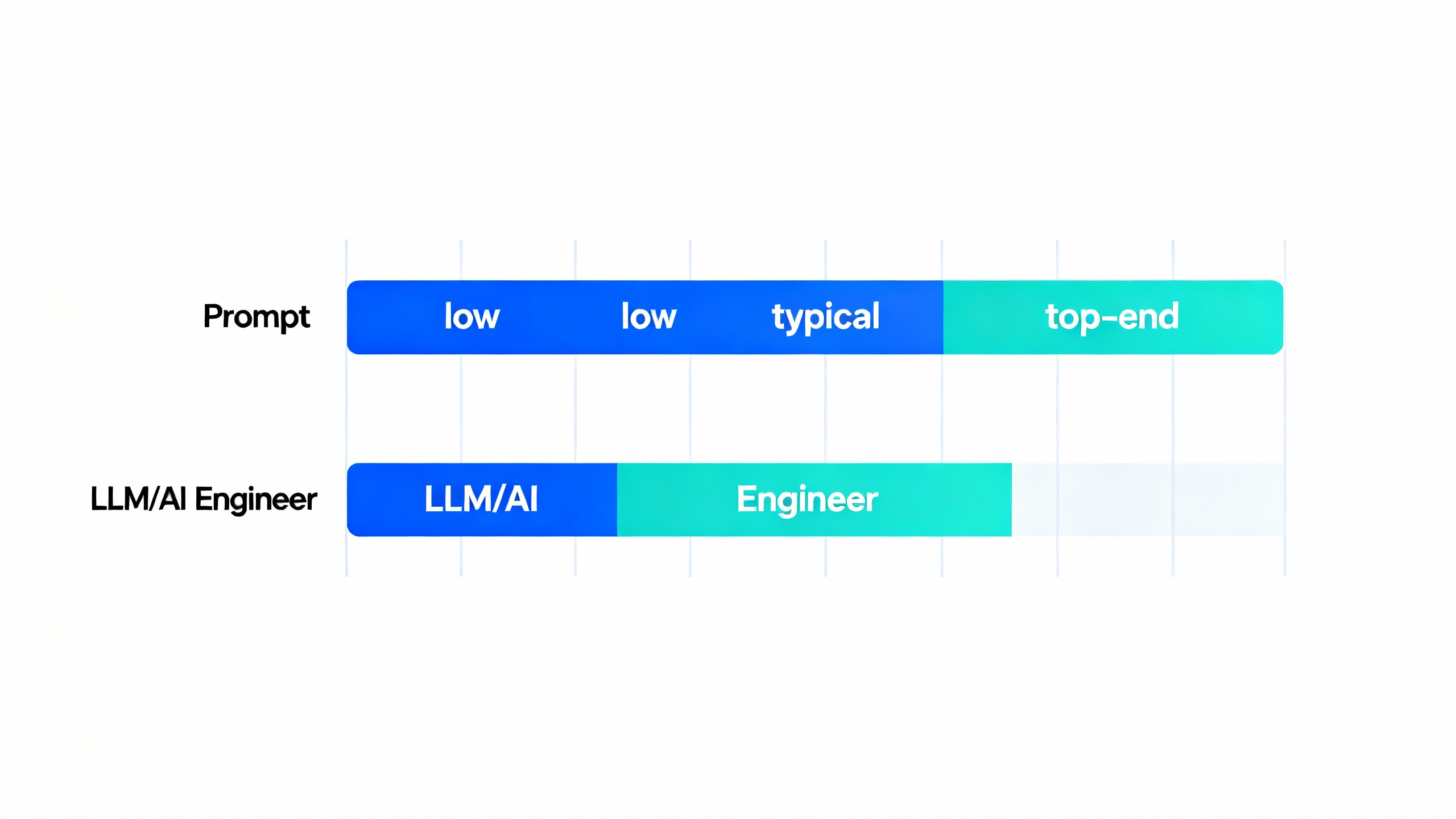
Base salary: Prompt Engineer bases commonly cluster around the low-to-mid six figures in the U.S., with large coastal companies and frontier labs paying at the top end. LLM/AI Engineer bases trend higher on average, reflecting broader systems ownership and SWE market competition.
- Equity and bonuses: LLM/AI Engineer roles more consistently include meaningful equity and performance bonuses—especially at tech companies with established engineering ladders. Prompt Engineer roles sometimes map to product/research bands where equity is present but can be less standardized.
- Scope and leverage: LLM/AI Engineers own cost/performance knobs (token usage, caching, batching, retrieval design) that visibly impact margins and reliability—often translating into stronger comp packages. Prompt Engineers can command top dollar when they directly improve model outcomes at scale or own high-impact evals/safety.
- Labeling effects: Some “Prompt Engineer” postings actually expect LLM engineering. Read responsibilities, not just the title; the scope often predicts the pay.
- Location and remote: High cost-of-living hubs (SF Bay, NYC, Seattle) still pay a premium. Many companies use geo-adjusted pay bands for fully remote roles.
Compensation snapshot
Role Typical U.S. Base Total Comp Potential Equity Prevalence Selected Sources Prompt Engineer $110k–$200k (with top listings $175k–$335k) $140k–$400k Moderate, varies by ladder Anthropic, Glassdoor, ZipRecruiter LLM/AI Engineer $160k–$250k $220k–$500k+ High, especially at scaled tech Levels.fyi, Glassdoor Freelancer note: Hourly “prompt engineering” contracts commonly range from ~$50–$200+/hr depending on portfolio and scope (Upwork). High-trust, outcome-based engagements can go higher.
-
Pros and Cons
Prompt Engineer
- Pros
- Fast impact on product quality; highly collaborative with design/research.
- Lower barrier to entry for strong communicators without deep SWE backgrounds.
- Competitive pay at top labs; clear path to safety/evals specialization.
- Cons
- Title ambiguity; some orgs undervalue or conflate with content ops.
- Less standardized ladders; equity/bonus can be inconsistent.
- Risk of being seen as “tooling user” vs “tooling builder” if you avoid code entirely.
LLM/AI Engineer
- Pros
- Strong total compensation with robust equity at scaled tech companies.
- Clear advancement via engineering ladders (senior, staff, principal).
- Portable skill set across infra, data, and product teams.
- Cons
- Higher bar: distributed systems, retrieval, observability, cost/perf.
- On-call/production responsibilities; more platform toil.
- Interview processes skew SWE-heavy; less emphasis on qualitative prompt craft.
- Pros
-
Use Case Recommendations
- You’re a product thinker with research chops: If you love rapid iteration, user studies, and qualitative evals, a Prompt Engineer role can be ideal. Target orgs that treat prompt/eval work as an R&D function (labs, safety teams, applied research groups) and benchmark comp against top-tier listings.
- You’re a software/ML engineer shipping systems: LLM/AI Engineer will generally maximize total comp and career mobility. Emphasize end-to-end ownership—retrieval, observability, test/eval harnesses, and cost optimization.
- You’re transitioning from content/UX/research: Prompt Engineer is an attainable entry point. Strengthen your profile with lightweight coding (Python eval scripts), prompt testing frameworks, and safety/guardrail knowledge.
- Freelance-first mindset: Build a public portfolio (eval notebooks, reproducible prompt baselines, before/after quality metrics). Start hourly (market-test your rate) and graduate to retainers tied to measurable outcomes.

-
Verdict
If you’re after the single number: U.S. Prompt Engineer bases commonly sit around the low-to-mid six figures, with elite roles stretching far higher. LLM/AI Engineer bases tend to be higher on average, and total compensation (with equity) is more consistently strong. The best “salary” is the one aligned with your scope: own more of the stack, influence reliability and unit economics, and your comp rises—regardless of title.
For most candidates with solid SWE/ML skills, the LLM/AI Engineer path offers the higher and more predictable ceiling. For product-leaning builders who can demonstrably move model quality metrics, a Prompt Engineer role at a research-heavy company can be exceptionally lucrative—just verify the ladder and scope before you sign.
Sources: Anthropic Careers, Levels.fyi, Glassdoor, ZipRecruiter, Upwork.