

What happened
A nationwide coalition of more than 230 environmental and community groups — including Food & Water Watch, Greenpeace USA and Friends of the Earth — sent Congress a letter on December 8, 2025 urging a national moratorium on approvals and construction of new U.S. data centers. The groups argue that the AI- and crypto-fueled buildout is driving up electricity demand and water use, straining local grids and budgets, and outpacing basic safeguards. Their letter calls for a pause “until adequate regulations can be enacted” and cites risks ranging from rate hikes to climate and water impacts. Read the coalition’s letter (PDF). Guardian coverage.
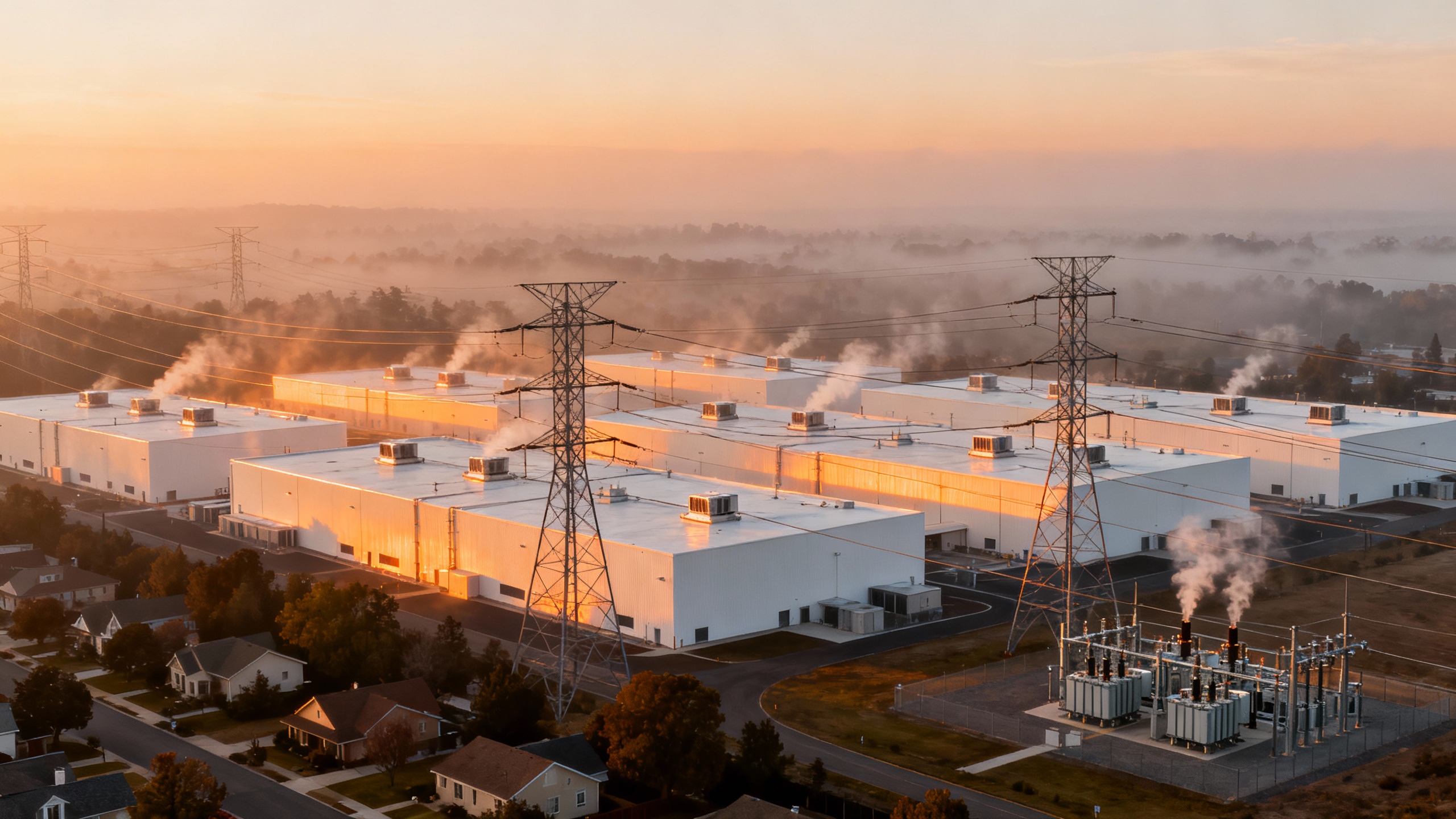
Why now: AI load meets the U.S. grid
- Federal and lab analysis shows data center power demand is climbing fast. A Department of Energy/LBNL report estimates U.S. data centers consumed about 4.4% of U.S. electricity in 2023 and could reach 6.7–12% by 2028 as AI workloads scale.
- BloombergNEF projects U.S. data‑center power demand more than doubling by 2035 to roughly 78 GW — about 8.6% of total U.S. electricity — driven by larger, AI‑optimized facilities. BloombergNEF analysis.
- NERC, the grid reliability watchdog, warned in its Winter 2025–26 assessment that rising peak demand (up ~20 GW year over year) is outpacing new capacity, with data centers among key drivers. Several regions could face supply shortfalls in extreme cold. NERC summaries via APPA and S&P Global. (S&P Global note).
- In PJM (Mid‑Atlantic/Midwest), the market monitor filed a November 25 complaint asking FERC to affirm that new large data‑center loads should connect only when they can be reliably served — highlighting $16.6B in added capacity revenues over two auctions tied to load growth. Utility Dive. (Business Insider summary also reported the filing.)
At the same time, federal policy is trying to keep pace. In February, FERC opened a show‑cause proceeding on “co‑location” (data centers sited at or next to power plants) and whether PJM’s tariff needs changes to ensure reliability and fair costs; responses are on an expedited timeline. FERC orders and chair statements. Follow‑up statement.
EPA also issued guidance on May 1 clarifying that certain stationary engines can run up to 50 hours per year in non‑emergencies to support grid reliability — a move welcomed by some operators as a reliability backstop, but criticized by advocates worried about diesel emissions. EPA announcement.
What the coalition is asking for
The moratorium letter frames a pause as a way to install “guardrails” before the footprint grows larger. Among the claims and concerns it cites:
- Tripling the current data-center fleet over five years would consume electricity equivalent to about 30 million U.S. households and use cooling water equal to the indoor needs of 18.5 million households.
- 56% of data‑center electricity is still fossil‑based nationally, which could worsen emissions without policy changes.
- Rapid buildout is contributing to rate pressure and infrastructure costs for non‑industrial customers.
These are advocacy estimates presented to Congress; several align directionally with government or industry analyses on growth rates, while precise magnitudes vary by region, technology choices, and timeline. Coalition letter. DOE/LBNL.
Politics: AI power hits the ballot box
For years, data centers were a “quiet” industry. In 2025 they became an election issue:
- Virginia: Democrat Abigail Spanberger won the governor’s race on November 4, 2025, flipping the office. Local debates in “Data Center Alley” about noise, water and rates featured in the broader affordability narrative. AP/PBS.
- New Jersey: Governor and legislative campaigns leaned into energy affordability after capacity‑market‑driven increases; the governor sought changes to a data‑center bill and ordered a study on grid/rate impacts. New Jersey Monitor.
- Georgia: In a notable upset on November 4, voters ousted two Republican incumbents on the Public Service Commission amid frustration with rising utility bills; Democrats campaigned on ratepayer protections and clean‑energy alternatives. Reuters. (Local coverage).
Meanwhile, watchdogs report that local opposition is increasingly organized. One tracker tallied at least 16 U.S. projects, worth about $64B, blocked or delayed since 2023 over water, noise, land‑use or grid concerns. Data Center Watch.
What industry and utilities say
Hyperscalers and utilities counter that the solution is smarter infrastructure, not a moratorium.
- Flexing demand: In August, Google signed demand‑response agreements with utilities in the Midwest and Tennessee Valley to curtail AI workloads at peak times — an early example of “flexible” AI compute. Reuters. Google blog.
- Pairing with firm power: AWS and Talen Energy inked a 1,920‑MW nuclear PPA from Pennsylvania’s Susquehanna plant, shifting an earlier co‑location proposal to a front‑of‑meter arrangement that avoids certain FERC hurdles. Utility Dive. (Reuters).
- New capacity and 24/7 CFE: Developers are co‑planning giant campuses with new generation. On December 8, NextEra announced expanded clean‑energy deals with Google and Meta alongside new gigawatt‑scale campuses. Reuters.
- Economic impact: A Data Center Coalition–commissioned PwC study finds the sector supported millions of U.S. jobs and large tax bases between 2017–2023, even as states debate incentives and net benefits. DCC/PwC 2025 update.
Industry groups argue that better siting, 24/7 clean‑energy procurement, advanced cooling, and flexible compute can meet AI demand without shifting costs onto households — and that pauses risk pushing investment offshore.
The regulatory scramble, at a glance
2025 moves shaping where and how U.S. data centers plug in
| Date | What changed | Why it matters |
|---|---|---|
| Feb 20, 2025 | FERC launches show‑cause proceeding on AI data‑center co‑location in PJM | Sets the stage for new tariff rules on siting large loads at/near generators and allocating costs. FERC order |
| May 1, 2025 | EPA clarifies emergency engine rules: up to 50 hours/year non‑emergency for grid reliability | Offers limited backup during peaks; raises local air‑quality questions if diesel is used. EPA |
| Aug 4, 2025 | Google signs first utility demand‑response deals for AI curtailment | Tests whether “deferrable compute” can ease peak stress and connection timelines. Reuters |
| Nov 25–26, 2025 | PJM market monitor asks FERC to limit large‑load interconnections to reliably served sites | Highlights rate and reliability risks; cites $16.6B in higher capacity revenues tied to load growth. Utility Dive |
| Dec 8, 2025 | 230+ groups urge Congress to pause new data centers | Moves the debate from local fights to national policy. Letter |
What this means for automation leaders
Whether you build AI or buy it, energy will shape your roadmap in 2026–2028. Three practical takeaways:
- Treat compute as flexible where you can. Training, indexing and batch analytics are often deferrable — opening doors to interconnection, tariffs and grid programs that lower cost and carbon without hurting SLAs. ACEEE/Duke synthesis.
- Pair growth with firm, clean supply. Contracts like long‑term nuclear or 24/7 carbon‑free energy portfolios increasingly determine siting speed and regulatory risk. AWS–Talen PPA and NextEra partnerships show the direction of travel.
- Water is a first‑class design constraint. Many campuses are moving to zero‑evaporation cooling and water‑positive commitments, but disclosure and local trust will matter more in 2026. Microsoft water strategy and Google water stewardship.
TipChecklist for responsible AI buildouts
- Map which workloads are truly deferrable; codify curtailment budgets (e.g., <100 hours/year) with utilities.
- Disclose site‑level power and water use; set 24/7 CFE and water‑replenishment targets tied to permits.
- Design for diesel‑free backup where feasible; pursue grid‑supportive batteries and on‑site clean firm.
- Engage early with communities on noise, traffic, and tax bases; avoid siting in water‑stressed basins.
The bottom line
The moratorium push crystallizes a real tension: AI is becoming an essential productivity platform, but its infrastructure is colliding with power and water limits — and with voters’ patience on monthly bills. Washington and the states are racing to rewrite the rules; utilities and hyperscalers are racing to prove that deferrable compute and clean power can scale faster than the backlash. 2026 will test which approach wins.
Sources
- Coalition letter: Food & Water Watch: National Data Center Moratorium Now (Dec 8, 2025); Guardian report
- Demand growth and grid risk: DOE/LBNL data‑center report (Dec 20, 2024); BloombergNEF forecast (Apr 15, 2025); NERC Winter 2025–26 assessments via APPA and S&P Global
- PJM/FERC and policy: Utility Dive on PJM market‑monitor complaint (Nov 26, 2025); FERC co‑location order and statement (Feb–Mar 2025) | Chair statement; EPA engine guidance (May 1, 2025)
- Company moves: Google demand response (Reuters, Aug 4, 2025) and Google blog; AWS–Talen nuclear PPA | Reuters; NextEra–Google/Meta (Reuters, Dec 8, 2025)
- Elections and public sentiment: Virginia governor results (AP/PBS, Nov 4, 2025); New Jersey data‑center bill study and rate context; Georgia PSC upsets and energy affordability (Reuters, Nov 5, 2025); Project delays tally
- Water and sustainability context: Microsoft zero‑water cooling design; Google water stewardship