

The quote that set the tone
Microsoft AI CEO Mustafa Suleyman has a blunt forecast for the next leg of the AI race: competing at the frontier will cost “hundreds of billions of dollars” over the next five to ten years. He made the comment on Peter Diamandis’ Moonshots podcast, published December 16, 2025 (recorded December 5). In the same conversation he likened Microsoft to a “modern construction company,” building out gigawatts of compute and the people and supply chains behind it—an image that captures how physical, capital-heavy, and infrastructure-dependent AI has become. Moonshots, EP #216 • Episode listing on iHeart • Coverage: Business Insider via AOL and Windows Central.
The checkbook reality: 2025 capex, in black and white
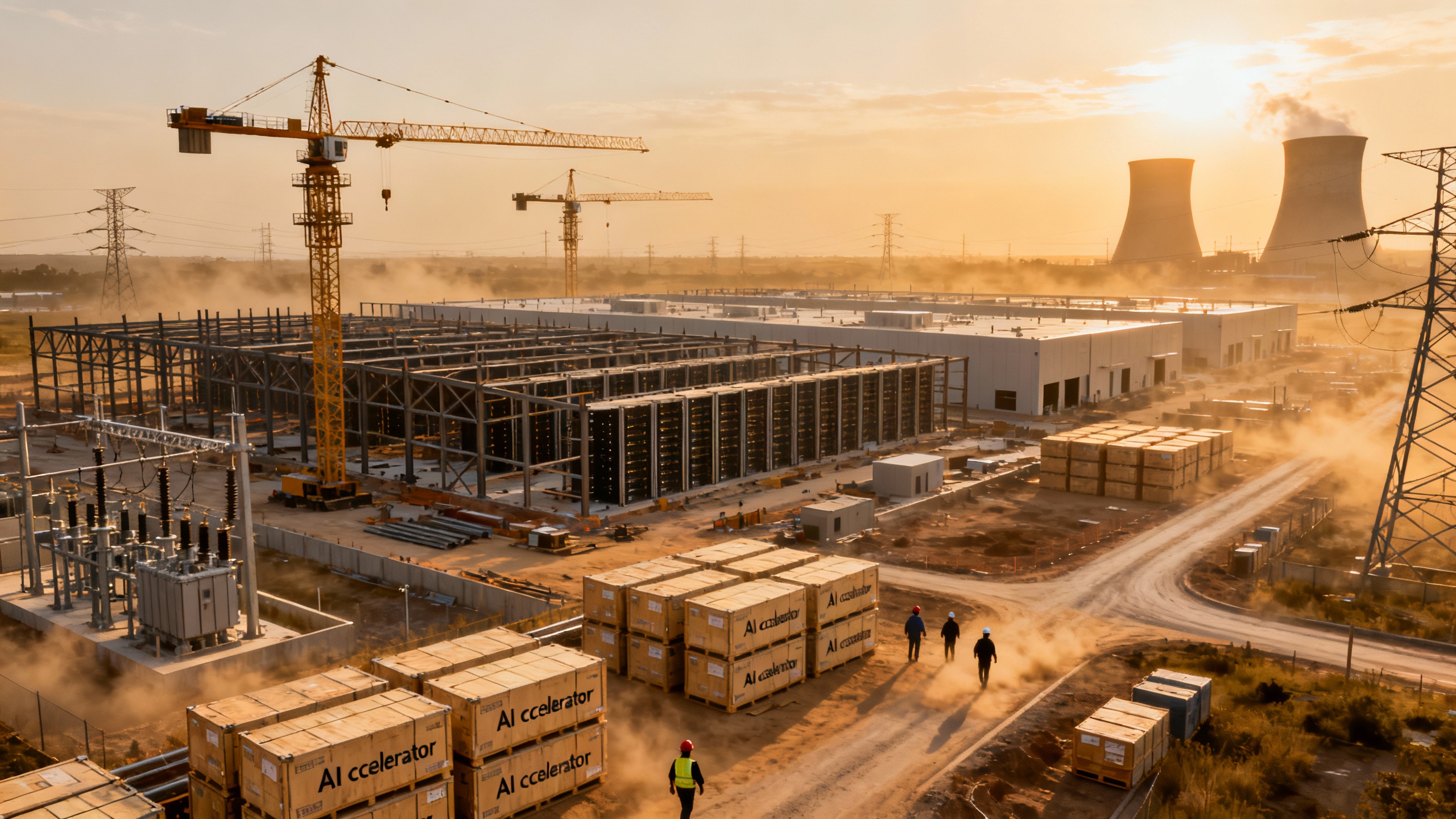
If Suleyman’s remark sounds hyperbolic, the 2025 spending plans from the hyperscalers say otherwise. Combined, the largest platforms telegraphed AI- and data-center-heavy capex comfortably north of $300 billion this year, according to CNBC’s tally from early February 2025. CNBC
2025 stated capex plans by major AI hyperscalers
| Company | 2025 capex guidance (headline) | Notes |
|---|---|---|
| Amazon | ~$100B | Andy Jassy said the “vast majority” targets AWS AI capacity. CNBC • GeekWire |
| Microsoft | >$80B (FY25) | AI data centers across the U.S. and abroad. CNBC • CNBC follow-up |
| Alphabet (Google) | ~$75B initially; later lifted toward $85B | Majority to servers and data centers; later guidance ticked up mid-year. CNBC • DCD update |
| Meta | $60–$65B | Targeting 1.3M+ GPUs and multi-GW campuses. CNBC • Reuters via Investing.com |
Even China’s ByteDance has reportedly mapped a ¥160B (~$23B) AI infrastructure budget for 2026, underscoring how global this buildout has become. Financial Times • Reuters
Why AI is suddenly so capital intensive
1) Chips that cost like industrial equipment
Nvidia’s latest Blackwell-class accelerators have list-price ranges in the tens of thousands of dollars per chip; CEO Jensen Huang told CNBC to expect $30,000–$40,000 per unit, with customers often buying full systems rather than bare chips. CNBC • Reuters Those economics scale quickly when clusters run to tens of thousands of accelerators.
At the same time, hyperscalers are racing to reduce dependence on a single vendor with in‑house silicon: Google’s TPUs (now at Trillium/v6), Amazon’s Trainium, Meta’s MTIA, and Microsoft’s Maia. Google Cloud Blog (TPU v5p) • Google Cloud (Trillium GA) • Amazon re:Invent 2025 • Meta Newsroom • Reuters on Microsoft Maia timeline
2) Data centers that look like utilities
Frontier AI doesn’t just need racks—it needs land, water, and power at utility scale. Georgia regulators, for example, approved a $16.3B plan to expand generation by 10 GW—most of it earmarked for data centers—illustrating power’s new centrality to AI planning. AP Alphabet even bought an energy developer (Intersect) to secure long‑term supply for AI workloads. Reuters Meanwhile, global data‑center dealmaking hit a record $61B in 2025. Reuters
The International Energy Agency projects data‑center electricity consumption to more than double to ~945 TWh by 2030, with AI‑optimized servers accounting for roughly half of the growth. IEA, Energy and AI • IEA, Executive Summary
3) Talent is scarce—and pricey
The “hardware” is only half the bill. Labs are competing for a small pool of researchers, safety and evaluation experts, and low‑level performance engineers. Suleyman explicitly called out soaring compensation for top technical staff in the same interview. Business Insider via AOL
The frontier isn’t the only path—but it sets the weather
Not every team needs to chase frontier‑scale systems to see productivity gains. Open‑weight and mid‑sized models continue to improve, and 2025’s big efficiency story—China’s DeepSeek—sparked global debate by claiming a ~$5.6M training bill for a model that challenged Western incumbents on key reasoning benchmarks. Analysts quickly cautioned that figure excluded major R&D and hardware ownership costs, but the signal was clear: better algorithms and data curation can bend the cost curve. CNBC • SemiAnalysis summary via CyberNews • IEEE Spectrum
That said, the market is voting with shovels: despite periodic investor jitters (remember the early‑2025 selloff after DeepSeek’s splash), hyperscalers reaffirmed their capex tracks. CNBC And Nvidia’s roadmap cadence—and order books—suggest “several hundred billion dollars of AI infrastructure” is already in motion. CNBC
What this means for automation leaders and CFOs
- Expect the “barbell” to sharpen. On one end, a handful of players will fund multi‑gigawatt campuses and proprietary models. On the other, most enterprises will mix and match smaller, efficient models and vendor APIs—prioritizing reliability, latency, and TCO over raw benchmark wins.
- Treat compute like a portfolio. Hedge across clouds and accelerators (GPUs, TPUs, Trainium/Inferentia, MTIA) and insist on architecture portability to avoid lock‑in shocks. Google Cloud TPU • Amazon Trainium • Meta MTIA
- Budget for energy and operations, not just instances. As inference share grows, model size, quantization, and retrieval design can cut your per‑task cost by orders of magnitude.
- Factor safety, evals, and governance into capex. The new bottleneck isn’t only compute—it’s testability and trust.
TipA three‑step playbook for 2026 AI ROI
- Start small, measure real usage, and set explicit per‑task unit‑economics targets (cost and latency).
- Move “north” only when a feature warrants it: distill to smaller models; use retrieval to reduce tokens; right‑size context.
- Keep two vendors and two model families viable in your stack so you can arbitrage price/perf as the market flips.
The big open question: Can efficiency outpace capital?
History says yes—up to a point. Better compilers, sparsity, KV‑cache tricks, and agentic orchestration are lifting throughput across the stack. But even the efficiency leaders acknowledge that next‑gen breakthroughs require clusters and power that look more like heavy industry than web startups. Projects rumored or announced in the $100B‑plus range for single supercomputers and multi‑year joint ventures are no longer outliers—they’re the frontier. Reuters (Stargate report) • Forbes summary • Fortune analysis
Bottom line
Suleyman’s “hundreds of billions” is not a provocation—it’s a practical description of where the frontier sits today. For most organizations, that’s good news: you can reap meaningful automation gains without frontier‑scale spending. But for those intent on pushing the edge of multimodal reasoning, autonomy, or science models, plan for an era where AI progress is inseparable from power substations, long‑lead supply chains, and very large checks.
Sources
- Mustafa Suleyman interview: Moonshots with Peter Diamandis, EP #216 (Dec 16, 2025; recorded Dec 5); episode page on iHeart. Coverage: Business Insider via AOL, Windows Central.
- 2025 capex context: CNBC: Megacaps to spend $300B+; Microsoft CNBC 1/3/25 and 2/24/25; Alphabet CNBC 2/4/25 and DCD 7/24/25; Meta CNBC 1/24/25 and Reuters via Investing.com; Amazon CNBC 2/6/25, GeekWire.
- Chips: Nvidia price guidance CNBC • Reuters. In‑house silicon: Google TPU v5p and Trillium; Amazon Trainium3; Meta MTIA v2 • Reuters; Microsoft Maia timeline Reuters.
- Power and real assets: Georgia generation plan AP; Alphabet–Intersect deal Reuters; record data‑center dealmaking Reuters; IEA projections Energy & AI • Executive summary.
- Efficiency debate: DeepSeek claims vs. analysis CNBC • CyberNews/SemiAnalysis • IEEE Spectrum.