

What just happened — and why it matters
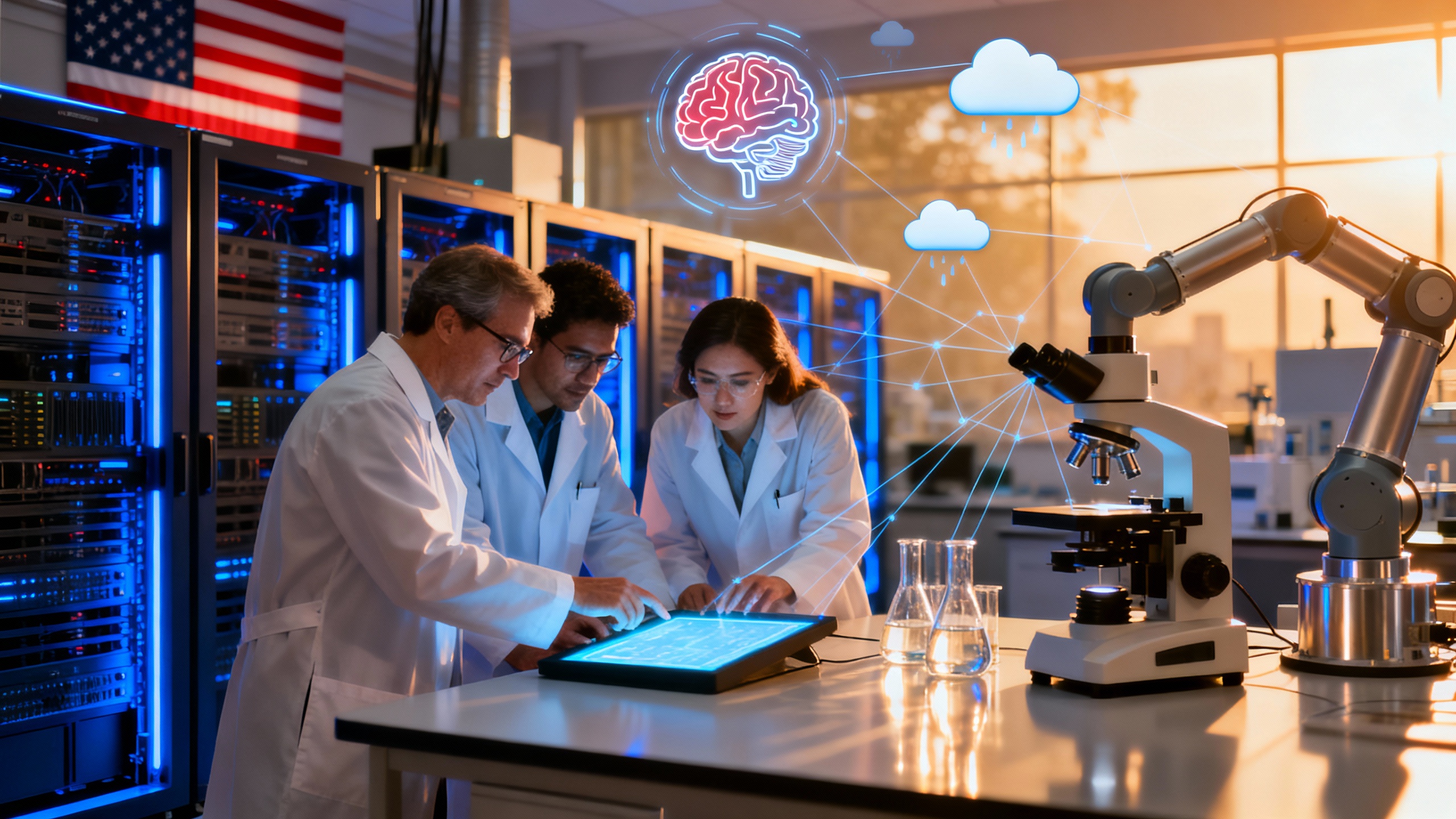
On December 18, 2025, the U.S. Department of Energy (DOE) signed collaboration agreements with 24 organizations—including Anthropic, OpenAI, NVIDIA, Microsoft, Google, AWS, Oracle, AMD, Intel, HPE, Palantir, xAI, and others—to power the Genesis Mission, a national push to bring frontier AI into U.S. science at scale. The MOUs kick off a public‑private effort to tie together national‑lab supercomputers, cloud AI, data, and autonomous labs to accelerate discovery across energy, biology, materials, and national security. DOE press release.
The Genesis Mission itself was launched by a White House executive order on November 24, 2025. It directs DOE to build an integrated American Science and Security Platform that unifies HPC, secure cloud AI, domain‑specific foundation models, and lab instrumentation—explicitly framed as “AI for discovery, not automation.” Executive Order and Genesis site.
Who’s bringing what: Big Tech meets Big Science
- Anthropic announced a multi‑year partnership giving DOE researchers access to Claude and a dedicated engineering team, with purpose‑built agents, Model Context Protocol (MCP) servers to connect AI to instruments, and Claude Skills for scientific workflows. Focus areas: American energy “dominance,” bio/life sciences, and scientific productivity across all 17 labs. Anthropic announcement.
- OpenAI and DOE signed an MOU under the OpenAI for Science initiative to deploy frontier models in real research environments and coordinate on Genesis projects. OpenAI update and OpenAI for Science.
- NVIDIA and Oracle, with DOE and Argonne, will build Solstice—slated as DOE’s largest AI supercomputer—featuring ~100,000 Blackwell GPUs; near‑term cloud access and on‑prem builds aim to speed agentic‑AI research. NVIDIA and DOE.
- DOE also announced a $1B public‑private partnership with AMD for two AI supercomputers: Lux (targeted to come online within months) and Discovery (expected around 2029), led with ORNL, HPE, and Oracle. Reuters.
Why this blend is notable: unlike prior lab‑only HPC upgrades, Genesis marries leadership‑class on‑prem compute with secure cloud AI and “agents” that can read papers, plan experiments, operate instruments (via MCP), and iterate with scientists—opening a path from weeks‑long runs to near‑real‑time hypothesis loops. Executive Order and Anthropic.
How the platform will work
Genesis directs DOE to operate an integrated platform with: leadership‑class HPC; secure cloud AI for large‑scale training and inference; domain foundation models; AI agents to explore design spaces and automate workflows; governed access to federal and proprietary scientific datasets; and hooks into autonomous lab systems. Security requirements cover classification, supply‑chain integrity, and federal cybersecurity standards. Executive Order.
The DOE positions Genesis as “AI for discovery, not automation,” emphasizing that AI augments human researchers. The goal: double the productivity and impact of U.S. research within a decade. Genesis site.
Money, timelines, and signals of seriousness
- On December 10, DOE announced $320M to jump‑start Genesis AI capabilities and begin building the American Science and Security Platform. DOE funding note.
- The agency is soliciting industry input via RFIs—for new models and national‑security AI—with deadlines in January 2026. DOE press release.
- In parallel, DOE labs are commissioning autonomous‑capable science systems (e.g., PNNL’s AMP2 for microbes), aligning with Genesis’ “closed‑loop” experimentation. DOE article.
Leadership and oversight: Energy Secretary Chris Wright is overseeing execution, with DOE Under Secretary for Science Darío Gil designated as Genesis Mission Director; OSTP Director Michael Kratsios is coordinating across agencies. DOE press release and DOE bio.
Why Anthropic’s MCP—and “agentic AI”—matter in a lab
Anthropic’s Model Context Protocol (MCP) is an open standard (now stewarded with other tools under the new Agentic AI Foundation) for safely connecting models to instruments, databases, and specialized tools—think of it as USB‑C for research workflows. For DOE scientists, MCP servers could bridge Claude to beamlines, microscopes, sequencers, or simulation pipelines without brittle one‑off integrations, while maintaining security boundaries. Anthropic docs and coverage of open‑standards push.
Practically, that means AI agents can read 50 years of DOE literature, propose an experiment, drive the instrument to collect data, update a simulation, and suggest the next step—in hours instead of weeks—while a human stays in the loop. Anthropic announcement.
The upside—and the fine print
- Scientific acceleration: Protein design, fusion‑plasma control, advanced alloys, and grid planning are all data‑ and compute‑hungry problems that benefit from frontier models paired with HPC. Early pilots at Argonne and Los Alamos already show value. NVIDIA/Oracle with DOE and OpenAI for Science.
- Economic and strategic framing: The administration casts Genesis as an Apollo‑scale mobilization to secure U.S. leadership, reduce foreign dependencies, and bolster national security. Executive Order and Reuters.
- Power, privacy, and governance concerns: Massive compute build‑outs raise energy and infrastructure questions; integrating federal datasets calls for careful protections. DOE says the platform will operate under classification, privacy, and cybersecurity requirements. AP and Executive Order.
TipIf you work in a U.S. lab or energy company
- Inventory your data and instruments: What could an AI agent safely read or operate today? MCP servers and standardized connectors reduce integration cost.
- Start with “cycle‑time killers”: literature triage, parameter sweeps, QA, and simulation‑experiment loops.
- Design for auditability: preserve logs of AI actions, experiment changes, and provenance to meet DOE security requirements.
Who’s at the table so far
Initial Genesis Mission collaborators (Dec 18, 2025)
| Organization | Category | Announced focus (where stated) | Source |
|---|---|---|---|
| Anthropic | Frontier models/agents | Claude access; agents; MCP; Claude Skills; energy, bio, productivity | Anthropic |
| OpenAI | Frontier models | MOU to collaborate via OpenAI for Science | OpenAI |
| NVIDIA | AI hardware/software | Solstice AI supercomputer at Argonne (with Oracle), near‑term access | NVIDIA |
| Oracle | Cloud/HPC | Partnering on DOE’s largest AI supercomputer | DOE |
| AMD | AI hardware | Lux (months) and Discovery (~2029) AI supercomputers with ORNL/HPE/Oracle | Reuters |
| Microsoft | Cloud/AI | Collaboration MOU | DOE list |
| Cloud/AI | Collaboration MOU | DOE list | |
| AWS | Cloud/AI | Collaboration MOU | DOE list |
| Intel | Hardware | Collaboration MOU | DOE list |
| HPE | Systems/HPC | Part of Lux/Discovery builds | Reuters |
| Palantir | Data platforms | Collaboration MOU | DOE list |
| xAI | Frontier models | Collaboration MOU | DOE list |
| Accenture | Systems integration | Platform design/integration support | Accenture |
| Oracle Cloud (see above) | Cloud/HPC | — | — |
| CoreWeave | GPU cloud | Collaboration MOU | DOE list |
| Dell | Systems | Collaboration MOU | DOE list |
| Cerebras | AI hardware | Collaboration MOU | DOE list |
| Groq | AI hardware | Collaboration MOU | DOE list |
| IBM | AI/HPC/quantum | Collaboration MOU | DOE list |
| Periodic Labs | AI/science | Collaboration MOU | DOE list |
| Armada | Infrastructure | MOU to support Genesis platform | Armada |
| Project Prometheus | AI/science | Collaboration MOU | DOE list |
| Radical AI | AI | Collaboration MOU | DOE list |
| XPRIZE | Nonprofit | Prizes/competitions collaboration | DOE list |
The bottom line
With the Genesis Mission, DOE is fusing national‑lab HPC, commercial cloud AI, and agentic tooling into a single scientific instrument for the country—one designed to cut the cycle time from hypothesis to result. The December 18 MOUs formalize the industry’s role; the coming months will show how fast pilots move from press release to reproducible results. If the platform delivers even part of its ambition—2× R&D productivity in a decade—the impact on energy, health, and security could be generational. DOE press release and Genesis site.
Sources
- DOE: Energy Department announces collaboration agreements with 24 organizations to advance the Genesis Mission (Dec 18, 2025)
- White House Executive Order: Launching the Genesis Mission (Nov 24, 2025)
- Genesis Mission official site: overview, goals, and FAQs
- Anthropic: Working with the U.S. Department of Energy to unlock the next era of scientific discovery (Dec 18, 2025)
- OpenAI: Deepening our collaboration with the U.S. Department of Energy; OpenAI for Science
- NVIDIA/Oracle/DOE: DOE’s largest AI supercomputer for scientific discovery (Oct 28, 2025)
- Reuters: $1B AMD–DOE supercomputer partnership; DOE inks Big Tech collaboration for Genesis (Oct 27 and Dec 18, 2025)
- DOE: $320M to advance AI for science (Dec 10, 2025); PNNL AMP2 autonomous bio platform (Dec 5, 2025)