

The short version
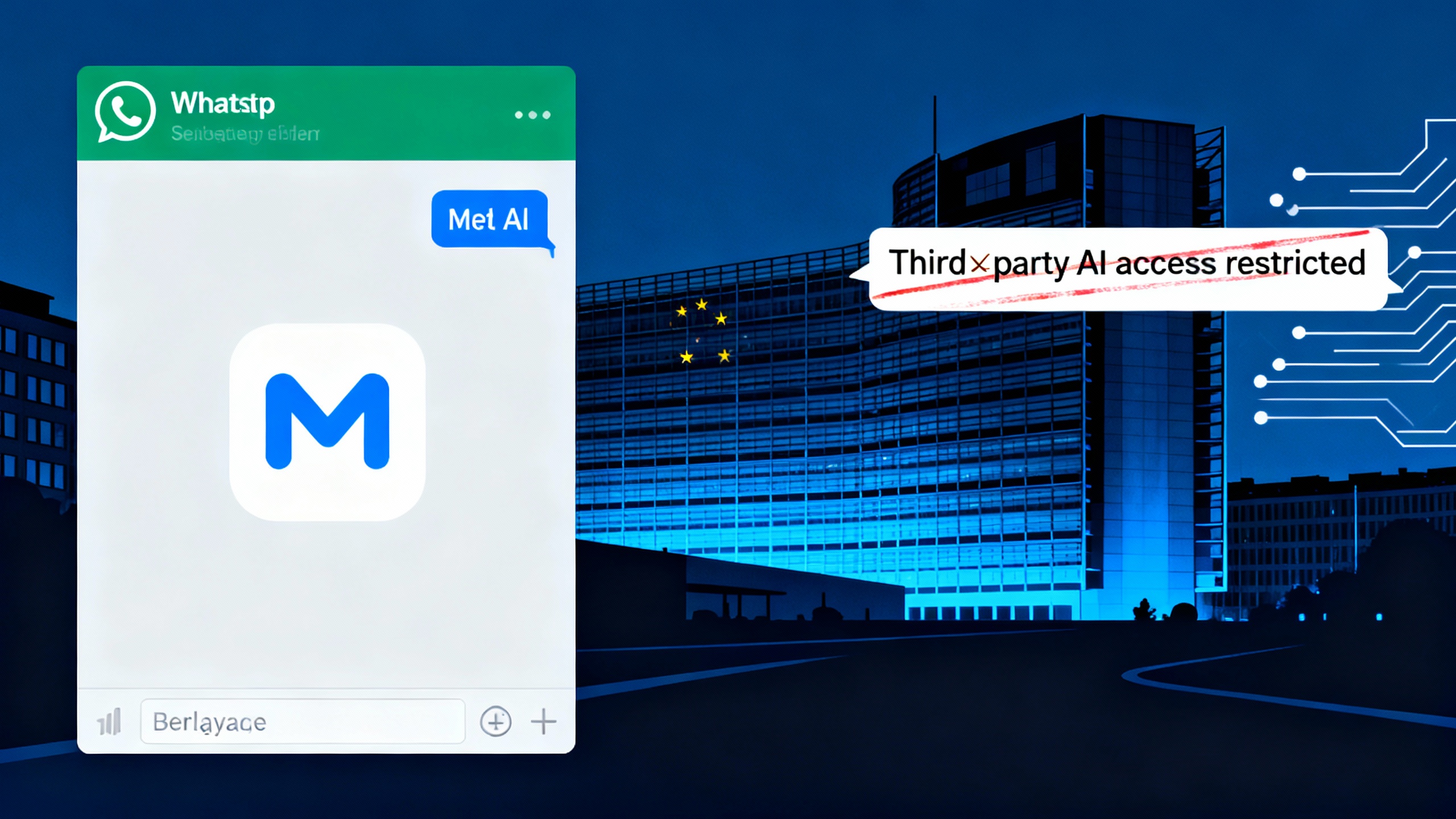
- On December 4, 2025, the European Commission opened a formal antitrust investigation into Meta’s new WhatsApp policy that restricts third‑party AI chatbot access in the EU/EEA (Italy excluded due to its own case).
- Regulators say the rule may block rival AI assistants from reaching users via WhatsApp while Meta’s own “Meta AI” remains available—potentially an abuse of dominance under EU law. Reuters, AP, FT.

What changed in WhatsApp’s rules—and why it matters
In late October, WhatsApp added an “AI Providers” clause to its Business Solution Terms. In plain English: providers of general‑purpose AI chatbots (think large‑language‑model assistants) are prohibited from using WhatsApp’s Business API “when such technologies are the primary … functionality.” Meta says businesses can still use AI for ancillary tasks like automated support. See the official terms (last modified October 28, 2025) here: WhatsApp Business Solution Terms.
Timing is crucial: the restriction has applied to new AI providers since October 15, 2025, and kicks in for existing ones on January 15, 2026. That staging is highlighted in coverage of the EU’s announcement. TechCrunch and the Commission’s notice republished by Mirage News outline those dates.
Key dates and what changes
| Date | What changed | Who’s affected |
|---|---|---|
| Mar 19, 2025 | Meta begins rolling out Meta AI in Europe across WhatsApp, Instagram and Messenger | EU users; Meta AI becomes a first‑party assistant surface (Meta Newsroom) |
| Oct 15, 2025 | New AI providers barred from using WhatsApp’s Business API for general‑purpose chatbots | New entrants (e.g., emerging chatbot providers) (Mirage News) |
| Oct 28, 2025 | WhatsApp updates and posts the “AI Providers” clause in Business Solution Terms | All Business API users (WhatsApp terms) |
| Dec 4, 2025 | EU opens an antitrust probe into Meta’s WhatsApp AI policy | Meta; WhatsApp; third‑party AI providers (Reuters) |
| Jan 15, 2026 | Rule applies to existing AI providers on WhatsApp | Existing general‑purpose chatbot integrations (e.g., ChatGPT, Copilot) (TechCrunch) |
How this changes the competitive landscape
- Platform access is distribution power. If rivals can’t reach users where they already are, their growth slows and switching costs rise. Regulators worry this amounts to self‑preferencing Meta’s own assistant (Meta AI) while locking out competitors.
- The Commission is proceeding under classic antitrust rules (Article 102 TFEU on abuse of dominance), not the DMA. Italy’s competition authority (AGCM) is running a parallel case focused on the bundling of Meta AI into WhatsApp. AGCM (July 30, 2025), AGCM update (Nov 26, 2025).
Meta’s position—and how third parties are responding
Meta contends the Business API wasn’t designed to distribute general‑purpose chatbots, adding that such use creates system strain and support burdens. A WhatsApp spokesperson called the EU’s claims “baseless,” noting people can access rival AI assistants via other channels (apps, web, email, OS integrations). Reuters, TechCrunch.
Meanwhile, two of the biggest third‑party assistants are exiting WhatsApp ahead of the deadline:
- OpenAI confirmed ChatGPT on WhatsApp will end after January 15, 2026, and published migration steps for users. OpenAI.
- Microsoft announced Copilot will leave WhatsApp on the same date and advised users to move to its apps and web. Microsoft Copilot Blog, TechCrunch.
TipIf your AI uses WhatsApp today, do this before January 15, 2026
- Audit your use case: if your bot is a general‑purpose AI assistant, plan to sunset or re‑route users.
- Preserve continuity: provide clear in‑app links to your native apps or web experience; communicate timelines proactively.
- Handle data portability: WhatsApp doesn’t support direct chatbot conversation transfer; publish instructions for exporting chats and offer a simple onboarding flow in your app (both OpenAI and Microsoft provide examples).
- Consider permitted patterns: AI used incidentally within a customer‑support workflow on WhatsApp may remain viable—validate your design against the official terms.
What happens next in Brussels
The Commission will investigate whether Meta’s policy unlawfully forecloses rivals in an emerging AI assistant market. There’s no legal deadline to conclude the case, but the Commission can move faster via interim measures if it sees urgent risk to competition. Reuters.
Potential outcomes range from commitments (changes to business terms) to fines, or—in a fast‑moving scenario—temporary remedies preserving access while the full case is assessed.
The bigger picture: AI, messaging, and distribution power
- Messaging is a high‑frequency surface where assistants can gain daily active use quickly; that’s why access rules matter. Meta’s stance is that WhatsApp’s Business API serves transactional, business‑to‑customer messaging—not consumer chatbot distribution.
- The EU’s interest is broader than one app. Over 2024–2025, Brussels layered classic antitrust enforcement alongside the DMA’s gatekeeper rules. Italy’s AGCM, for its part, is also examining whether pre‑installing or tightly integrating an in‑house assistant inside WhatsApp can tip the market. AGCM, AGCM interim‑measures update.
- Context for users: Meta rolled out Meta AI in Europe beginning March 2025 with a chat‑first experience inside WhatsApp and Meta’s other apps. That’s the backdrop to the current dispute over how open WhatsApp should be to competing assistants. Meta Newsroom, TechCrunch.
Why it matters for automation and productivity
For startups and enterprises that leaned on WhatsApp as a zero‑friction channel to deliver AI assistants, this is a forced pivot. The near‑term playbook:
- Shift your assistant to owned surfaces (apps/web) and deep‑link from WhatsApp while you still can.
- If you run customer support on WhatsApp, keep it—but ensure AI is ancillary to a clearly business‑led workflow.
- Invest in account‑linking and identity so users keep context when they move from messaging to your app.
- Build a channel‑mix strategy that hedges against future platform policy changes (e.g., email, web widgets, other messengers that permit bots).
Whether or not the EU ultimately forces changes to WhatsApp’s terms, this episode underscores a durable lesson: when your growth rides on another company’s rails, policy is a product dependency.
Sources
- European Commission probe (news coverage): Reuters, AP, Financial Times, TechCrunch.
- Commission notice (syndicated): Mirage News.
- WhatsApp policy text (official): WhatsApp Business Solution Terms.
- Third‑party exits: OpenAI on ChatGPT leaving WhatsApp; Microsoft Copilot blog; TechCrunch on Copilot.
- Italian parallel case: AGCM opens investigation (July 30, 2025); AGCM expands case, seeks interim measures (Nov 26, 2025).
- Meta AI EU rollout: Meta Newsroom, TechCrunch.