

What just happened
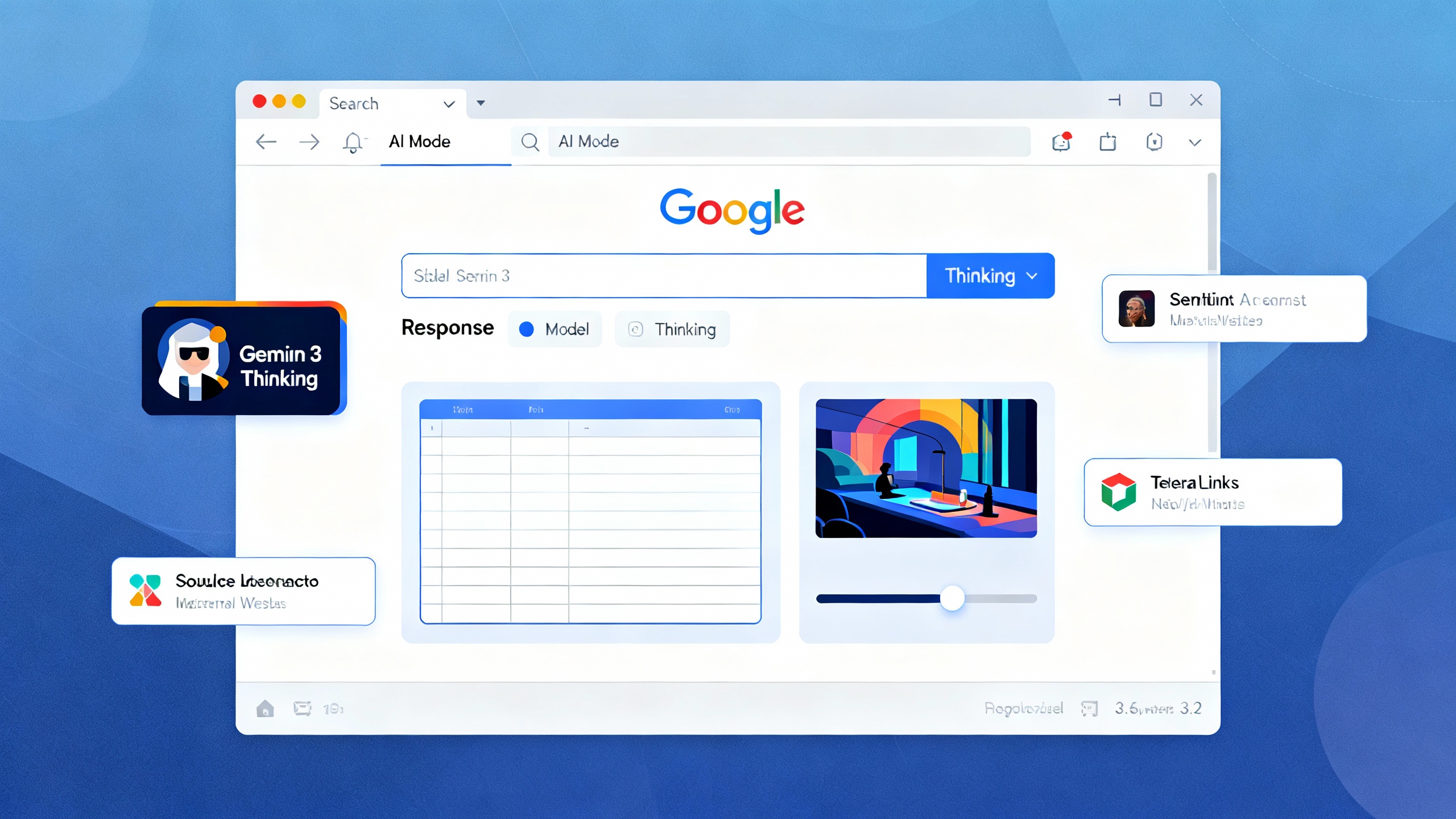
Google has begun powering parts of Search’s AI Mode with its new Gemini 3 model. On November 18, 2025, Google introduced Gemini 3 and, for the first time, turned a new Gemini model on inside Search on day one. U.S.-based Google AI Pro and AI Ultra subscribers can manually pick “Thinking” (Gemini 3 Pro) in the AI Mode model menu. On November 26, Google started rolling out automatic model routing so tougher questions asked in AI Mode are handled by Gemini 3 Pro for those subscribers. Google says wider U.S. access will follow. Google Search with Gemini 3; Search Engine Land.
TipQuick way to check if you have Gemini 3 in AI Mode
If you’re in the U.S. on a Google AI Pro or Ultra plan, open Search’s AI Mode and click the model drop-down. If you see “Thinking (Gemini 3 Pro),” you’re on Gemini 3. When automatic routing is enabled for your account, tough questions will be sent to Gemini 3 even if you didn’t switch models manually.
AI Mode vs. AI Overviews: why this distinction matters
AI Mode is a conversational, chat-like tab in Search where you can ask follow-ups, upload images, and explore links. AI Overviews, by contrast, are AI summaries that sometimes appear on the classic results page. At I/O 2025, Google said AI Mode would roll out to all U.S. users and highlighted strong adoption of both experiences. Independently, TechCrunch reported that by Q2 2025, AI Overviews had reached roughly 2 billion monthly users, and AI Mode had surpassed 100 million MAUs in the U.S. and India. I/O 2025 keynote recap; TechCrunch.
- <<stat label="AI Mode monthly users" value=">100M" source="techcrunch-2025-ai-mode-100m">>
Why it matters for traffic: users behave differently in each surface. Similarweb’s 2025 study found that when an AI Overview appears, the median zero‑click rate jumps from about 60% to around 80% (avg. ~83%). That can materially lower outbound clicks from those SERPs. Similarweb.
What Gemini 3 changes inside Search
Gemini 3 is designed for deeper reasoning and richer multimodal understanding. In AI Mode, Google says the model brings three meaningful shifts:
- Smarter query fan‑out: Search issues more sub‑queries, and Gemini better interprets intent, which should uncover relevant sources it previously missed. Google; Google explainer PDF.
- Generative UI: AI Mode can now compose dynamic layouts (images, tables, grids) and even generate interactive tools on the fly—think a custom mortgage calculator or a physics simulation embedded in the response. Google.
- Model routing: For complex queries, Search can automatically route to Gemini 3 Pro; simpler tasks still use faster models. This routing started appearing for AI Pro/Ultra subscribers on November 26. Search Engine Land.
Will Gemini 3 increase or decrease clicks?
Short answer: it depends on the query. Three data points to balance:
- Similarweb shows zero‑click rates are already significantly higher when AI Overviews are present (~80% median), so richer, more self‑contained answers generally depress clicks. Similarweb.
- Google’s own aggregated data (August 6, 2025) says total organic click volume from Google Search has been “relatively stable” year over year, and “quality clicks” (longer engagement, less pogo-sticking) are up. Google also argues that with AI Overviews, people see more links and ask longer questions—so the mix of clicks changes even as some zero‑click outcomes rise. Google.
- AI Overview prevalence has continued to expand through 2025, but the exact share varies by tracker and timeframe. Semrush data (via Digiday) suggested U.S. desktop AI Overviews reached roughly 20% of queries by May 2025; seoClarity’s Research Grid showed ~30% of U.S. desktop keywords by September 2025. Digiday; seoClarity.
Put together: as Gemini 3 makes AI Mode answers stronger and more interactive, expect more “SERP-as-a-UI” moments for exploratory and “how-to” searches—fewer clicks for the quick‑answer tier, with deeper clicks when users decide to go further.
What this means for SEO right now
- Optimize to be cited where AI lives. BrightEdge’s 16‑month study found citation overlap between AI Overviews and organic rankings climbed from ~32% to ~54.5% by September 2025. That’s a strong signal: classic SEO fundamentals (authority, technical hygiene, intent match) increasingly correlate with being referenced in AI answers. BrightEdge.
- Design for summarization. Use answer‑first paragraphs, concise bullet points, comparison tables, and clear headings to make extraction easy. Add accurate schema (FAQPage, HowTo, Product, Article) and keep facts traceable with authoritative citations. See primers from tooling vendors if you need checklists. Semrush.
- Target the long tail (and entities). Google notes users ask longer, more nuanced questions in AI surfaces. Build content hubs that map entities and real expertise to those deeper intents, and show E‑E‑A‑T (bylines, credentials, first‑hand evidence). Google.
- Measure the right things. Expect impressions to rise while CTR falls in some segments; BrightEdge reported impressions up ~49% YoY with clicks down ~30% across monitored sets after AI Overviews’ first year. Track share-of-voice in AI surfaces (citations, brand mentions, sentiment) alongside classic rankings. BrightEdge.
- Lean into formats AI favors. Forums, video, and first‑person perspectives are attracting more engagement from searchers, per Google. Invest in authentic formats that AI can credibly cite and that users want to click when they decide to go deeper. Google.
Where Gemini 3 runs in Google Search (as of Nov 27, 2025)
Gemini 3 in Search
| Experience | Is Gemini 3 live? | Who gets it now | Notes |
|---|---|---|---|
| AI Mode (Search tab) | Yes (Gemini 3 Pro) | U.S. Google AI Pro & Ultra subscribers; broader U.S. promised | Manual “Thinking” model selection available; automatic routing for hard queries began Nov 26, 2025. Google; Search Engine Land |
| AI Overviews (classic SERP) | Not generally confirmed as of Nov 27 | All markets where AIOs are live | Google’s Nov 18 post mentioned upcoming routing “in AI Mode and AI Overviews,” but Google comms clarified the current rollout applies to AI Mode; watch for changes. Google; Search Engine Land |
Industry ripple effects to watch
- Regulatory pressure: European publishers filed antitrust complaints over AI summaries’ impact on traffic; U.S. lawsuits are emerging. Expect ongoing debate about compensation and opt‑outs in AI experiences. Reuters; The Verge.
- Ads and design changes: Google is testing and shipping more prominent links and in‑line citations in AI Overviews, plus ads in AIO on mobile U.S.—design choices that affect downstream clicks. Google.
- “Web” filter adoption: Users can switch to a web‑links‑only filter, which may become a haven for some power users—but expect AI surfaces to grow regardless. TechCrunch.
Practical FAQs
Will Gemini 3 make AI Mode answers replace my site?
For simple intents, expect more zero‑click outcomes. For complex intents, Gemini 3 often functions as a guide, sending more qualified visitors to sources it deems credible. The opportunity: be the expert source worth clicking.
What should I change on my pages?
Keep your best articles but modernize the structure: answer‑first intros, scannable bullets, comparison tables, clean schema, clear author expertise and dated revisions, and links to primary research that AI can ground against. Semrush.
How do I measure impact?
Triangulate: classic Google Search Console data; third‑party AIO visibility trackers (seoClarity, Semrush); and a repeatable panel of your priority queries run in AI Mode, recorded weekly. Track whether you’re cited, how you’re labeled, and whether interactive tools are displacing clicks.
Sources
- Google: Google Search with Gemini 3: Our most intelligent search yet (Nov 18, 2025)
- Search Engine Land: Gemini 3 now used for some queries in AI Mode (Nov 26, 2025)
- Google: AI in Search is driving more queries and higher quality clicks (Aug 6, 2025)
- Similarweb: Zero‑Click Searches And How They Impact Traffic (May 22, 2025)
- seoClarity: Impact of Google’s AI Overviews: SEO Research Study (last updated Oct 23, 2025)
- BrightEdge: One Year Into Google AI Overviews… Search Usage Increases by 49% (May 14, 2025)
- BrightEdge: AI Overview citations now 54% from organic rankings (Sept 18, 2025)
- TechCrunch: AI Overviews hit ~2B MAUs; AI Mode 100M MAUs (July 23, 2025)
- Google: AI Overviews expansion and in‑line links/ads details (Oct 28, 2024)
- Digiday (via Semrush, seoClarity): AI platforms are driving more traffic, but not enough to offset zero‑click search (July 2025)
- Google: AI Overviews & AI Mode in Search—how it works (PDF, May 2025)
- I/O 2025: Sundar Pichai keynote highlights for AI Mode rollout