


What happened — and why it matters
On December 1, 2025, Nvidia took a $2 billion equity stake in Synopsys via a private placement, buying 4,821,717 newly issued shares at $414.79 apiece. The investment accompanies a multi‑year partnership to fuse Nvidia’s accelerated computing and AI stack with Synopsys’ silicon‑to‑systems design software (which now includes Ansys after Synopsys closed that acquisition in July). The goal: move everything from chip design to complex physics simulation and digital twins onto GPUs and into AI‑assisted workflows.
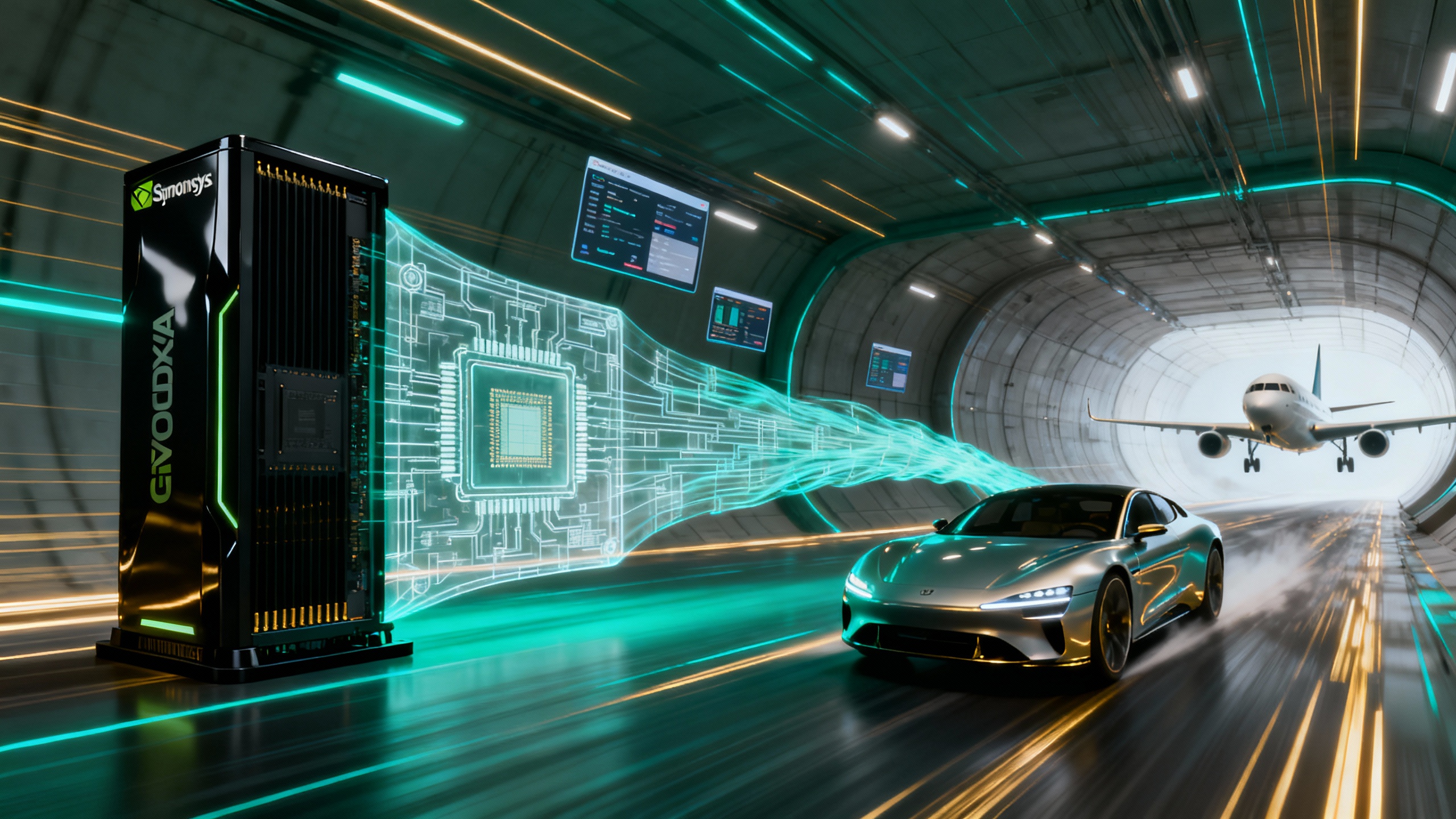
Two details stand out. First, Synopsys disclosed the deal in an SEC 8‑K as an unregistered sale under Section 4(a)(2), clarifying it was a direct share issuance rather than open‑market buying. Second, both companies emphasized the pact is non‑exclusive: Synopsys will continue working with other CPU/GPU vendors, and Nvidia will keep collaborating with rival EDA and CAE providers. That matters for customers who want choice — and leverage — in their toolchains.
The technical play: AI‑accelerated EDA meets physics simulation
At its core, the tie‑up is about collapsing wall‑clock time in engineering loops by combining three layers:
- Nvidia’s GPU hardware (Grace Blackwell and successors) and CUDA‑X libraries for heavy numerics.
- Nvidia’s agentic‑AI software stack (NIM microservices, NeMo Agent Toolkit, and Llama Nemotron reasoning models) for copilots and autonomous workflows.
- Synopsys’ portfolio spanning electronic design automation (EDA), semiconductor IP, and — via Ansys — broad multiphysics simulation.
Recent benchmarks and product roadmaps underline the upside:
- Synopsys reported projected speedups of up to 30× for circuit simulation (PrimeSim) on Grace Blackwell, and up to 20× for computational lithography (Proteus) when paired with Nvidia’s cuLitho and Blackwell‑class GPUs.
- Nvidia has highlighted “orders of magnitude” gains for real‑time digital twins in CAE software across vendors — with up to 50× acceleration on Blackwell for certain workloads — enabling interactive design‑validate loops that previously took days on CPU clusters.
- Synopsys and Nvidia are integrating agentic AI directly into design workflows, connecting Synopsys AgentEngineer (in development) with Nvidia’s NIM/NeMo/Nemotron stack so multi‑agent systems can propose fixes, run experiments, and advance flows semi‑autonomously.
What’s new is the breadth: beyond chips, Synopsys says it will accelerate physical verification, molecular simulations, electromagnetics, optics, and more — and use Nvidia’s Omniverse plus Cosmos world‑foundation models to build higher‑fidelity digital twins for sectors like aerospace, automotive, energy, robotics, and healthcare.
What the partnership actually includes
Scope of the Nvidia–Synopsys collaboration
| Initiative | Nvidia tech | Synopsys domain | What it means for teams |
|---|---|---|---|
| Broad acceleration of compute‑intensive apps | CUDA‑X libraries; Grace Blackwell GPUs | EDA, TCAD, computational lithography, verification | Shorter runtimes and bigger design spaces without ballooning CPU clusters |
| Agentic AI for engineering | NIM microservices; NeMo Agent Toolkit; Llama Nemotron | Synopsys AgentEngineer; Synopsys.ai Copilot | From copilots to multi‑agent automation across design & signoff |
| Digital twins at scale | Omniverse; Cosmos WFMs | Ansys‑class multiphysics (now part of Synopsys) | Real‑time “design‑simulate‑validate” loops for complex systems |
| Cloud‑ready delivery | GPU access in major clouds | Portfolio enablement for cloud | Easier pilots, elastic bursts; fewer on‑prem constraints |
| Joint go‑to‑market | Ecosystem programs | Synopsys’ global sales/channel | Faster rollout to mainstream engineering orgs |
Why this could boost productivity (and not just for chip teams)
- Faster iteration, richer exploration: When a SPICE‑accurate sim drops from a day to an hour — or a CFD case runs interactively instead of overnight — teams can test more ideas and converge sooner on better designs.
- AI as a collaborator: Agentic workflows can handle boilerplate steps (setup, parameter sweeps, report synthesis) and proactively suggest fixes or optimizations. Engineers stay in the loop, but spend more time on intent and trade‑offs.
- Unified digital twins: Linking electronics with physics lets cross‑functional teams (EE, ME, thermal, RF, firmware) debug system interactions early, trim late‑stage surprises, and reduce lab churn.
- Cloud elasticity: GPU‑accelerated toolchains that run elastically in the cloud help small teams pilot advanced flows without buying racks of hardware up front.
TipQuick wins to consider in 2026 planning
- Target one pain point per domain for a GPU pilot (e.g., PrimeSim for analog signoff; Proteus for OPC/ILT; Fluent or structural solvers for thermal/CFD). Measure wall‑clock time, queue time, and cost per job.
- Stand up an AI assistant baseline using NIM‑hosted models for doc search, log parsing, and scripting. Expand to flow orchestration only after you’ve proven trust and ROI on narrow tasks.
- Start small with digital twins: pick a subsystem (battery pack, antenna module, cooling loop) before modeling the whole product.
The competitive angle (and why non‑exclusivity matters)
Nvidia already collaborates with Synopsys’ chief rivals. Cadence, for example, has announced multiple integrations with Nvidia’s platforms — from Blackwell‑accelerated solvers to data‑center digital twins for DGX SuperPOD. Meanwhile, Siemens and other ISVs are tying their CAE portfolios into Omniverse and Blackwell. For Synopsys customers, the non‑exclusive clause signals two things:
- You’ll likely see accelerated options across vendors, not just one.
- Leverage remains: tool selection can reflect your silicon and system roadmap rather than a single‑vendor lock‑in.
Reuters also flagged investor concerns about “circular” AI deals in which Nvidia invests in (or pre‑buys from) customers. Synopsys’ CEO addressed this directly, noting there’s no commitment to spend the $2B on Nvidia hardware. Regardless, enterprises should keep governance tight: request transparency on any strategic credits, bundling, or preferred‑pricing that might bias tooling choices.
How big is Nvidia’s stake?
Synopsys reported 185,748,673 shares outstanding as of September 5, 2025. On that base, Nvidia’s 4,821,717 newly issued shares would equal roughly 2.6%. That’s a back‑of‑the‑envelope calculation — the official percentage will move with further issuances, buybacks, or M&A — but it gives a sense of materiality for a strategic (not controlling) stake.
What to watch next
- Early customer case studies: Expect 2026 pilots that quantify end‑to‑end cycle‑time cuts in analog signoff, OPC/ILT, and multiphysics twins.
- Agentic AI in production: Keep an eye on how Synopsys’ AgentEngineer evolves from demos to robust, auditable flow automation — and where NIM/NeMo/Nemotron land in enterprise governance.
- Cloud economics: Transparent burst‑pricing for GPU‑accelerated EDA/CAE will determine whether gains pencil out at scale.
- Ecosystem openness: Will AMD/Intel GPUs see first‑class support? Non‑exclusivity suggests yes; procurement should pressure‑test it.
- Toolchain convergence: With Ansys inside Synopsys, watch for deeper silicon‑to‑system flows (e.g., co‑sim across EM/thermal/RTL) and standardized data models.
Bottom line
Nvidia’s $2B in Synopsys is more than a financial headline. It’s a bet that the future of engineering productivity is GPU‑accelerated, AI‑assisted, and natively multiphysics — with digital twins and agentic AI turning weeks of iteration into hours of exploration. If the early speedups hold in real customer designs, the payoff won’t just be faster chips; it’ll be shorter, smarter product cycles across entire industries.
Sources
- NVIDIA and Synopsys announce strategic partnership; Nvidia invests $2B at $414.79 per share (Dec 1, 2025)
- Synopsys Form 8‑K confirming $2B private placement; 4,821,717 shares at $414.79 (Dec 1, 2025)
- Reuters: Nvidia takes $2B stake in Synopsys; deal is non‑exclusive; rationale and market reaction (Dec 1, 2025)
- Synopsys completes acquisition of Ansys (Jul 17, 2025)
- Synopsys at GTC: up to 30× PrimeSim, up to 20× Proteus, NIM‑powered Copilot (Mar 18, 2025)
- NVIDIA: Blackwell accelerates CAE software by up to 50× for real‑time digital twins (Mar 18, 2025)
- Cadence expands digital‑twin platform with NVIDIA DGX SuperPOD model (Sep 9, 2025)
- NVIDIA NIM microservices overview (Mar 18, 2024)
- Synopsys expands AI capabilities; AgentEngineer under development (Sep 3, 2025)
- NVIDIA Cosmos world‑foundation models for physical AI and digital‑twin data (Mar 18, 2025)