

What happened, and why it matters
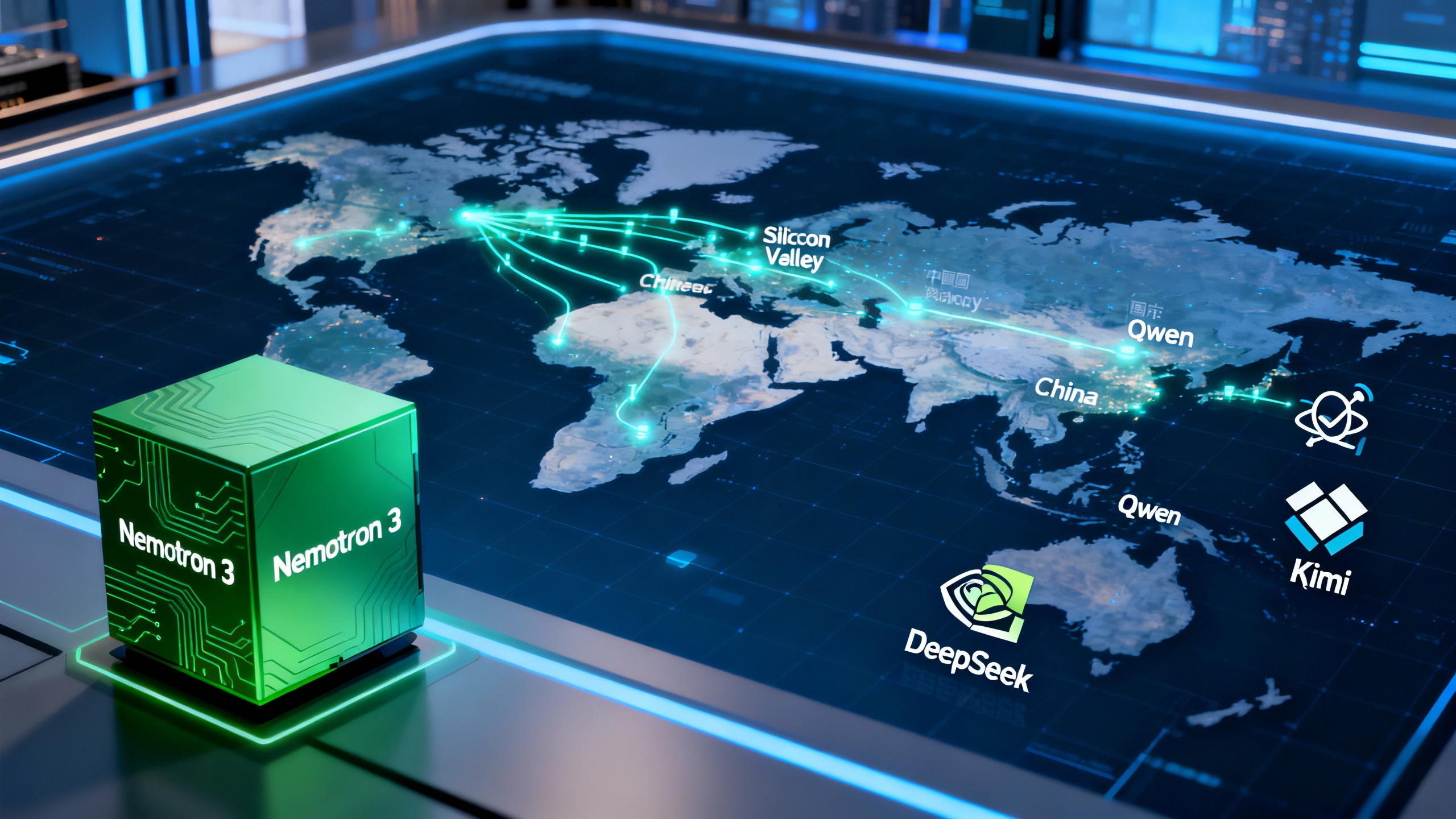
Nvidia announced a new generation of open‑source large language models called Nemotron 3 on December 15, 2025. The first release, Nemotron 3 Nano, is available immediately, with larger variants due in the first half of 2026. Nvidia frames the launch as a direct response to the rapid rise of Chinese open models such as DeepSeek’s R1, Moonshot’s Kimi K2, and Alibaba’s Qwen, which have raced up benchmarks and into production at Western companies. Nvidia says Nemotron 3 aims to be a fast, cost‑efficient, and transparent U.S. alternative for developers, enterprises, and government users. Reuters.
What’s new in Nemotron 3
- Open release and scope: Nemotron 3 is positioned as a fully open family of models for writing, coding, and long, multi‑step tasks. Nvidia says the models are more efficient than their predecessors, lowering run‑time costs while improving performance on complex tasks. Reuters.
- Transparent by design: Nvidia says it is publishing training data and tools to support security testing and customization, describing Nemotron as something it will “treat like a library.” That emphasis on auditability is meant to ease adoption inside regulated enterprises and public agencies. Reuters.
- Licensing: Current Nemotron releases are governed by the permissive NVIDIA Open Model License, which allows commercial use and derivative works. The license was updated on October 24, 2025. NVIDIA Open Model License. Nvidia’s Nemotron FAQ also emphasizes that the company publishes model weights, training datasets, and techniques. Nvidia Nemotron FAQ.
The China context: why “open” has become strategic
Chinese open models have changed the market narrative in 2025:
- DeepSeek’s open‑source reasoning model R1 triggered a global AI debate in January and contributed to a major tech‑stock selloff. Coverage from CNBC and others highlighted R1’s performance‑per‑dollar and open licensing. CNBC, CNBC analysis.
- Moonshot AI open‑sourced its Kimi K2 model with aggressive token pricing, explicitly targeting cost‑sensitive coding and agentic workloads. CNBC.
- Alibaba’s Qwen has won notable Western adopters. Airbnb CEO Brian Chesky said in October the company “relies a lot on Alibaba’s Qwen” because it’s “fast and cheap,” alongside models from OpenAI and Google. Fortune/Bloomberg, Los Angeles Times.
- Security policy is shifting. Texas and other U.S. states barred Chinese AI apps like DeepSeek on government devices, and Commerce Department bureaus restricted DeepSeek internally. That has created demand for domestic, auditable models in the public sector. Texas Governor’s Office, Reuters, StateTech Magazine.
Against that backdrop, Nvidia’s move isn’t just about releasing another model—it’s about offering an open, U.S.‑based alternative that can be vetted, self‑hosted, and integrated under a permissive license.
How Nemotron 3 fits Nvidia’s broader open stack
Nemotron 3 builds on a year of related “open” groundwork from Nvidia:
- Llama Nemotron reasoning models (March 18, 2025) delivered open, post‑trained models in Nano, Super, and Ultra sizes for agentic and reasoning tasks—available free for development and deployable as NIM microservices. NVIDIA Newsroom, Investor release.
- Open datasets and post‑training recipes: Nvidia published the Llama‑Nemotron 30M post‑training dataset and detailed how it tunes for math, code, and reasoning—helpful for teams building custom variants. NVIDIA Technical Blog.
- Inference at scale: Nvidia open‑sourced Dynamo, an inference server designed for “reasoning‑time compute” and disaggregated serving, with reported multi‑x throughput improvements—including on DeepSeek‑R1 when running on new Blackwell systems. NVIDIA Newsroom, Investor release.
The upshot: Nemotron 3 slots into a maturing, open‑leaning stack that spans training data, post‑training methods, model weights, and enterprise‑grade serving.
Open vs. open-ish vs. closed: where Nemotron 3 stands
- Nemotron 3: Nvidia says it will publish training data along with weights and tools, under the NVIDIA Open Model License—positioning Nemotron 3 as open‑source in both spirit and practice. Reuters, NVIDIA Open Model License, Nemotron FAQ.
- Chinese open models: DeepSeek R1 and Kimi K2 use permissive licenses and low pricing to speed experimentation and adoption globally. CNBC, CNBC.
- Meta’s direction: Multiple reports indicate Meta is weighing a shift to more proprietary approaches (e.g., a paid “Avocado” model) even as it maintains a mix of open and closed work. If that happens, Nvidia becomes one of the most prominent U.S. suppliers of truly open models at scale. Bloomberg via Yahoo, TechCrunch, The Verge.
Where Nemotron 3 fits for builders
| Option | What you get | Why you’d pick it |
|---|---|---|
| Nvidia Nemotron 3 | Open weights, training data, permissive license; enterprise‑grade tooling (NIM, Dynamo) | U.S.‑based, auditable supply chain; strong ops and serving stack; fits regulated environments |
| Chinese open models (DeepSeek R1, Kimi K2, Qwen) | Cutting‑edge open models with aggressive cost/perf | Cost‑sensitive workloads; rapid iteration; diverse model zoo |
| Closed frontier APIs | Best single‑model raw capability (often) with managed services | You value top‑end performance and are comfortable with vendor lock‑in and data governance trade‑offs |
What this means for productivity and AI agents
For teams building AI agents, copilots, and automation workflows, three practical implications stand out:
- Lower TCO for “thinking” tasks: Nvidia emphasizes multistep reasoning and efficiency. If Nemotron 3 Nano’s efficiency claims hold up, you can run more complex chains (planning, tool use, verification) on less GPU. Reuters.
- Faster compliance reviews: Publishing training data and model cards should compress security review cycles for public‑sector and regulated workloads—especially where Chinese models are restricted. Reuters, Texas Governor’s Office.
- A clearer open stack: With open datasets, open models (Nemotron), and open inference (Dynamo), Nvidia is making it easier to assemble a fully auditable, on‑prem agent platform. NVIDIA Newsroom, NVIDIA Technical Blog.
Risks and unknowns
- Benchmarks and weights for larger Nemotron 3 models aren’t public yet. Until those arrive in 1H 2026, you’re validating primarily on Nano.
- “Open” is evolving. Nvidia’s open stance is clear today, but industry norms are shifting—Meta is reportedly reconsidering how open its next models will be. Plan for a heterogeneous, multi‑model future. Bloomberg via Yahoo, TechCrunch.
The bottom line
Nemotron 3 signals that Nvidia intends to lead not only in AI hardware but also in open, enterprise‑ready models. For U.S. organizations that want the flexibility of open source without importing Chinese model risk—or the lock‑in of closed APIs—Nemotron 3 provides a timely new default to evaluate.
Sources
- Reuters: Nvidia unveils Nemotron 3, Dec 15, 2025 (launch details, intent and quotes) — link
- Nvidia: Llama Nemotron reasoning models (Mar 18, 2025) — newsroom, investor release
- Nvidia: Llama‑Nemotron 30M open dataset (May 14, 2025) — technical blog
- Nvidia: Dynamo open‑source inference (Mar 18, 2025) — newsroom, investor release
- Nvidia: Open Model License (updated Oct 24, 2025) — license; Nemotron FAQ — link
- Chinese open models context — DeepSeek R1 coverage (CNBC, CNBC analysis); Moonshot Kimi K2 (CNBC); Airbnb and Qwen (Fortune/Bloomberg, LA Times)
- U.S. restrictions on Chinese AI tools — Texas ban (Governor’s Office); Commerce Dept. bureaus restrict DeepSeek (Reuters); Roundup of state bans (StateTech Magazine)
- Meta’s potential shift away from open — Bloomberg via Yahoo, TechCrunch, The Verge