

What happened (and what didn’t)
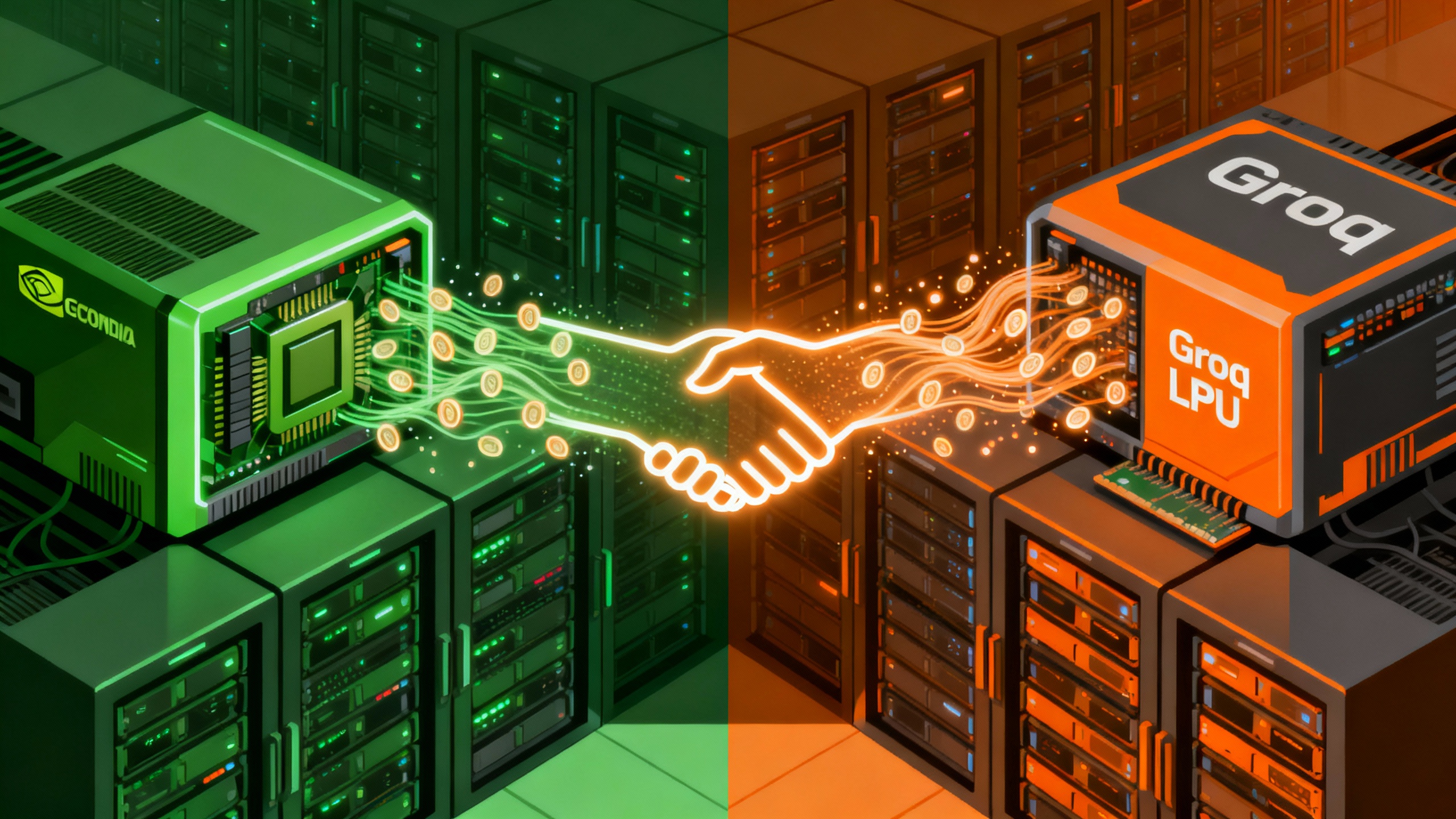
On December 24, 2025, Groq said it signed a non‑exclusive licensing agreement that gives Nvidia access to Groq’s inference technology. As part of the deal, Groq’s founder and CEO Jonathan Ross and president Sunny Madra, along with other engineers, will join Nvidia. Groq will remain an independent company; Simon Edwards steps in as CEO, and GroqCloud continues operating for developers and enterprises. Groq newsroom and Reuters confirmed the non‑exclusive license and executive moves.
Some outlets initially framed this as an outright acquisition at a $20 billion price tag. Nvidia has not announced an acquisition, and Groq’s statement characterizes the arrangement as licensing plus talent joining Nvidia. TechCrunch clarified that Nvidia described it as not an acquisition of the company.
Why this is a big deal for AI and automation
AI’s bottleneck is shifting from model training to real‑time inference. Groq focuses on ultra‑low‑latency inference using LPUs (Language Processing Units) that store model weights in large on‑chip SRAM to minimize memory fetch latency—an approach that contrasts with GPU architectures that rely more heavily on external HBM/DRAM. That design targets faster, more predictable token generation with lower energy draw for production workloads. Groq LPU architecture, Reuters.
For builders of agents, copilots, and streaming AI features in apps, the promise is clear: lower latency, better cost profiles, and more consistent throughput at scale. Those are the ingredients that turn AI demos into revenue‑generating features.
What Nvidia gets
- Proven inference IP designed around deterministic execution and on‑chip SRAM, which could complement Nvidia’s GPU‑centric “AI factory” stack for serving large models and AI agents at scale. Groq LPU architecture.
- Talent and institutional know‑how: Jonathan Ross led Google’s TPU effort before founding Groq; Sunny Madra built Groq’s cloud and GTM execution. TechCrunch.
- Strategic positioning as inference demand explodes, when speed and energy efficiency per token matter more than raw training FLOPS. Reuters.
What Groq keeps
- Independence as a company, including GroqCloud, which continues without interruption. Groq newsroom.
- The option (in principle) to license its technology to other partners due to the non‑exclusive structure. Groq newsroom.
- A leadership reset under Simon Edwards (formerly CFO), who takes over as CEO. Reuters.
What’s in the Nvidia–Groq deal (so far)
| Element | Status | Source |
|---|---|---|
| License scope | Non‑exclusive license to Groq inference tech | Groq |
| Talent moves | Jonathan Ross, Sunny Madra, and other engineers join Nvidia | Groq, Reuters |
| Groq corporate status | Remains independent; Simon Edwards becomes CEO | Groq |
| GroqCloud | Continues operating | Groq |
| Deal value | Not disclosed; early reports suggested $20B asset purchase | TechCrunch |
Context: The rise of “license + talent” mega‑deals
Regulators are scrutinizing big tech M&A, so many companies are structuring arrangements as licensing paired with large‑scale hiring. Nvidia itself reportedly paid over $900 million to hire the CEO of Enfabrica and license its tech, and Microsoft’s $650 million Inflection AI arrangement is another template. This Groq deal fits the pattern—and may invite similar antitrust questions even without a formal acquisition. CNBC, Reuters.
How this could change AI operations and productivity
- Faster, cheaper inference unlocks real‑time assistants, voice agents, and live multimodal systems that feel responsive—key for customer support, analytics co‑pilots, and embedded AI in devices.
- Deterministic execution (compiler‑scheduled, cache‑free compute) can simplify capacity planning and SLOs for production AI. Groq LPU architecture.
- If Nvidia productizes Groq’s approaches across its software stack, we could see hybrid pipelines that choose GPUs or LPUs dynamically by workload, tightening end‑to‑end latency budgets for complex AI agent graphs.
TipWhat builders should do now
- If you run on GroqCloud today, plan for continuity—Groq says operations continue.
- Watch Nvidia’s software roadmap (CUDA‑X, Triton, NIM microservices) for LPU‑aware inference paths.
- Benchmark latency and $/token across GPU and LPU targets; keep a multi‑target deployment option in case one supply chain tightens.
- For on‑prem plans, revisit power and cooling budgets—SRAM‑heavy inference designs can shift your rack‑level assumptions. Groq LPU architecture.
Open questions we’ll be tracking
- Integration details: What exactly does Nvidia license—and how will it show up in its product stack?
- Roadmap timing: When do developers see tangible benefits (SDKs, runtime support, deployment blueprints)?
- Groq’s partner strategy: With a non‑exclusive license, will Groq sign additional strategic deals?
- Talent retention: How much of Groq’s engineering depth moves to Nvidia, and what’s Groq’s hiring plan under its new CEO?
Sources
- Groq newsroom: non‑exclusive license; leadership changes and GroqCloud continuity. Groq
- Deal framing and antitrust context. Reuters
- Clarification that this is not an outright acquisition of Groq. TechCrunch
- Groq’s LPU architecture and memory model (on‑chip SRAM, deterministic execution). Groq LPU architecture
- Example of Nvidia’s recent “license + hire” playbook. CNBC on Enfabrica