

What happened — and what’s confirmed
Nvidia has entered a non‑exclusive licensing agreement to use Groq’s inference technology and will hire key Groq leaders — including founder and CEO Jonathan Ross and president Sunny Madra — to help scale that tech inside Nvidia. Groq says it remains an independent company, with Simon Edwards becoming CEO, and GroqCloud continuing to operate.
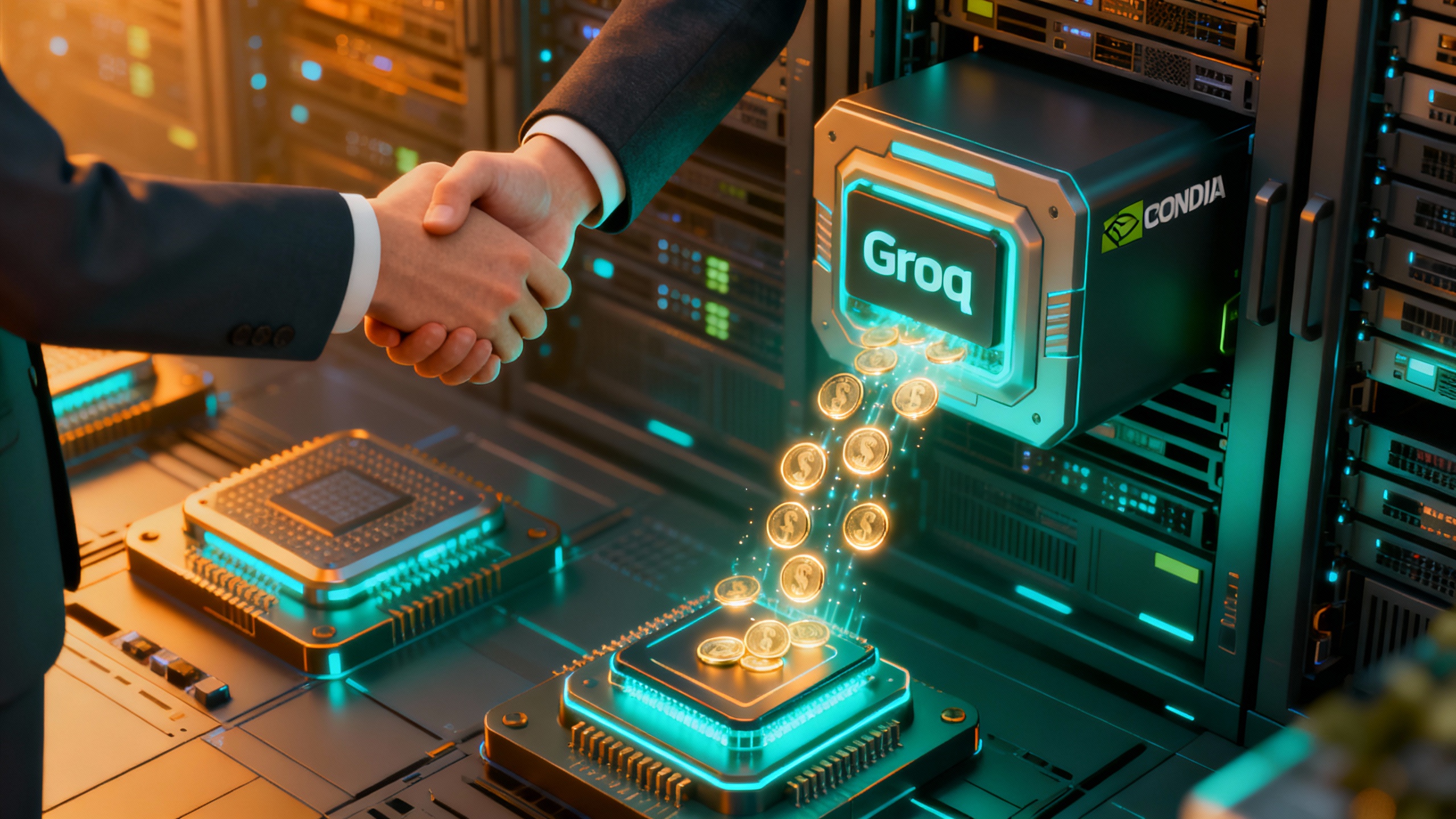
Multiple outlets initially framed the move as a $20B “acquisition” of Groq or its assets. Nvidia has told reporters it is not acquiring the company, and Groq’s language describes licensing plus a talent transfer. The headline dollar figure has been widely reported but not confirmed by either company.
<<callout type="note" title="Confirmed vs. rumored"> Confirmed: non‑exclusive license of Groq’s inference tech; Ross, Madra and other Groq staff are joining Nvidia; Groq remains independent; GroqCloud continues. Rumored/Unconfirmed: the widely cited ~$20B consideration for licensed IP and/or certain assets — reported by CNBC and others but not acknowledged by Nvidia or Groq.
Why it matters: inference is the new battleground
Training gets the headlines; inference pays the bills. Nvidia has spent most of 2025 talking up “AI factories” designed for generating tokens at scale and has rolled out platform updates (from TensorRT‑LLM to NIM microservices) to push down latency and cost per token. Bringing Groq’s low‑latency, SRAM‑heavy LPU approach in‑house — at least via licensed IP and key engineers — signals Nvidia wants to win the real‑time inference race, not just training.
Groq’s LPU architecture is built for deterministic, token‑streamed execution with on‑chip SRAM and compiler‑driven static scheduling — choices aimed squarely at minimizing latency variance in production inference. Independent and company benchmarks through 2024–2025 emphasized high tokens‑per‑second and time‑to‑first‑token performance on popular LLMs.
What Nvidia gets — beyond GPUs
- Licensed access to Groq’s inference IP and the engineers who built it — including Ross, who previously helped invent Google’s TPU — to inform Nvidia’s roadmap for low‑latency, energy‑efficient serving.
- A complementary architecture to its GPU‑centric stack for training and increasingly for inference (TensorRT‑LLM, NIM). Expect learnings to flow into Nvidia’s software and silicon, whether that’s kernel‑level tricks for deterministic scheduling, memory hierarchies tuned for short‑context bursts, or product decisions about specialized inference SKUs.
- A defensive and offensive posture as hyperscalers explore custom silicon and alternative accelerators for inference workloads.
Deal at a glance
| Item | What’s known today |
|---|---|
| Structure | Non‑exclusive tech license + hiring of Groq founder/execs/engineers |
| Companies’ status | Groq remains independent under CEO Simon Edwards; GroqCloud continues |
| Consideration | Not disclosed by either company; ~$20B figure reported by CNBC remains unconfirmed |
| Strategic aim | Faster, cheaper, more predictable real‑time inference at scale |
| Timing | Announced Dec 24–26, 2025 (depending on time zone/report) |
What Groq keeps — and what changes for builders
Groq says it will continue operating independently and keep GroqCloud online. For developers already on Groq’s platform, the near‑term message is continuity; the open question is how the company executes after losing its founder and other senior engineers to Nvidia. At a minimum, users should expect closer interop between Groq’s ideas and Nvidia’s inference software toolchain over time.
Performance claims won’t vanish with the team: Groq has documented the LPU’s focus on on‑chip SRAM, static scheduling and direct chip‑to‑chip links, and highlighted third‑party benchmarks on Llama‑class models. Those design choices — and the licensed know‑how behind them — are precisely what Nvidia appears keen to internalize.
The bigger pattern: license + hire deals under antitrust scrutiny
This structure mirrors several 2024–2025 mega‑deals where Big Tech licensed IP and hired key teams rather than buying companies outright — for example Microsoft–Inflection and Amazon–Adept, and Meta’s investment while recruiting Scale AI’s CEO — deals that drew regulatory attention but, so far, have largely stood. Nvidia–Groq fits the same mold and could face similar questions.
<<callout type="warning" title="Regulatory watch"> Regulators in the U.K. and U.S. have examined license‑plus‑hiring structures (e.g., Microsoft–Inflection). Expect scrutiny here too, though the non‑exclusive nature of the Groq license and Groq’s continued independence may help Nvidia’s case.
What this means for AI, automation, and productivity
For enterprise teams, the practical takeaway is better real‑time AI:
- Lower latency and steadier tail latency reduce user‑perceived lag in copilots, voice agents, and RAG apps — the difference between “wow” and “wait.” Groq’s design and Nvidia’s inference stack both target exactly these metrics.
- If Nvidia incorporates Groq techniques into CUDA/TensorRT‑LLM and NIM, you could see speedups on existing GPU fleets without changing hardware — a software dividend that compounds over time.
- On the hardware side, watch for Nvidia to expand its portfolio of inference‑optimized options (alongside Blackwell and future parts) with features inspired by LPU‑style scheduling and memory.
<<callout type="action" title="For buyers and builders">
- Validate latency and cost per token with your own prompts and concurrency profiles; don’t rely on single‑number TPS claims.
- Track Nvidia software releases (TensorRT‑LLM, NIM) for inference gains; these may arrive before any silicon changes.
- If you’re on GroqCloud today, scrutinize SLAs and roadmap updates under the new leadership — and keep a fallback plan.
- If procurement policies require “multiple sources,” the non‑exclusive nature of this license could help preserve vendor diversity.
What we’re watching next
- Whether Nvidia discloses financial terms — or regulators compel detail — around the license and any asset purchases.
- How quickly Ross and team land in Nvidia org charts (e.g., TensorRT‑LLM/NIM, Blackwell/Rubin roadmaps) and what shows up in early 2026 software drops.
- Any near‑term interop between GroqCloud and Nvidia tooling or marketplaces that hints at longer‑term integration.
Sources
- Groq newsroom: Non‑exclusive licensing agreement with Nvidia; leadership changes; GroqCloud continuity (Dec 24–25, 2025)
- TechCrunch: Nvidia to license Groq’s tech and hire its CEO; not an acquisition, Nvidia says (Dec 24, 2025)
- Reuters: Nvidia to license Groq tech, hire executives; $20B asset‑buy report referenced but unconfirmed (Dec 24–25, 2025)
- PYMNTS: Nvidia spokesperson clarifies license‑plus‑hiring, not a company acquisition (Dec 26, 2025)
- Groq: LPU architecture overview (on‑chip SRAM, deterministic scheduling)
- Groq press/PR: Independent benchmark highlights on Llama‑class models (Feb 13, 2024)
- Nvidia Blog (GTC 2025): AI factories and the push to accelerate inference
- Nvidia Technical Blog: TensorRT‑LLM inference advances on Blackwell (Mar 18, 2025)
- Reuters: Microsoft–Inflection $650M license‑plus‑hiring deal (Mar 21, 2024)
- CNBC: Amazon hires Adept founders and licenses tech (June 28, 2024)
- Groq PR: $750M fundraise at $6.9B valuation (Sept 17, 2025)