

What actually happened (and what didn’t)
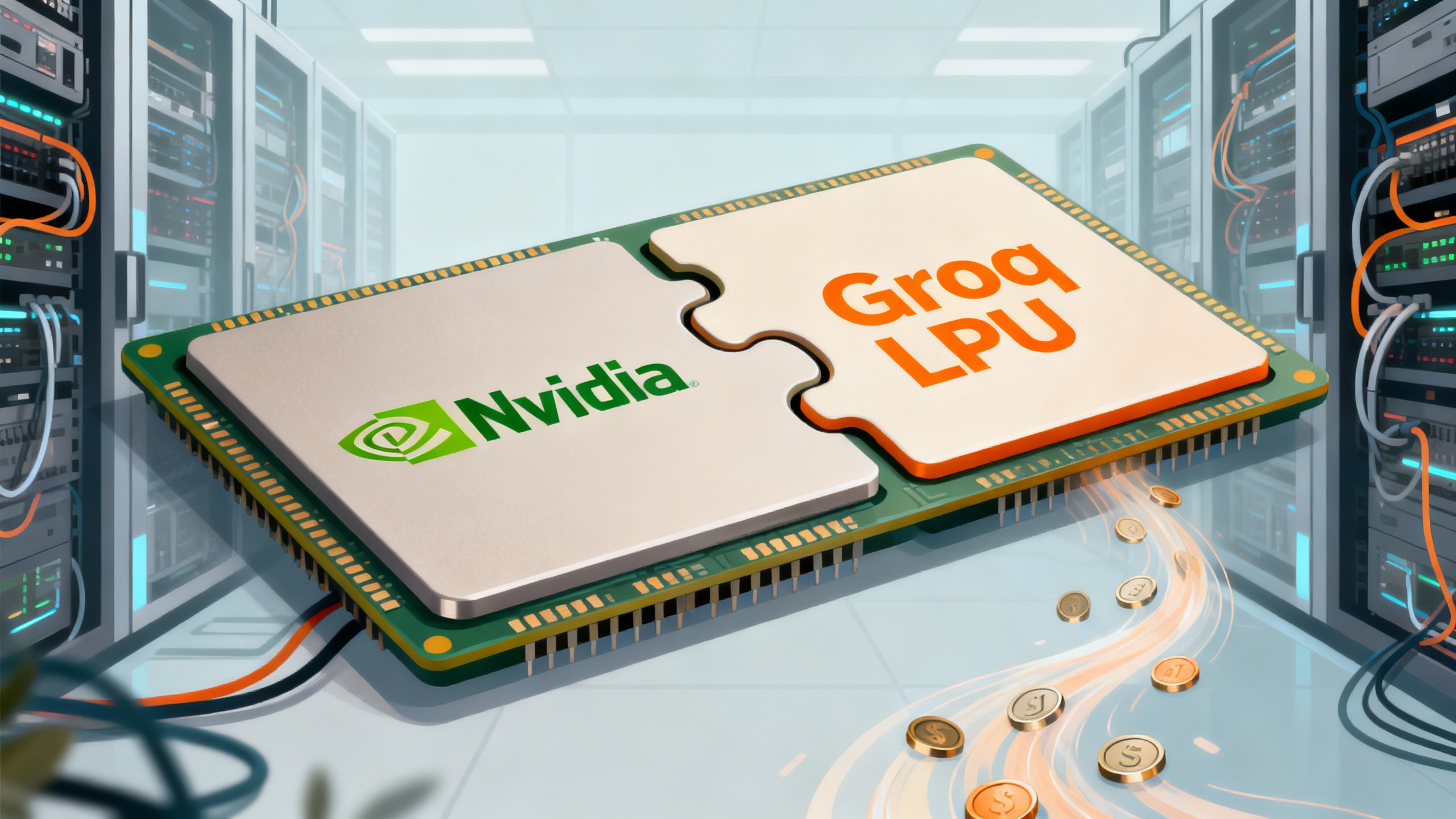
On December 24, 2025, Groq said it had entered a non‑exclusive licensing agreement granting Nvidia access to Groq’s inference technology. At the same time, Groq founder Jonathan Ross and president Sunny Madra agreed to join Nvidia with other team members. Groq emphasized it remains an independent company, named finance chief Simon Edwards as CEO, and said GroqCloud “will continue to operate without interruption.” Groq newsroom.
Major outlets initially framed the move as a $20 billion acquisition of Groq’s assets. Groq’s statement (and subsequent reporting) clarified that the structure is a license plus a senior talent transfer, not a corporate buyout. Reuters described it as part of a broader Big Tech pattern of “license‑and‑hire” deals, while also noting CNBC’s report that put a $20 billion figure on the transaction—an amount neither company has confirmed. Reuters, TechCrunch, MarketWatch.
Why Nvidia wants Groq’s tech right now
Nvidia dominates AI training with GPUs; the next battleground is real‑time inference, where latency and cost per request decide user experience and unit economics. Groq’s Language Processing Unit (LPU) architecture emphasizes deterministic, low‑latency execution with large on‑chip SRAM and static scheduling—an approach built for high‑throughput, predictable serving of language models. Groq LPU overview, Groq explainer.
In an internal note to staff reported by the Financial Times, Nvidia CEO Jensen Huang said the company plans to integrate Groq’s low‑latency processors into Nvidia’s “AI factory” architecture to broaden support for real‑time workloads—an explicit signal that this isn’t just about hiring talent; it’s about bringing Groq‑style inference into Nvidia’s data‑center blueprint. Financial Times.
Performance claims around Groq’s platform—such as significantly higher tokens‑per‑second on Llama‑2‑70B compared with common GPU deployments—have been showcased in public benchmarks and the company’s own materials, framing LPUs as a viable alternative for latency‑sensitive applications. Groq newsroom on benchmarking, Groq benchmark blog.
Why not a straight acquisition?
Two words: regulatory risk. Nvidia’s abandoned attempt to acquire Arm (terminated in February 2022 after global scrutiny) is a reminder that large chip deals face heavy antitrust headwinds. A licensing‑plus‑talent structure is less likely to trigger the same level of merger review—especially if the license is explicitly non‑exclusive and the target company continues operating. FTC statement on Nvidia–Arm termination.
The model isn’t new. In 2024, Microsoft paid roughly $650 million to Inflection AI for licensing while it hired the founders and much of the staff; the U.K. Competition and Markets Authority later deemed that arrangement a merger in substance but cleared it at Phase 1. Amazon used a similar license‑and‑hire path with Adept in 2024. Regulators on both sides of the Atlantic have been watching these structures closely. Reuters on Microsoft–Inflection, CMA case page, Reuters on Amazon–Adept.
What each side gets—and keeps
Deal snapshot
| Topic | Nvidia | Groq |
|---|---|---|
| Technology | Non‑exclusive license to Groq’s inference tech; intent to integrate into “AI factory” architecture. | Retains IP ownership and ability to license elsewhere (non‑exclusive). |
| Talent | Founder Jonathan Ross, president Sunny Madra, and other team members join Nvidia. | New CEO Simon Edwards; Groq continues operations and hiring independently. |
| Cloud services | Potential to influence real‑time inference roadmap across Nvidia platforms. | GroqCloud continues serving developers and customers without interruption. |
| Competitive position | Accelerates push into low‑latency inference; neutralizes a fast‑rising rival without full M&A. | Gains validation and potential distribution momentum while preserving corporate independence. |
Sources: Groq newsroom, Financial Times, Reuters.
How this could change AI infrastructure buying
- Real‑time AI at scale: If Nvidia successfully incorporates Groq‑style low‑latency serving into its systems, expect more “instant” agentic and speech applications where response time matters as much as model quality. Financial Times.
- Cost visibility: Deterministic execution can make capacity planning and SLOs more predictable, tightening the link between latency budgets and spend. Groq LPU overview.
- Multi‑silicon stacks: Non‑exclusive licensing leaves room for heterogeneity. Enterprises may mix GPUs (training, large‑context inference) and LPUs (real‑time, token streaming) depending on workload.
The bigger picture: “Acquisition by any other name”
Regulators increasingly treat large license‑and‑hire deals like mergers in substance, even when the target company remains technically independent. Reuters frames Nvidia–Groq as part of that new normal, alongside recent Microsoft and Amazon transactions. Whether authorities open formal reviews will likely depend on the precise contours of the license and any ongoing inter‑company dependencies. Reuters, CMA decision on Microsoft–Inflection.
For Nvidia, the approach reduces headline antitrust risk while accelerating its roadmap for real‑time inference—exactly where hyperscalers and startups are pushing the next wave of AI apps. For Groq, the deal monetizes its technical edge and elevates its architecture’s influence without giving up its cloud business.
Bottom line
As of December 26, 2025, Nvidia hasn’t bought Groq the company. It has bought time—and a head start—in the race to make AI feel instantaneous. The non‑exclusive license and talent transfer give Nvidia new tools for real‑time inference while preserving Groq’s independence and cloud service. It’s a structure that blurs the line between licensing and acquisition—and one we’re likely to see more often as AI infrastructure rapidly consolidates.
Sources
- Groq: Groq–Nvidia licensing announcement; LPU architecture; Benchmark explainer.
- Reporting/analysis: Reuters: Nvidia to license Groq tech, hire executives; Financial Times: Nvidia to integrate Groq processors into AI factory; TechCrunch: Nvidia to license Groq’s tech and hire its CEO; MarketWatch roundup.
- Context on license‑and‑hire structures: Reuters on Microsoft–Inflection; CMA decision (Microsoft/Inflection); Reuters on Amazon–Adept.
- Antitrust backdrop: FTC statement on termination of Nvidia–Arm.