

What happened
OpenAI said on December 3, 2025 that it has entered a definitive agreement to acquire Neptune (neptune.ai), a specialist in experiment tracking and training observability used for frontier-scale model development. OpenAI’s chief scientist Jakub Pachocki framed the deal as a way to “integrate [Neptune’s] tools deep into our training stack to expand our visibility into how models learn.” OpenAI announcement. Neptune’s CEO Piotr Niedźwiedź confirmed the agreement and noted the company will wind down external services in the coming months Neptune blog.
Key facts at a glance
| Item | Detail |
|---|---|
| Announcement date | December 3, 2025 |
| Buyer / Target | OpenAI / Neptune (neptune.ai) |
| What Neptune does | Experiment tracking and training observability for foundation/frontier models |
| Reported consideration | Undisclosed; reported to be a stock deal under $400M[^price] |
| Customers cited by Neptune | Samsung, Roche, HP |
| Sunset date for hosted service | March 5, 2026 (10:00 a.m. PST) |
Sources: OpenAI, Neptune, Neptune transition hub, Neptune customers, Reuters.
What OpenAI is buying: a training telemetry layer for frontier models
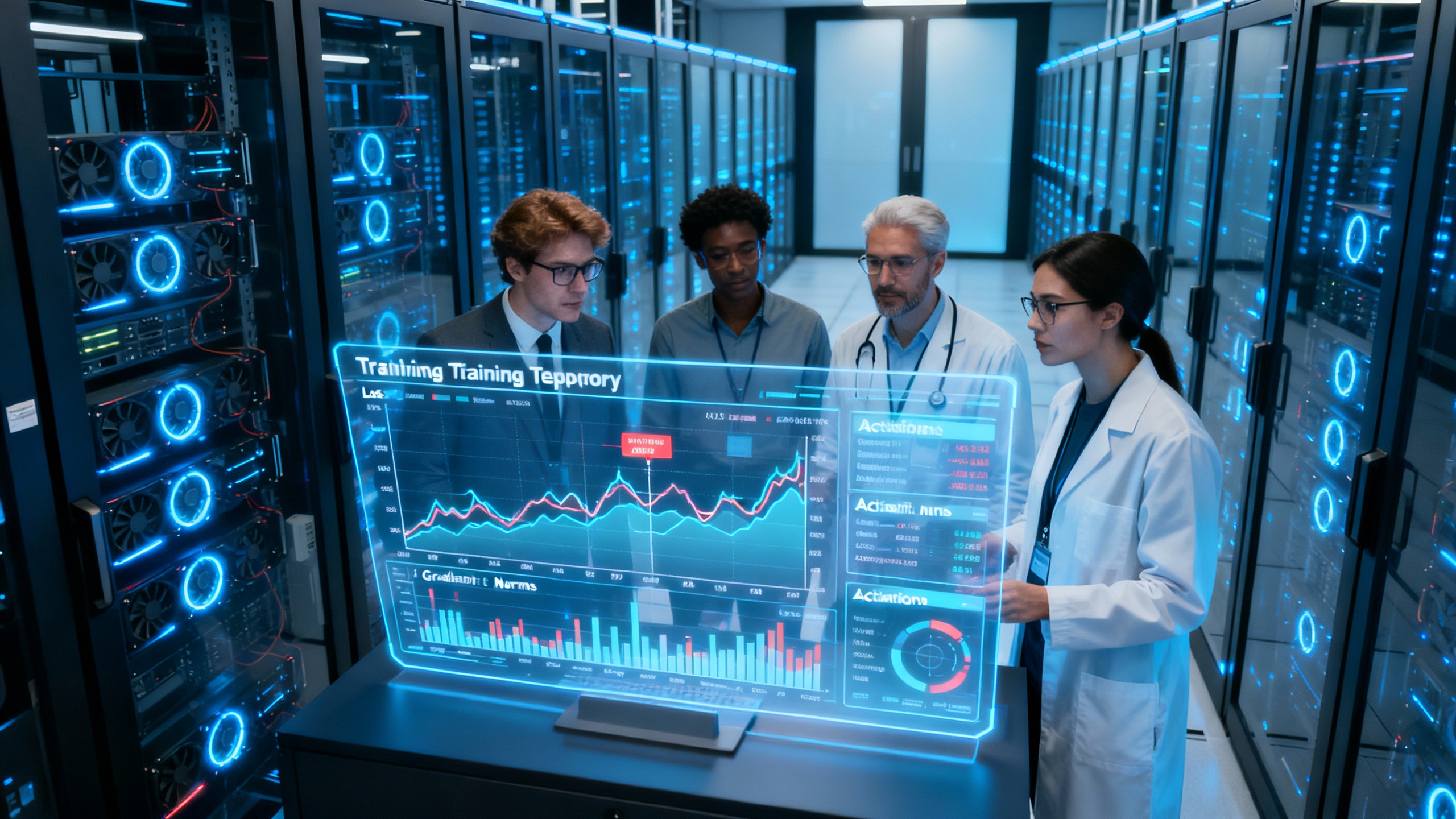
If you develop large models, you live and die by telemetry—the rich stream of metrics that tells you what’s happening inside your training runs. Neptune’s platform focuses on this “glass box” view: logging and visualizing thousands of per‑layer metrics (losses, gradients, activations) without downsampling, enabling researchers to compare runs, surface anomalies, and debug issues in real time. Neptune showcases live projects with 100M+ data points and emphasizes accuracy at interactive speeds Neptune product overview and docs.
For OpenAI, bringing this in‑house formalizes a collaboration that already existed. The company says Neptune has helped its researchers “compare thousands of runs, analyze metrics across layers, and surface issues,” and that deeper integration will speed iteration on frontier training OpenAI announcement.
Why this matters: speed, stability, and safety
When training spans thousands of GPUs, the cost of blind spots is measured in wasted compute and lost velocity. Neptune’s emphasis on high‑fidelity, per‑layer visibility is designed to:
- Detect subtle failures early (e.g., vanishing/exploding gradients or batch divergence) before they snowball into expensive restarts.
- Preserve signal quality by avoiding lossy downsampling so “needle” events aren’t smoothed into invisibility.
- Enable apples‑to‑apples comparisons across vast experiment trees, so teams converge faster on robust configurations.
Those capabilities map directly to OpenAI’s priorities: moving more quickly while keeping long‑running training stable and interpretable. Neptune markets exactly this outcome—“keep your model training stable while reducing wasted GPU cycles” Neptune product.
What changes for Neptune customers
Neptune will sunset its hosted (SaaS) service after a three‑month transition window that ends on March 5, 2026 at 10:00 a.m. Pacific. Self‑hosted customers are being contacted to plan bespoke timelines. Neptune says it will not transfer customer content or PII to OpenAI, and has published exporter tools and migration guides to Weights & Biases and MLflow Transition hub, W&B migration, MLflow migration.
The bigger picture: AI toolchains are consolidating
OpenAI has been steadily pulling critical telemetry and analytics closer to its core stack. In September, it agreed to acquire Statsig for about $1.1B to bring product experimentation and feature flagging under its umbrella—useful for closing the loop between what’s learned in research and what’s shipped in products CNBC. The Neptune deal extends that vertical integration back into the heart of training.
For the wider MLOps market, the signal is clear: the largest model builders are assembling full‑stack, proprietary pipelines—from data to training telemetry to product analytics. Neutral platforms remain vital, but customers should plan for a world where best‑of‑breed tools sometimes get absorbed by their biggest users.
What to watch next
- Closing conditions and integration milestones: OpenAI has not disclosed a timetable beyond the acquisition agreement OpenAI announcement.
- Customer migration pace and guidance updates: Neptune is maintaining a living transition page, including changelog updates (for example, the sunset date was updated to March 5, 2026) Transition hub.
- How OpenAI links training telemetry to safety and reliability work: deeper visibility into learning dynamics could support better guardrails, evals, and red‑team feedback loops at training time.
Sources
- OpenAI. “OpenAI to acquire Neptune” (Dec 3, 2025). https://openai.com/index/openai-to-acquire-neptune/
- Neptune. “We are joining OpenAI” (Dec 3, 2025). https://neptune.ai/blog/we-are-joining-openai
- Neptune docs. “Transition hub—Acquisition & Shutdown” (accessed Dec 5, 2025). https://docs.neptune.ai/transition_hub
- Neptune. Product overview and capabilities (accessed Dec 5, 2025). https://neptune.ai/
- Neptune. Customers page (accessed Dec 5, 2025). https://neptune.ai/customers
- Reuters. “OpenAI agrees to acquire AI startup Neptune…” (Dec 4, 2025). https://www.reuters.com/business/openai-agrees-acquire-ai-startup-neptune-boost-model-training-capabilities-2025-12-04/
- Reuters. “OpenAI hits $500 billion valuation after share sale…” (Oct 2, 2025). https://www.reuters.com/technology/openai-hits-500-billion-valuation-after-share-sale-source-says-2025-10-02/
- CNBC. “OpenAI acquires Statsig for $1.1 billion…” (Sep 2, 2025). https://www.cnbc.com/2025/09/02/openai-buys-statsig-for-1point1-billion-hires-ceo-as-applications-exec.html