

What happened, and why it matters now
Google CEO Sundar Pichai warned on November 30, 2025 that a fast‑growing “patchwork” of state AI rules could make it harder for U.S. companies to compete—and potentially hand an edge to China—unless Congress enacts coherent national standards. Speaking on Fox News Sunday, he cited more than “1,000” AI‑related state bills in play and urged a balance between innovation and guardrails, ideally set at the federal level and aligned internationally. Fox Business.
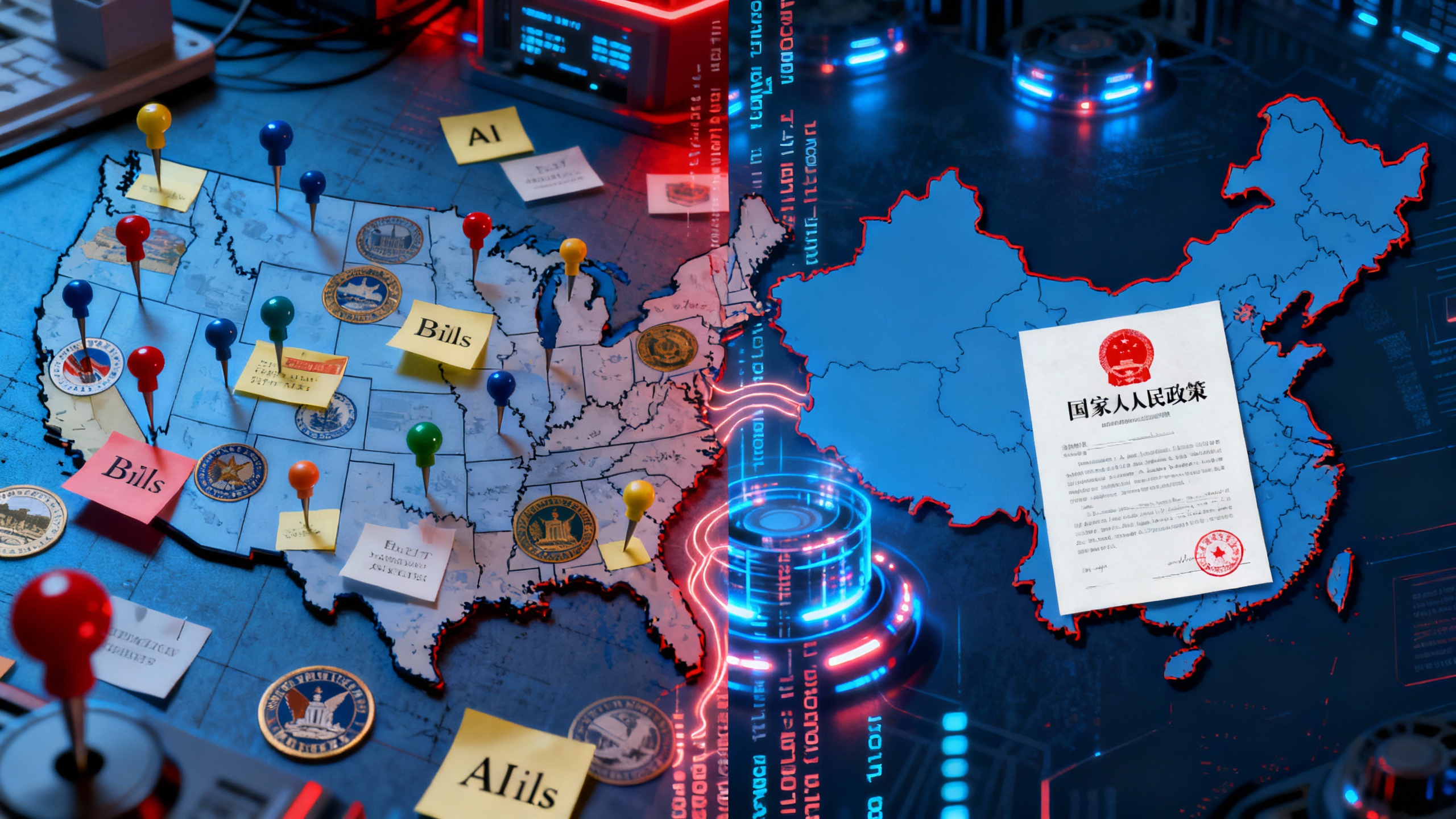
That plea lands amid a very real tug‑of‑war over who writes the rules. A bipartisan group of 35 state attorneys general plus Washington, D.C., just asked Congress not to block state AI laws, arguing that preemption without a federal framework would invite “disastrous consequences.” Reuters. Meanwhile, California has enacted the country’s most sweeping “frontier model” safety law to date, requiring disclosures and incident reporting for powerful systems, with staged obligations beginning in 2025–2026. AP News.
The U.S. patchwork problem—by the numbers
The surge in state activity is undeniable:
BSA’s analysis tallied nearly 700 state AI proposals in 2024 across 45 states, with more expected through 2025. BSA; BSA TechPost. Axios reported roughly 50 AI bills per week early in 2024. Axios.
To be clear, there’s merit on both sides. State leaders argue they’ve long filled federal voids on tech harms—from deepfakes to discrimination—while big‑tech CEOs argue that 50 divergent rulebooks raise compliance costs, slow deployment, and muddle global alignment.
Pichai’s argument in context: speed, safety, and strategy
Pichai’s core point is strategic: fragmented rules can slow U.S. model development, deployment, and go‑to‑market at the very moment global rivals are accelerating. That’s not just a Google view; Nvidia’s Jensen Huang has repeatedly warned that U.S. policies that limit scale or access can benefit competitors, with China “right behind” and advancing fast. CNBC; Reuters via Investing.com.
At the same time, Pichai emphasized guardrails and international coordination—citing tools like DeepMind’s SynthID to watermark AI content and support safer ecosystems. Google expanded SynthID to images, audio, video and even text, and launched a detector portal this year. Google DeepMind; Google Blog; The Verge.
What the rest of the world is doing
If Congress wants templates, two are front and center—Europe’s single rulebook and China’s centralized controls.
Europe: one regulation, phased in
The EU’s AI Act entered into force on August 1, 2024, with prohibitions and literacy duties applying from February 2, 2025, general‑purpose AI (GPAI) governance from August 2, 2025, and most other provisions by August 2, 2026 (with some high‑risk product categories by 2027). European Commission; DG Connect; CSET.
China: centralized, security‑first rules
China finalized nationwide measures for generative AI in 2023, building on “deep synthesis” rules and layering technical standards that emphasize safety, national security, and content controls. Library of Congress; DigiChina; CSET (standards translation).
How the rulebooks differ at a glance
| Jurisdiction | Core approach | Key dates/milestones | Developer duties (high level) |
|---|---|---|---|
| United States (current) | State‑led patchwork; federal guidance via NIST; preemption debate active | 2024–2026: rapid state activity; federal safety institute network launched 2024 | Varies by state (e.g., impact assessments, risk programs, disclosures); NIST AI RMF widely referenced |
| European Union | Single risk‑based regulation (AI Act) | In force Aug 1, 2024; prohibitions/AI literacy Feb 2, 2025; GPAI Aug 2, 2025; most rules Aug 2, 2026 | Risk management, documentation, transparency, conformity assessments; GPAI duties incl. documentation and content labeling |
| China | Centralized rules with security, content controls and standards | Generative AI measures effective Aug 15, 2023; ongoing standards work | Security reviews (for certain services), data/traceability norms, content controls, platform accountability |
Sources: DG Connect; European Commission news; LoC China; CSET.
Is a national U.S. playbook realistic?
There are signs of federal scaffolding. The U.S. AI Safety Institute at NIST stood up a 200‑plus‑member consortium, coordinates an International Network of AI Safety Institutes, and is developing shared testing, watermarking and risk assessment practices. NIST; NIST Fact Sheet.
Yet actual legislation has stalled. With states moving ahead and the Senate rejecting preemption 99–1 earlier this year, consensus looks most likely around: (1) narrow, nationally uniform guardrails for the riskiest model capabilities; (2) standardized transparency/testing for frontier models; and (3) interoperability with the EU and like‑minded partners.
Notably, industry isn’t monolithic. While several large companies favor federal preemption to avoid 50 different rule sets, others—like Anthropic—oppose sweeping state moratoria and instead back immediate federal transparency mandates for advanced models. Reuters.
What this means for builders and automation leaders
For operations, compliance, and product teams, the practical question is how to ship responsibly at speed when requirements vary by state and country. A few pragmatic moves:
- Build to the strictest common denominator. Use NIST’s AI Risk Management Framework (RMF) to organize controls and documentation, then “map down” to state specifics (Colorado, California) and “map across” to the EU AI Act. NIST AISIC.
- Treat pre‑deployment testing as table stakes. Align internal evals with government institute methods where possible; track incident reporting obligations that California and the EU will require. AP News; European Commission.
- Bake in provenance. Watermark generated media and adopt interoperable content credentials (e.g., C2PA) to simplify compliance and build trust. Google DeepMind SynthID; Google Blog.
- Expect enforcement to start with documentation. Two things regulators consistently ask first: your risk program and your impact assessments. Colorado’s statute is explicit on both. Colorado SB24‑205.
- Watch the politics, not just the policy. A federal preemption push could return; in the interim, state calendars, attorney‑general actions, and milestone dates in the EU AI Act will drive near‑term obligations. Reuters; European Commission news.
The bottom line
Pichai’s warning is less about politics and more about tempo. The U.S. currently has the talent, capital, and company base to lead—but the cost and uncertainty of 50 different AI regimes can slow product cycles just as Europe standardizes and China centralizes. A targeted federal framework—paired with strong institutes and international alignment—would let the U.S. keep moving fast without flying blind.
Sources
- Pichai interview and “patchwork” remarks: Fox Business (Nov 30, 2025).
- State AGs oppose federal preemption; Senate 99–1 vote reference: Reuters (Nov 25, 2025); preemption debate context The Verge.
- California frontier‑model law: AP News; supplementary coverage Reuters.
- Colorado SB24‑205 and updates: Colorado General Assembly – SB24‑205; SB25B‑004.
- State activity levels: BSA analysis and summary; BSA TechPost; Axios.
- EU AI Act timeline and obligations: European Commission news; DG Connect overview; CSET explainer.
- China measures and standards: Library of Congress; DigiChina draft translation; CSET standards translation.
- NIST AI Safety Institute and international network: NIST consortium; NIST International Network fact sheet.
- Industry viewpoints on U.S.–China competition: CNBC (Huang: China not behind); Reuters via Investing.com.
- Google watermarking tools: Google DeepMind SynthID; Google Blog – SynthID Detector; The Verge.