

The short version
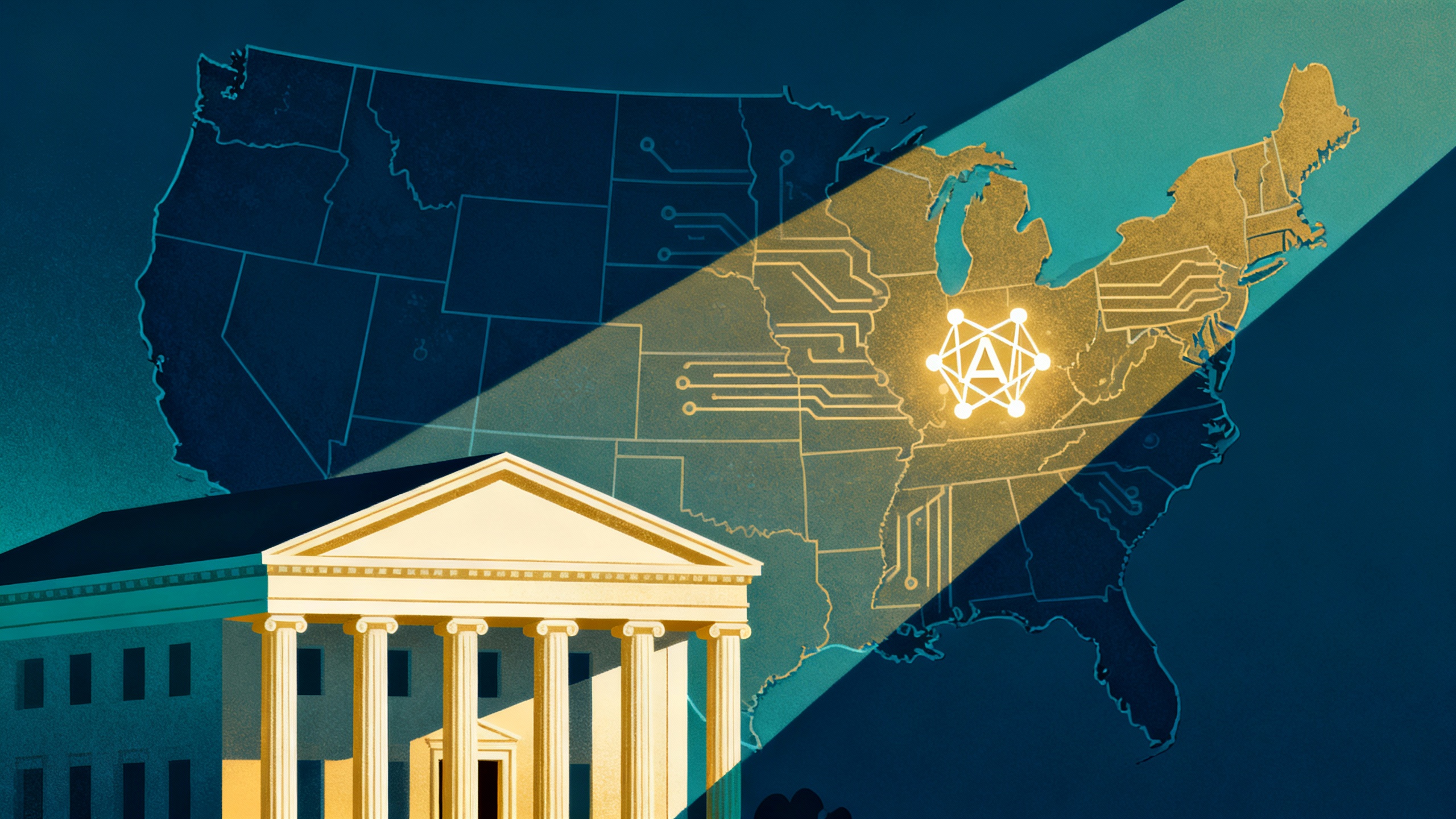
On December 11, 2025, the White House moved on two fronts at once: an executive order aimed at curbing state AI rules and a new OMB memo that effectively requires “political bias” evaluations for any large language model (LLM) sold to federal agencies. Together, they set up a federal–state showdown over who writes the rulebook for AI—and add fresh compliance obligations for vendors that want U.S. government contracts. Executive Order: Ensuring a National Policy Framework for AI. OMB M‑26‑04 memo. Reuters coverage.
What’s in the new executive order
The executive order, signed December 11, 2025, asserts a national policy to avoid a “patchwork” of 50 state AI regimes and directs a series of actions that could preempt or pressure state laws:
- Creates a Department of Justice AI Litigation Task Force (due within 30 days) to challenge state AI laws viewed as inconsistent with the order’s “minimally burdensome” policy. EO Sec. 3.
- Instructs the Commerce Department to publish, within 90 days, a catalog of state AI laws the administration deems onerous—flagging specific candidates for litigation. EO Sec. 4.
- Leverages federal funding: directs NTIA/Commerce to issue a policy notice that can make some BEAD broadband funds off‑limits to states with targeted AI laws, “to the maximum extent allowed by Federal law.” EO Sec. 5. Reuters summary: link.
- Signals two preemption tracks through independent agencies:
- FTC: a policy statement, within 90 days, on when state AI rules that force models to alter “truthful outputs” are preempted by the FTC Act’s ban on deceptive practices. EO Sec. 7. Background on FTC UDAP authority: CRS explainer, FTC policy statement on unfairness.
- FCC: within 90 days after Commerce’s state‑law catalog is published, begin a proceeding on a federal AI disclosure/reporting standard that could supersede conflicting state requirements. EO Sec. 6.
- Asks the White House tech team to draft legislation establishing a federal AI framework that expressly preempts conflicting state laws—with carve‑outs for child safety, data center infrastructure permitting, and state government use/procurement. EO Sec. 8(b).
Reporting from The Washington Post and Politico underscored how unusually aggressive this is for federal tech policy—and how controversial: major tech groups applauded the move, while critics on the left and right framed it as federal overreach that sidelines consumer protections. Washington Post. Politico. Industry reaction: U.S. Chamber, BSA | The Software Alliance. Civil liberties pushback: ACLU statement.
The companion policy: bias checks for federal AI vendors
Separate from the EO, OMB published Memorandum M‑26‑04 the same day, implementing July’s “Unbiased AI Principles” executive order for federal procurement. It tells agencies to buy only LLMs that meet two principles—truth‑seeking and ideological neutrality—and to build those requirements into solicitations and contracts. White House EO (July 23, 2025). OMB M‑26‑04. Reuters summary: link.
What vendors may be asked to provide, depending on use case:
- Model/system/data cards and acceptable‑use policies.
- Documentation of pre‑training and post‑training steps that affect factuality and neutrality; descriptions of system prompts and safety filters.
- Critically: results of bias evaluations—including tests that probe politically oriented prompt pairs—and the methodology behind them. (See Appendix A, “Model Evaluations.”)
- Enterprise controls (e.g., configurable system instructions), and any third‑party modifications like classifiers or content filters.
Key scope and timing details:
- Applies to LLMs procured by executive agencies; national security systems are excluded (though use is “encouraged” where practicable).
- Agencies should avoid demanding sensitive technical data like model weights, favoring documentation instead.
- Agencies must update procurement policies by March 11, 2026; OMB set a two‑year sunset unless extended. M‑26‑04. Earlier acquisition memo: M‑25‑22; federal use memo: M‑25‑21.
Why this is a big deal for state laws
- The order explicitly targets laws like the Colorado AI Act, which requires “reasonable care” to prevent algorithmic discrimination in high‑risk uses. That law was delayed to June 30, 2026, but remains the most comprehensive state AI regime on the books. Colorado AG explainer. Implementation delay summary.
- The White House says some state requirements could compel “false results” to avoid discriminatory impact—setting up a conflict the FTC policy statement is meant to police. EO text.
- Politically, the move splits Republicans: several GOP figures who favor states’ rights criticized the order, while national business groups cheered a single framework. Washington Post. U.S. Chamber. BSA.
Can an executive order really “preempt” state AI laws?
Short answer: not by itself. Preemption typically rides on statutes enacted by Congress or valid federal rules under clear statutory authority. The EO instead:
- Mobilizes DOJ to litigate state laws using constitutional and statutory arguments (e.g., Dormant Commerce Clause, conflicts with federal law/policy).
- Tries to steer independent agencies (FTC, FCC) toward positions that, if adopted and upheld in court, could crowd out inconsistent state rules.
- Uses conditional spending to pressure states, a tactic the Supreme Court has upheld in some contexts (South Dakota v. Dole) but limited when conditions become coercive (NFIB v. Sebelius). Expect lawsuits to test whether the BEAD‑funding linkage is sufficiently related and not coercive. Dole. CRS summary of NFIB v. Sebelius and spending limits.
Also relevant: courts have recently trimmed agency latitude (e.g., 2024’s Loper Bright ending Chevron deference), which could make any FTC/FCC preemption efforts harder to defend without explicit congressional mandates. Reuters analysis. Harvard Law blog primer. A 2025 net‑neutrality ruling that clipped the FCC’s wings is another cautionary data point. Reuters.
Practical timeline for builders and buyers
What happens when
| Date (on/after) | What to watch | Why it matters |
|---|---|---|
| January 10, 2026 | DOJ’s AI Litigation Task Force stood up | Signals which state laws will be targeted first. |
| March 11, 2026 | Commerce/NTIA issues BEAD funding policy | States may face funding limits tied to AI laws. |
| March 11, 2026 | FTC policy statement on state laws vs. “truthful outputs” | Sets the administration’s legal theory for preemption via UDAP. |
| By March 11, 2026 (publication due first) + 90 days | FCC opens proceeding on a federal AI reporting/disclosure standard | Could lay groundwork for a national disclosure baseline that conflicts with some state rules. |
| March 11, 2026 | Agencies must update procurement policy to embed Unbiased AI requirements (M‑26‑04) | New contract language shows up in RFIs/RFPs/GSA vehicles. |
| June 30, 2026 | Colorado AI Act takes effect (delayed) | High‑risk AI deployers and developers in CO face new duties. |
| December 11, 2027 | OMB M‑26‑04 sunset (unless extended) | Bias‑testing and neutrality obligations could evolve or lapse. |
Sources for dates: Executive Order. OMB M‑26‑04. Colorado AI Act delay.
What this means for AI, automation, and productivity
- For agencies: Expect procurement to lean harder into American‑made AI options with documented factuality and “ideological neutrality” controls, and more frequent use of model documentation and evaluation artifacts in source selection. M‑25‑22.
- For enterprise buyers: Federal terms have a way of cascading into commercial deals—especially where vendors standardize compliance. Bias‑evaluation packs and configurable governance features will likely become table stakes for regulated sectors.
- For statehouses: Expect swift legal challenges if you’re considering broad anti‑bias mandates or disclosures for foundation models. Laws narrower in scope (e.g., child safety, narrow sectoral uses) may face less headwind given the EO’s carve‑outs and politics.
- For vendors: If you sell across jurisdictions, design compliance that satisfies both the OMB “unbiased AI” documentation/vetting and leading state frameworks (Colorado, California deepfake/replica rules, etc.). That minimizes re‑work while litigation plays out. Overview of state activity: Brookings snapshot, June 2025.
The bottom line
Whatever your view of the politics, the near‑term reality is clear: if you want to sell LLMs to the federal government, you’ll need a defensible, documented process for measuring and mitigating political‑viewpoint bias—and you’ll need to package those results for contracting officers. Meanwhile, the White House is betting that litigation, agency policy, and funding levers can blunt the advance of state AI rules until Congress acts. That fight has just begun.
Sources
- White House Executive Order: Ensuring a National Policy Framework for Artificial Intelligence (Dec 11, 2025). Text
- OMB Memorandum M‑26‑04 (Dec 11, 2025): Increasing Public Trust in AI Through Unbiased AI Principles. PDF
- Executive Order (July 23, 2025): Preventing Woke AI in the Federal Government. Text | Fact sheet
- Reuters: U.S. to mandate AI vendors measure political bias for federal sales (Dec 11, 2025). Link
- Washington Post coverage (Dec 11, 2025). Link
- Politico coverage (Dec 11, 2025). Link
- U.S. Chamber of Commerce statement (Dec 11, 2025). Link
- BSA | The Software Alliance statement (Dec 11, 2025). Link
- ACLU statement (Dec 11, 2025). Link
- Colorado AI Act overview. Colorado AG | Implementation delay (Sept 2025): Baker Botts
- Legal context: FTC UDAP authority CRS; End of Chevron deference Reuters; Net neutrality ruling (Jan 2, 2025) Reuters