

The short version
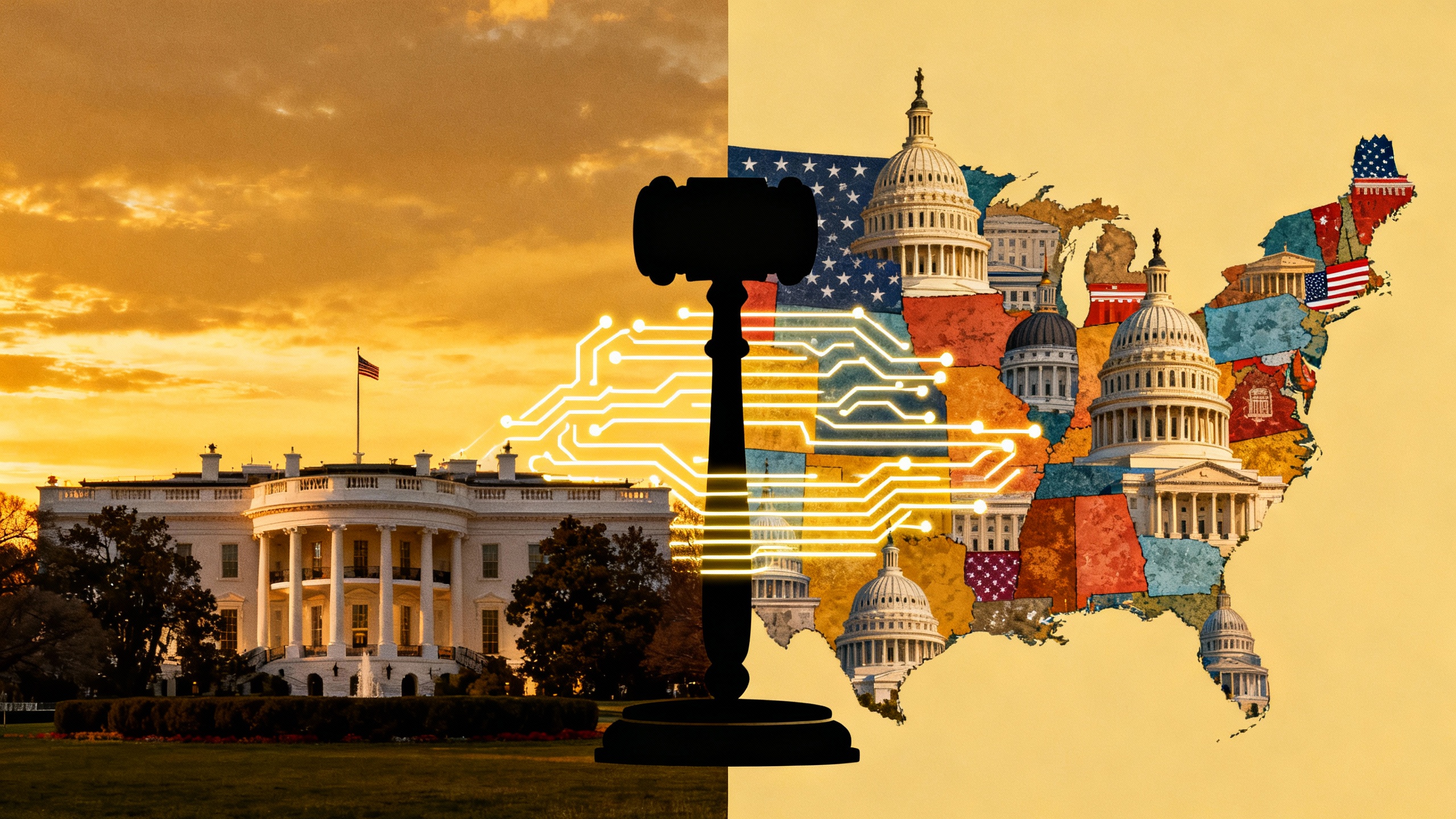
On December 11, 2025, President Trump signed an executive order designed to head off a “patchwork” of state artificial intelligence rules by directing federal agencies to challenge state AI laws, consider withholding some federal broadband dollars from states with “onerous” AI statutes, and draft preemptive federal legislation. The order immediately set off a political and legal fight with governors, attorneys general, lawmakers, and civil-society groups who say a president cannot preempt state law by executive order—and that states have a duty to protect residents now while Congress remains gridlocked. White House executive order; White House fact sheet; AP; Washington Post.
What the order actually does
- Creates a Department of Justice “AI Litigation Task Force” and instructs DOJ to sue states whose AI laws the administration deems unlawful or obstructive to national policy. Deadline: within 30 days of the order (by January 10, 2026). Executive order.
- Directs the Commerce Department to publish, within 90 days (by March 11, 2026), an evaluation identifying “onerous” state AI laws for potential challenge. Executive order.
- Ties portions of remaining BEAD broadband funds to state AI policy by instructing Commerce/NTIA to make states with “onerous” AI laws ineligible for certain non‑deployment dollars, to the extent permitted by law. Executive order; NTIA BEAD policy notices.
- Tells the FTC to issue a policy statement (within 90 days) asserting how the FTC Act’s ban on unfair or deceptive practices applies to AI models—and to explain when state laws that require altering a model’s “truthful outputs” may be preempted by federal law. White House fact sheet.
- Urges the FCC to consider a federal reporting/disclosure standard for AI models that would preempt conflicting state rules, kicking off a rulemaking after Commerce publishes its state‑law evaluation. Executive order; early analysis: Morrison Foerster.
- Calls for a federal AI bill that would preempt state laws that conflict with the order’s policy—but explicitly says preemption should not cover child‑safety protections, AI compute/data‑center infrastructure (beyond general permitting), or state government procurement/use of AI. Executive order.
The immediate backlash—and the likely court fight
- Governors and AGs across the spectrum signaled resistance. California Gov. Gavin Newsom criticized the move as an overreach that threatens the state’s newly enacted frontier‑model transparency law (SB 53). Florida Gov. Ron DeSantis said plainly that an executive order “can’t preempt” state AI rules. Guardian; Newsom’s SB 53 signing release; Politico.
- On Capitol Hill, Sen. Brian Schatz called the order “absurd and dangerous” and said he’ll introduce legislation to repeal it; Sen. Adam Schiff warned it replaces state safeguards “with nothing.” Schatz statement; Schiff statement.
- Civil-liberties and privacy groups (EFF, EPIC) argue the order tries to short‑circuit state experimentation without offering federal protections. EFF letter opposing preemption; EPIC commentary.
- Legal analysts across firms note that an executive order, by itself, cannot preempt state law; preemption typically requires an act of Congress or a valid federal regulation. Expect challenges centered on the Spending Clause (conditions on federal funds), the Dormant Commerce Clause, administrative law, and the limits of agency preemption. Ropes & Gray; Reuters.
A quick preemption 101
- Express preemption happens when Congress clearly says so in a statute. Conflict or obstacle preemption happens when complying with both state and federal law is impossible, or when state law stands as an obstacle to a federal objective. Executive orders can guide agencies, but they don’t themselves override state law. That’s why the order leans on: (1) agency litigation against states, (2) agency policy/rulemaking to claim federal standards, and (3) funding conditions via BEAD and other grants. How far those tactics can go will be tested in court. White House executive order; analysis: Akin Gump.
Which state AI laws are in the crosshairs
- Colorado’s Anti‑Discrimination in AI Law (SB24‑205) requires developers and deployers of “high‑risk” AI to use reasonable care to avoid algorithmic discrimination in consequential decisions. Colorado extended effective dates into 2026 during a 2025 special session—so companies still have time to prepare. Colorado AG explainer; effective‑date update SB25B‑004 (signed Aug 28, 2025) Colorado Legislature.
- California’s Transparency in Frontier AI Act (SB 53) mandates public safety disclosures for “frontier” model developers, establishes whistleblower protections, and seeds a public compute initiative (CalCompute). Governor’s press release.
- Utah’s AI Policy Act focuses on disclosure—especially for licensed professionals using GenAI with consumers—and has already been amended in 2025 to narrow some duties and extend sunset dates. Skadden summary; Davis Polk update.
- Tennessee’s ELVIS Act protects voice likeness and targets AI‑enabled impersonation—one of several “narrow‑use” state laws (e.g., deepfakes, election integrity) likely unaffected by the order’s carve‑outs for child safety and creator protections. Reuters; Gov. Lee’s site.
Key federal directives and dates
| Directive | Agency | What it does | Due date |
|---|---|---|---|
| Create AI Litigation Task Force | DOJ | Coordinate lawsuits challenging “onerous” state AI laws | Jan 10, 2026 |
| Identify state laws for challenge | Commerce | Publish evaluation of conflicting/onerous state AI laws | Mar 11, 2026 |
| Condition some BEAD funds | NTIA/Commerce | Make certain non‑deployment BEAD funds unavailable to states with identified “onerous” AI laws (to the extent permitted) | Mar 11, 2026 (policy notice) |
| Issue UDAP policy on AI model “truthful outputs” | FTC | Explain when state laws are preempted by the FTC Act | Mar 11, 2026 |
| Consider federal AI disclosure standard | FCC | Initiate rulemaking that could preempt conflicting state disclosure regimes | 90 days after Commerce publishes its evaluation |
The politics behind the order
The White House framed the action as necessary to keep U.S. AI competitive and to avoid 50 conflicting regimes. The move followed an intense internal GOP debate and lobbying by prominent tech investors and CEOs for a single national standard; it also prompted rare public pushback from Republicans wary of federal overreach and job loss. White House fact sheet; reporting: Washington Post; Politico.
What this means for builders, buyers, and compliance teams—now
Even if courts ultimately narrow the order, it will influence risk planning in 2026. Here’s a practical playbook to avoid whiplash:
- Keep your state‑law tracker live. If you operate nationally, continue preparing for Colorado SB24‑205’s updated effective timeline and California SB 53’s disclosure and incident‑reporting duties. Don’t pause compliance bets on the assumption the order will prevail. Colorado Legislature; California SB 53.
- Document “reasonable care” and testing for consequential decisions. Many state proposals converge on impact assessments, human‑in‑the‑loop controls, and bias testing. Those artifacts pay compliance dividends regardless of venue.
- Build an “explainability file.” Even if the FCC or FTC sets a national disclosure/reporting standard, expect to show how your model was tested, monitored, and governed. Treat it like a living spec you can tailor to state or federal templates.
- Refresh vendor and frontier‑model diligence. Ask suppliers of models or APIs for their safety documentation and incident‑reporting pathways—SB 53 makes those artifacts normal in procurement.
- Map funding exposure. If you rely on state broadband grants or related federal dollars, loop in your public‑sector team now to understand how a BEAD policy notice could change eligibility criteria in Q1 2026. NTIA BEAD notice.
TipGeneral counsel’s checklist for Q1–Q2 2026
- Track DOJ task‑force litigation targets and consider amicus strategy if your products are implicated.
- Monitor FTC’s policy statement on “truthful outputs” and the FCC’s docket for any preemption theory that would touch your disclosures.
- Keep an eye on Congress: bipartisan frustration could yield a narrow federal bill (child safety, creator rights, critical infrastructure) even if broader preemption stalls.
What to watch next
- Litigation: Expect multi‑state lawsuits challenging BEAD funding conditions and any agency preemption efforts (FTC/FCC). States will argue Spending Clause limits, lack of statutory authority, and procedural shortcuts. Early coverage: Reuters; analysis: Ropes & Gray.
- Commerce list of “onerous” laws: Watch for whether Colorado’s ADAI, California’s SB 53, and Utah’s disclosure rules appear—those are the most frequently cited examples. Colorado AG; California SB 53; Utah AI Act updates.
- Congress: Prior efforts to legislate a multi‑year state‑law moratorium failed after bipartisan pushback, but pieces may return in narrower form. Keep an eye on Senate Commerce and House Energy & Commerce. Politico; Akin Gump.
Sources
- White House: Executive Order — Ensuring a National Policy Framework for AI (Dec 11, 2025) and Fact Sheet
- Reporting: Associated Press; Washington Post; Reuters; Politico; Guardian
- State measures: Colorado AG on SB24‑205 (ADAI) overview and effective‑date update SB25B‑004; California SB 53 Governor’s release; Utah AI Act Skadden and Davis Polk update; Tennessee ELVIS Act Reuters
- Legal analysis: Ropes & Gray; Morrison Foerster; Akin Gump
- Context/data: NCSL AI database overview; Brookings state AI tracker summary; BSA statement on EO support; NTIA BEAD policy notice