

The short version
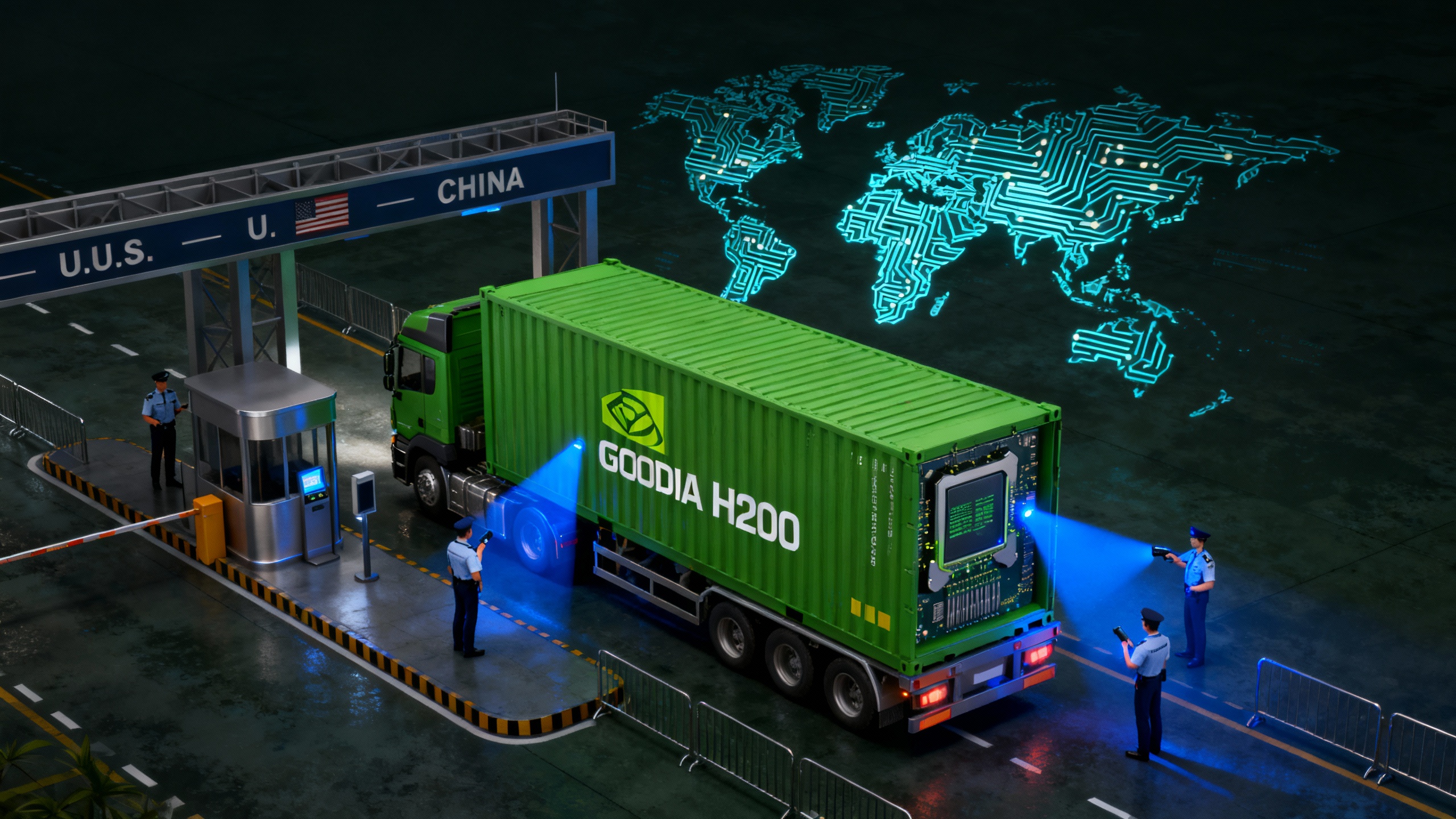
The U.S. Commerce Department has kicked off a formal, interagency review of Nvidia’s license applications to ship H200 AI accelerators to approved customers in China—an implementation step that could turn President Trump’s December 8 pledge (allowing such sales with a 25% surcharge to the U.S.) into reality. Agencies have 30 days to weigh in; the final call rests with the President. If approved, it would mark a pivot from blanket bans to tightly metered access—reshaping AI supply chains, compliance playbooks, and competitive dynamics on both sides of the Pacific. Reuters.
What changed this week—and why it matters
- Commerce has sent Nvidia’s H200 export-license applications to State, Energy, and Defense for review. Under the Export Administration Regulations, those agencies typically have 30 days to provide input; the President makes the ultimate decision. This is the first concrete step since Trump said the U.S. would allow H200 exports to “approved customers” in China and collect a 25% fee. Reuters; Reuters/Yahoo Finance; Washington Post.
- Reports suggest any approval could include guardrails—such as limiting shipments to older (roughly 18‑month‑old) H200 inventory, excluding Nvidia’s latest Blackwell-generation chips. TechCrunch.
Why it matters: The H200 is still a workhorse for training and serving large models. Nvidia’s own materials cite 141GB of HBM3e and 4.8 TB/s memory bandwidth—well above earlier H100 configurations—and performance that remains highly relevant for LLMs and HPC. Nvidia product page; Tom’s Hardware.
A real shift in U.S. export strategy
From 2022–2025, Washington repeatedly tightened AI chip controls—most notably the October 2023 rules that introduced “Total Processing Performance” thresholds (e.g., 4,800 TPP or 1,600 TPP with performance density ≥5.92), effectively sweeping in A100/H100‑class parts and successors. BIS summary (Oct. 2023); Alston & Bird analysis.
The Biden administration then added further restrictions in January 2025 (country tiers, quotas, and controls on advanced AI infrastructure)—a move industry decried as overbroad. Washington Post.
Today’s H200 review points to a different tack: rather than absolute denial, the U.S. is testing “regulated access” paired with a revenue-based surcharge. That fee—15% for earlier H20/MI308 exports and now 25% proposed for H200—has drawn legal scrutiny as potentially clashing with limits on export taxes. CNBC; Washington Post.
How Beijing may respond
Here’s the wild card: Will Chinese regulators allow H200s in at scale? After the U.S. green‑lit sales of Nvidia’s lower‑powered H20 to China in 2025 (with a 15% fee), Beijing urged state‑linked buyers to avoid the part—signaling a willingness to counter U.S. policy with its own restrictions. Reuters; CNBC.
Semafor reports China may permit limited H200 imports with approvals, but uncertainty remains—and the U.S. review itself emphasizes that approvals are not a foregone conclusion. Semafor; Reuters.
The H200, in context
- Specs that matter for builders: 141GB HBM3e, 4.8 TB/s bandwidth, NVLink up to 900 GB/s, and MIG support for multitenancy. Nvidia.
- Why it was restricted: H200 performance sits well above 2023 TPP thresholds, keeping it squarely in controlled territory until any license is granted. Alston & Bird.
- What’s still off-limits: The Blackwell generation (e.g., B200/GB200) remains excluded from any deal, according to multiple reports. Reuters/Yahoo Finance; Semafor.
Source: Reuters.
Workarounds already exist—policy is catching up
Even with bans, Chinese firms have tapped foreign clouds to access powerful Nvidia GPUs remotely, skirting “on‑shore ownership” restrictions. Recent investigations detail access via data centers in allied countries and public‑cloud tenders referencing A100/H100‑class services. Barron’s; CIO (summarizing a Reuters review).
If Washington moves from “deny” to “meter and monitor,” expect stricter end‑use certifications, audits, and carve‑outs for specific commercial workloads—paired with continued prohibitions on cutting‑edge parts.
What to watch next
- The 30‑day clock: Interagency feedback and any additional conditions (age‑banding of chips, volume caps, end‑user lists) will signal how far the shift goes. Reuters.
- Legalities of the surcharge: The 25% fee could face challenges; companies should plan for payment escrows or alternative compliance mechanisms. CNBC; Washington Post.
- Beijing’s gatekeeping: Will China green‑light purchases after previously discouraging H20 use? Expect selective approvals tied to data‑security reviews. Reuters.
- Supply allocation: If H200s flow to China, how will Nvidia balance demand versus Blackwell ramp—and will OEM partners face new allocation clauses? Nvidia Q1/Q2 FY26 releases.
Impact for builders and automation leaders
If H200 licenses are granted, Chinese cloud and AI providers will get a sanctioned path to capacity that’s good enough for most production‑grade LLM fine‑tuning and large‑scale inference. That could:
- Lower training queue times and inference latencies for Chinese users of enterprise and consumer AI services.
- Intensify global price competition for GPU time, especially in regions where Chinese firms expand via joint ventures or capacity leases.
- Nudge multi‑region architectures: U.S. and allied enterprises serving China‑adjacent markets may colocate workloads to comply with both regimes while minimizing latency.
TipYour 2026 GPU roadmap—practical moves to de‑risk
- Build multi‑SKU readiness: Optimize stacks for Hopper‑class (H100/H200) and non‑Nvidia accelerators to avoid single‑vendor risk.
- Harden export‑control ops: Tag all clusters, tenants, and datasets with country‑of‑use and end‑user attributes; log and attest to end‑use.
- Contract for compliance: Add clauses on resale bans, tamper‑evident telemetry, and audit rights; require partners to notify you of any regulator inquiries.
- Model pricing bands: Include scenarios with a 25% export fee and potential volume caps; ensure TCO remains positive for high‑throughput inference.
- Keep an eye on China’s own moves: Prior discouragement of H20 shows Beijing will use its own levers—even when Washington loosens.
Timeline: From blanket controls to a potential H200 opening
U.S.–China AI chip controls since 2022
| Date | Policy/action | What changed | Source |
|---|---|---|---|
| Oct 7, 2022 | Initial advanced computing and SME controls | Restricted A100/H100‑class exports to China | BIS |
| Oct 17, 2023 | Rule updates add TPP/performance‑density tests | Closed loopholes; expanded coverage of AI accelerators | Alston & Bird |
| Jan 13, 2025 | Broader AI export framework | Country tiers, quotas, and infrastructure guardrails | Washington Post |
| Apr 9, 2025 | License now required for H20 to China | Nvidia records multi‑billion charge; sales paused | Nvidia Q1 FY26 |
| Aug 10–12, 2025 | 15% revenue‑share deal (H20/AMD MI308) | Unusual fee‑for‑license arrangement announced | CNBC, CBS |
| Dec 8–9, 2025 | Trump says H200 sales will be allowed with 25% fee | Excludes Blackwell; details pending | Reuters/Yahoo Finance, Semafor |
| Dec 19, 2025 | Commerce launches interagency review | Licenses routed to State/Energy/Defense; 30‑day window | Reuters |
Bottom line
A green light for H200—bounded by age, volume, and end‑use conditions—would formalize what the market has been inching toward: regulated access rather than outright denial. For practitioners, the immediate homework is operational—compliance telemetry, contract language, and multi‑SKU readiness—so that when policy winds shift again (as they likely will), your AI roadmaps don’t.
Sources
- Reuters: U.S. launches review that could green‑light Nvidia H200 sales to China (Dec 19, 2025).
- Reuters/Yahoo Finance: Trump says U.S. will allow H200 exports with 25% fee (Dec 8, 2025).
- Washington Post: Trump says Nvidia can sell H200 to Chinese companies (Dec 9, 2025).
- TechCrunch: Commerce to allow H200 exports; potential age limits (Dec 8, 2025).
- BIS/Alston & Bird: Oct 2023 rule details and TPP thresholds.
- Washington Post: Jan 2025 AI export framework.
- Nvidia H200 specs.
- Reuters: China discouraged H20 use (Aug 2025).
- CNBC: 15% fee legal mechanics still being worked out (Aug 2025).
- Semafor: China may allow limited H200 imports (Dec 9, 2025).
- Barron’s: Cloud workaround highlights loopholes (Dec 2025).
- CIO: Reuters review of Chinese access via foreign clouds.