

The short version
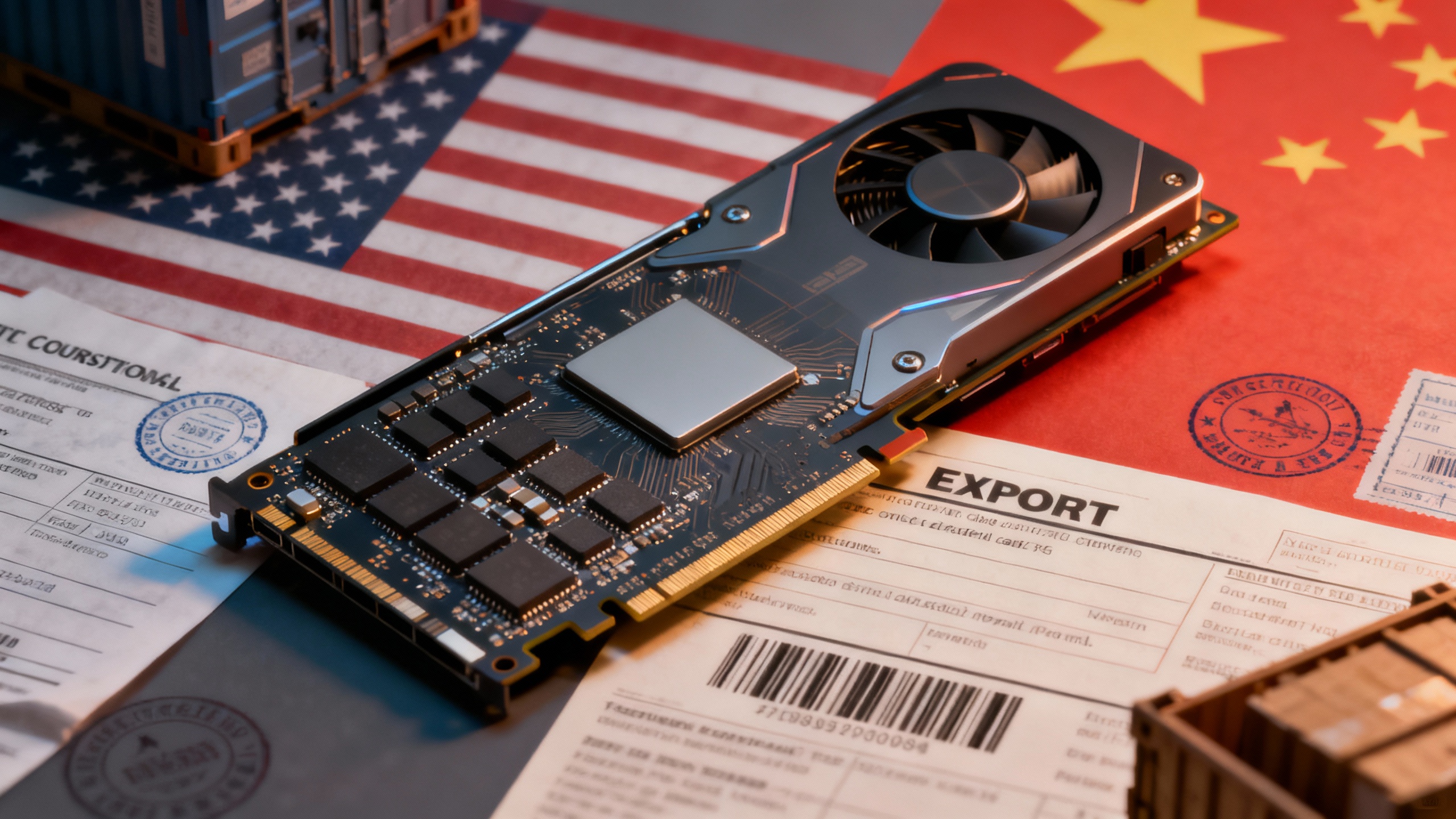
The U.S. Commerce Department is reviewing whether to let Nvidia sell its H200 AI accelerators to China—chips that are currently barred under U.S. export rules. No decision has been made, but the review follows a broader thaw in U.S.–China trade ties this fall and would mark a step beyond July’s partial reopening that allowed Nvidia’s China‑specific H20 to resume shipments under license. Reuters, Washington Post.
What’s new, exactly?
- On November 21, 2025, Reuters reported that Washington is weighing a policy change to allow Nvidia’s H200 sales to China, stressing plans could still change. The H200 is more capable than the H20 that was cleared for China in July—Reuters’ sources characterize H200 as roughly twice as powerful as H20—and is currently prohibited. Reuters.
- The review comes after an October Trump–Xi meeting in Busan produced a limited “trade-and-tech” truce, with both sides stepping back from some restrictions. In July, Washington reversed an April ban and began licensing sales of Nvidia’s H20 in China, a less‑capable variant built to comply with U.S. rules. Washington Post, CNBC.
Why H200 matters for AI and automation
H200 is a memory‑supercharged Hopper‑generation GPU: it’s the first accelerator with HBM3e, packing 141 GB and delivering 4.8 TB/s of memory bandwidth—precisely the kind of profile that speeds training and, especially, large‑model inference where memory, not just raw compute, is the bottleneck. Nvidia product page, Nvidia press release.
For builders, more H200s in any market generally translates into faster fine‑tuning cycles, cheaper inference, and higher service reliability—key ingredients for rolling out AI copilots, agent workflows, and data‑heavy automations at scale. If China‑based providers gain legal access to H200, expect shorter lead times on Chinese AI services and more competitive pricing in that region’s clouds.
The policy backdrop—how we got here
- 2022–2024 controls: The U.S. first restricted exports of Nvidia’s A100/H100 to China in 2022, then tightened rules in 2023 to close loopholes (which also captured cut‑down variants like A800/H800). U.S. Commerce/BIS, CSIS explainer, CNBC.
- April–July 2025 whiplash: In April, the U.S. required licenses for Nvidia’s H20, prompting a $5.5B charge. In July, the administration reversed course and began granting H20 licenses after a broader diplomatic framework emerged. CNBC, Washington Post.
- Unusual licensing economics: In August, officials confirmed an arrangement under which Nvidia and AMD remit 15% of China chip‑sale revenues (e.g., H20, AMD MI308) to the U.S. government as a license condition—controversial on Capitol Hill but emblematic of a more transactional export posture. Reuters.
- Beijing’s response: Chinese regulators later discouraged government‑related use of Nvidia’s H20 and probed the chip over alleged security risks—claims Nvidia denied. Reuters, CNBC.
All of this leaves H200—more capable than H20—squarely in the policy spotlight.
What a greenlight could look like (and what it would not)
If Commerce approves H200 sales, expect tight guardrails:
- License‑by‑license approvals with end‑user/end‑use vetting, volume caps, and reporting obligations, consistent with current practice on H20. Washington Post.
- Potential technical controls (e.g., disabled interconnect features, firmware policies) to blunt clustering at supercomputer scale—an issue raised by policy analysts as inference hardware grows more potent. IFP analysis.
- Movement toward post‑shipment verification: Congress is considering “Chip Security Act” bills to require location verification and diversion reporting for advanced AI chips, which would dovetail with stricter license terms. Congress.gov, Reuters.
What it would not be: a blanket reopening. The underlying 2022/2023 controls remain in force; any approval would likely be narrow, conditioned, and revocable.
How it could reshape AI, automation, and productivity
- Chinese cloud ecosystems: Legal access to H200 could cut wait times and costs for LLM training and fine‑tuning in China, accelerating releases of sector‑specific copilots (finance, manufacturing, logistics) and boosting automation adoption among state‑owned and private enterprises.
- Competitive pressure on domestic silicon: Huawei’s Ascend chips have improved rapidly—credible tests peg 910C around ~60% of H100 on certain inference tasks—but capacity constraints persist. H200 availability could slow, but not stop, domestic substitution. Tom’s Hardware, Financial Times.
- U.S. vendors’ global posture: Nvidia’s FY2025 filings show ~13% of revenue billed to China (including Hong Kong). Re‑opening a higher‑end product tier—even partially—could stabilize that mix while the company ramps next‑gen platforms elsewhere. Nvidia 10‑K, FY2025.
- Standards and tooling: Allowing H200 under license keeps Chinese developers closer to CUDA/TensorRT and mainstream open‑source stacks, reinforcing the “U.S. tech stack” as a default. That has long‑run implications for interoperability and developer productivity across borders.
What builders and buyers should do now
- Map compliance per region: Treat China, the Gulf, EU, and U.S. as distinct compliance zones with different license and reporting duties. Keep vendor purchase orders contingent on license issuance and delivery windows.
- Engineer for portability: Use containerized inference, framework abstraction (e.g., ONNX Runtime, vLLM), and parameter‑efficient fine‑tuning so models can move between H20/H200/H100/Ascend‑class hardware with minimal rework.
- Plan for multi‑sourcing: Even with approvals, China‑bound H200 supply will be constrained. Hedge with cloud credits, colocation partners, or domestic accelerators where performance/latency allows.
- Build an audit trail: If you export or operate across jurisdictions, maintain chip inventories, device telemetry, and workload logs to simplify license compliance and potential location‑verification requirements.
Chip snapshot
Nvidia data‑center GPUs relevant to China in late 2025
| Chip | Architecture | Memory (type/capacity) | Bandwidth | China status (Nov 2025) | Notes |
|---|---|---|---|---|---|
| H20 | Hopper‑derived (China variant) | HBM (var.), reduced interconnect | Lower vs H100 | Licensed (reopened July 2025) | Designed to comply with U.S. thresholds; later probed by Chinese regulators. CNBC |
| H100 | Hopper | Up to 80 GB HBM3 | ~3.35 TB/s | Prohibited | Flagship 2022–2023 cycle; blocked in China under 2022/2023 rules. BIS |
| H200 | Hopper (HBM3e) | 141 GB HBM3e | 4.8 TB/s | Under review | Reuters estimates ~2× H20 performance; drop‑in for H100 systems. Reuters, Nvidia |
The decision to watch
Commerce has not set a public deadline. Given the sensitivity, any approval will likely come with explicit license conditions and monitoring. Between now and a decision, watch for:
- License terms leaked or published that specify end‑user lists, per‑license volumes, or feature constraints.
- Beijing’s stance—especially whether it maintains pressure on state entities to avoid Nvidia chips, which would blunt any U.S. approval’s commercial impact. Reuters.
- Congressional reaction to any further easing, especially from the House Select Committee on the CCP and sponsors of the Chip Security Act. Press release.
However this lands, one thing is clear: policy is now a primary variable in AI capacity planning. If you build or buy AI at scale, wire your roadmaps to regulatory reality as tightly as you do to model benchmarks.
Sources
- Reuters, “US mulls letting Nvidia sell H200 chips to China” (Nov 21, 2025): https://www.reuters.com/world/asia-pacific/us-considering-letting-nvidia-sell-h200-chips-china-sources-say-2025-11-21/
- The Washington Post, “Trump administration lifts ban on AI chip sales to China” (Jul 15, 2025): https://www.washingtonpost.com/world/2025/07/15/nvidia-ai-chip-sales-china/
- CNBC, “Nvidia will record $5.5B charge tied to H20 export licenses” (Apr 15, 2025): https://www.cnbc.com/2025/04/15/nvidia-says-it-will-record-5point5-billion-quarterly-charge-tied-to-h20-processors-exported-to-china.html
- U.S. Commerce/BIS press release on Oct 7, 2022 controls: https://www.bis.gov/press-release/commerce-implements-new-export-controls-advanced-computing-semiconductor-manufacturing-items-peoples
- CSIS explainer on updated 2023 rules: https://www.csis.org/analysis/updated-october-7-semiconductor-export-controls
- Nvidia H200 product page and press release: https://www.nvidia.com/en-us/data-center/h200/ and https://investor.nvidia.com/news/press-release-details/2023/NVIDIA-Supercharges-Hopper-the-Worlds-Leading-AI-Computing-Platform/default.aspx
- Reuters, “Nvidia, AMD to pay 15% of China chip-sale revenues to U.S.” (Aug 12, 2025): https://www.reuters.com/world/china/nvidia-amd-pay-15-china-chip-sale-revenues-us-official-says-2025-08-10/
- Congress.gov, H.R.3447 (Chip Security Act) text (May 15, 2025): https://www.congress.gov/bill/119th-congress/house-bill/3447/text
- Reuters, “U.S. senator proposes location‑tracking on AI chips” (May 9, 2025): https://www.reuters.com/world/us/us-senator-introduces-bill-calling-location-tracking-ai-chips-limit-china-access-2025-05-09/
- Reuters, “China urges firms to avoid Nvidia H20” (Aug 12, 2025) and CNBC follow‑up on CAC probe (Jul 31, 2025): https://www.reuters.com/world/china/china-urges-local-firms-not-use-nvidias-h20-chips-bloomberg-news-reports-2025-08-12/ and https://www.cnbc.com/2025/07/31/china-probes-nvidia-h20-chips-for-tracking-risks.html
- Nvidia Form 10‑K (FY2025), geographic revenue: https://www.sec.gov/Archives/edgar/data/1045810/000104581025000023/nvda-20250126.htm