

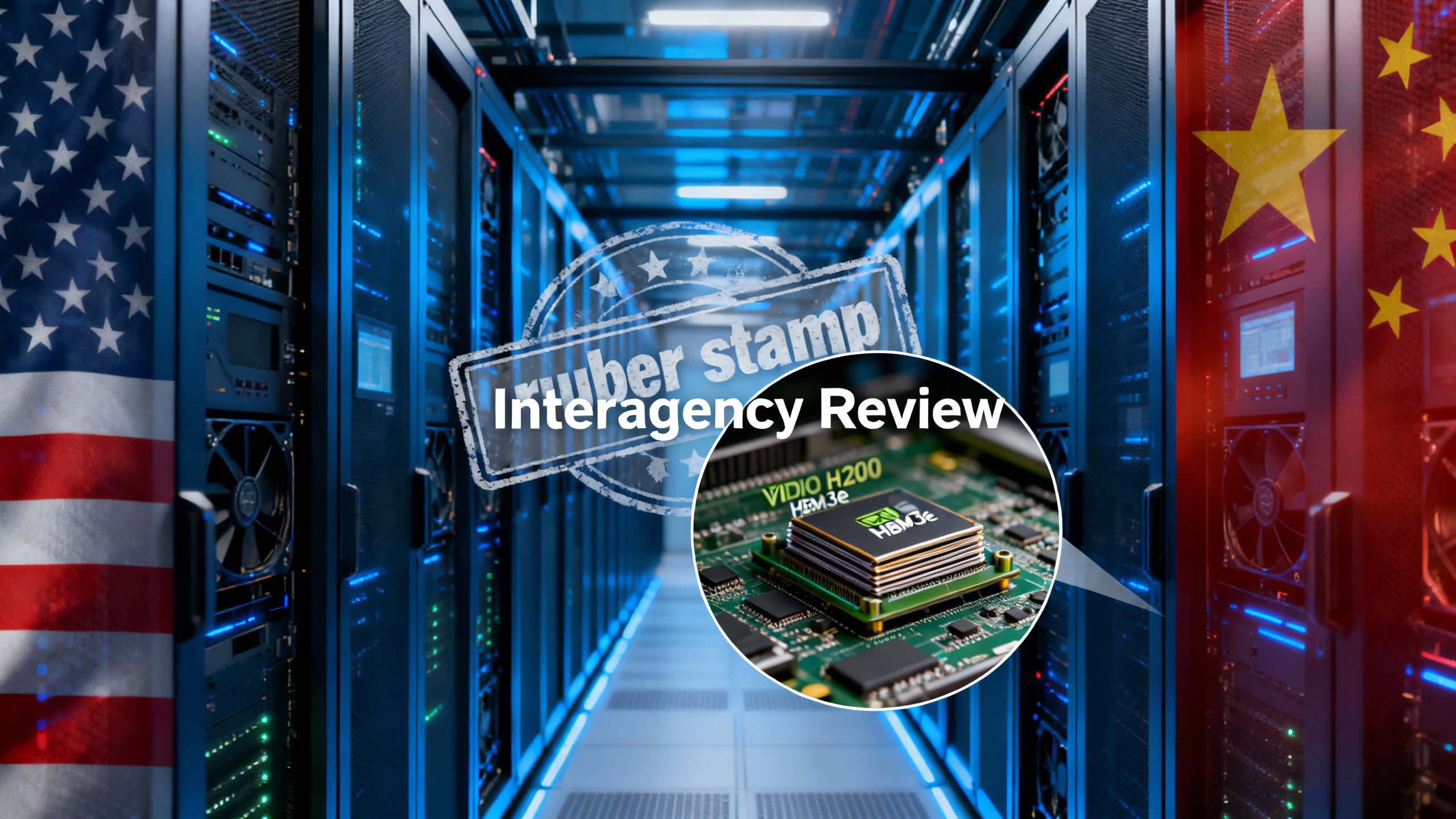
On December 19, 2025, Washington formally kicked off an interagency review that could clear the way for Nvidia’s H200 AI accelerators to ship to approved buyers in China—potentially reshaping the global compute map for AI builders and automation programs in 2026.
What changed—and why it matters now
The U.S. Commerce Department has forwarded Nvidia’s export license applications for H200 chips into a 30‑day interagency review with State, Defense, and Energy—an initial step toward issuing licenses that would allow sales to vetted commercial customers in China. The move follows President Donald Trump’s December 8 announcement that the U.S. would permit such exports while collecting a 25% fee on the sales. Blackwell‑generation chips remain excluded. Reuters, Barron’s, Reuters via Yahoo Finance, The Guardian
Why this matters for automation leaders: access to high‑bandwidth compute determines how fast enterprises can train and scale foundation models, stand up agents, and automate knowledge workflows. If these licenses are granted, Chinese hyperscalers and startups could add materially more GPU capacity in 2026, accelerating deployment of AI‑driven automation across finance, commerce, logistics, and manufacturing.
A quick primer on the H200
Nvidia’s H200 is a Hopper‑architecture GPU that upgrades H100 with 141 GB of HBM3e memory and 4.8 TB/s bandwidth—features that boost training throughput and slash inference latency for large models. It sits below Nvidia’s latest Blackwell line but well above the China‑tuned H20. Nvidia product page, Nvidia technical blog
What’s actually under review
- Scope: license applications to sell H200s to approved commercial customers in China (not military end users), with an interagency review window of roughly 30 days. Reuters
- Financial term: the White House has said the U.S. will take a 25% cut of H200 sales permitted under this framework—an unusual mechanism that’s already drawing scrutiny. Reuters via Yahoo Finance, Ars Technica
- Performance boundary: Nvidia’s latest Blackwell parts are still off‑limits for China under current policy. Reuters via Yahoo Finance, The Guardian
What changes—and what doesn’t
| Item | Status for China (as of Dec 19, 2025) | Notes |
|---|---|---|
| H200 (Hopper, HBM3e) | Under interagency review; potential licensed exports with 25% U.S. fee | Commerce-led review launched; licenses would be for vetted commercial customers. Reuters |
| Blackwell (e.g., B200) | Restricted (not part of approval) | White House statements and coverage indicate Blackwell remains excluded. Reuters via Yahoo Finance |
| H20 (China‑tuned Hopper) | On‑off licensing in 2025; later faced Chinese scrutiny | U.S. licensing path reopened mid‑year, then China tightened checks; production reportedly adjusted. CNBC, CNBC |
The market signal: demand, supply, and lead times
- Demand: Following the policy shift, Chinese tech platforms reportedly indicated strong interest in H200 systems—enough for Nvidia to weigh boosting output. Reuters
- Supply: H200s are built on TSMC’s advanced nodes, and capacity is shared with newer lines; any expansion may balance against global orders for Blackwell and forthcoming platforms. Reuters, Nvidia HGX specs
- Timing: even with fast approvals, shipping windows, datacenter integration, and software tuning (CUDA, Triton, TensorRT‑LLM, and NIM microservices) imply that meaningful capacity additions would likely land across mid‑to‑late 2026.
The policy fight, in plain English
- Pro‑export case: Allowing legacy‑plus (H200) instead of frontier (Blackwell) chips to China, while taxing sales, preserves U.S. vendor dominance and channels revenue—and visibility—through a regulated framework. Barron’s
- National‑security case against: Critics argue the H200 is still powerful enough to materially boost China’s aggregate compute, eroding the U.S. lead the 2022–2024 controls aimed to protect. Analysts and former officials have blasted the 25% “cut” as policy incoherence. Council on Foreign Relations, Ars Technica
- Hill reaction: Lawmakers in both parties have pressed Commerce for details or urged a reversal, citing military‑civil fusion risks and potential leakage to sanctioned entities. Reuters, U.S. Senate Banking Committee press release
How Beijing may respond
China is signaling it could restrict H200 uptake—requiring buyers to justify that domestic accelerators can’t meet requirements—tempering any upside for U.S. vendors while reinforcing self‑reliance goals. Customs scrutiny of Nvidia shipments has already tightened this year. Reuters via Yahoo Finance (FT report), Reuters
The automation and productivity angle
- Faster training cycles: H200’s larger memory and bandwidth can reduce parallelism overhead, speeding up training and fine‑tuning of domain models that power copilots, enterprise search, and agentic workflows. Nvidia technical blog
- Lower unit cost of inference: Capacity additions—if realized—can ease GPU scarcity, lowering queue times and per‑token costs for generative services used in RPA, contact centers, and analytics.
- Competitive pressure: If Chinese firms expand compute significantly, expect faster iteration on open and proprietary models, intensifying competition for global automation contracts and raising the bar for MLOps quality, privacy, and compliance.
TipWhat builders and IT leaders should do now
- Treat the H200 review as a scenario input, not a certainty: model China‑facing capacity plans with and without additional H200 supply in 2026.
- De‑risk with multi‑region training: design pipelines that can shift training between regions and clouds without rebuilding data loaders or orchestration.
- Optimize for memory bandwidth: prioritize kernels and model sharding strategies that exploit HBM3e; validate gains on H100/H200 interchangeably where possible.
- Track license conditions closely: end‑use/end‑user screening, resale restrictions, and service‑provider obligations may affect how clusters are hosted and shared.
Bottom line
Today’s review is just that—a review—but it marks a meaningful policy pivot. If licenses are granted and Beijing allows purchases at scale, China could add substantial non‑frontier compute in 2026, accelerating AI‑driven automation across industries. If not, the status quo of constrained supply and workarounds (overseas training, model distillation, heavier inference on domestic chips) is likely to continue. Either way, the H200 has become the fulcrum for how the world allocates high‑value compute in the near term.
Sources
- Reuters: U.S. opens interagency review on Nvidia H200 exports (Dec 19, 2025). Link
- Barron’s: “Nvidia Stock Rises. The Road to Sales in China Opens Up.” (Dec 19, 2025). Link
- Reuters via Yahoo Finance: Trump says U.S. will allow H200 shipments with 25% fee (Dec 8, 2025). Link
- The Guardian: Trump clears way for Nvidia to sell H200 to China (Dec 8, 2025). Link
- Nvidia: H200 product specs and HGX platform pages. Link, Link
- Nvidia technical blog: H200 memory/bandwidth and MLPerf results. Link
- Reuters: Nvidia weighs increasing H200 output on China demand (Dec 12, 2025). Link
- Reuters via Yahoo Finance: FT reports Beijing to limit access to H200 (Dec 9, 2025). Link
- Ars Technica: Experts question the 25% U.S. cut structure (Dec 2025). Link
- U.S. Senate Banking Committee: Warren letter urging denial of H200 sales (Dec 3, 2025). Link
- CNBC: H20 licensing whiplash and Chinese scrutiny (July 2025). Link, Link