

What’s new, and why it matters now
The U.S. is weighing whether to let Nvidia sell its H200 data‑center GPUs to China—an upgrade over the H20 parts currently licensed for that market. According to Reuters, the Commerce Department is reviewing a change to its export‑control posture; no final decision has been made, but the move comes amid a recent U.S.–China thaw. The White House declined to comment on specifics.
If approved, H200 access would mark a meaningful shift: earlier this month the White House reiterated it is not planning to allow Nvidia’s most advanced Blackwell‑generation chips to ship to China “at this time,” even as allies in the Gulf won approvals for large Blackwell orders. In other words, H200 could become the high‑water mark of what’s permitted in China for now.
H200, in plain English
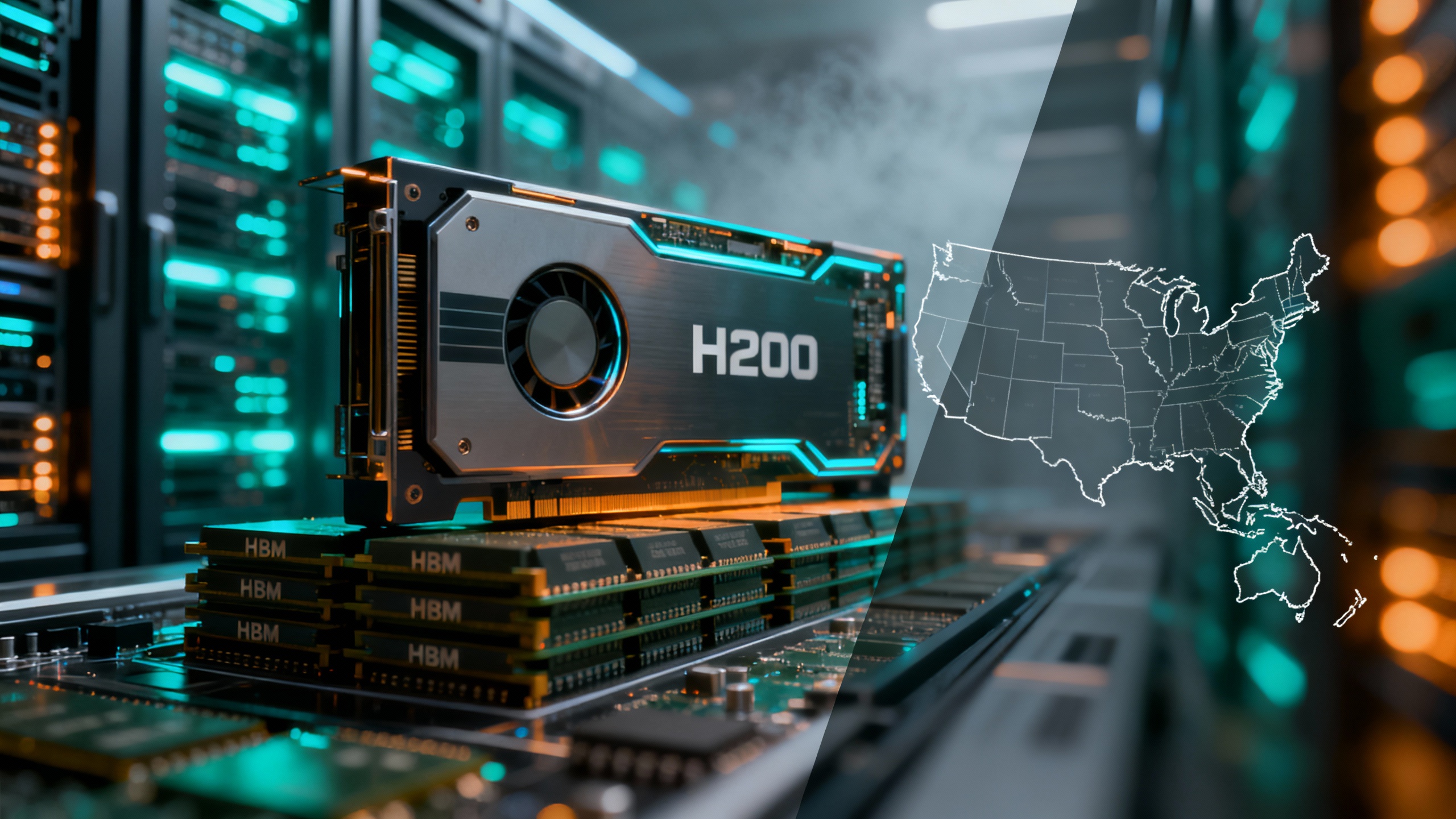
Nvidia’s H200 is a Hopper‑architecture accelerator with first‑generation HBM3e memory. It pairs 141 GB of on‑package HBM3e with up to 4.8 TB/s of memory bandwidth—useful for training and serving large language models and other memory‑bound AI workloads. Compared with the prior H100, H200 primarily lifts memory capacity and bandwidth while retaining similar compute engines.
By contrast, Nvidia’s H20 is a China‑specific, de‑tuned Hopper part engineered to fit within U.S. export rules (reduced interconnect and bandwidth). H20 shipments to China were paused in April 2025 pending licenses, then moved toward resumption over the summer under a new licensing regime.
How we got here: controls, carve‑outs, and a fragile truce
- April–June 2025: Washington tightened licenses on China‑bound accelerators (notably Nvidia H20 and AMD MI308), prompting big write‑downs and forecast changes at the chipmakers. Nvidia disclosed a $5.5 billion charge tied to H20 and said China‑related uncertainty would weigh on results.
- July–August 2025: The U.S. began allowing licensed H20 and MI308 shipments again, paired with an unusual revenue‑sharing condition: 15% of China sales remitted to the U.S. government—a policy that drew bipartisan scrutiny.
- October–November 2025: A Busan meeting between President Trump and President Xi delivered a limited trade/tech truce. Separately, Commerce authorized exports of up to 35,000 Nvidia Blackwell chips each to the UAE’s G42 and Saudi Arabia’s Humain—underscoring that “no‑China” does not mean “no‑exports.”
Against that backdrop, Commerce is now reviewing whether H200—one generation behind Blackwell—should be licensed into China. The administration has signaled Blackwell remains off‑limits to China for now.
Demand in China is real—and diversified
Chinese hyperscalers and AI teams had already placed billions of dollars’ worth of orders for H20 earlier this year, amid a boom in model development and deployment (from Big Tech through startups like DeepSeek). Server makers warned of H20 shortages as the licensing stop‑start created planning whiplash.
At the same time, Huawei’s Ascend 910C has improved yields and is filling gaps, especially for inference, though most analyses still place it behind Nvidia’s top Hopper parts in raw performance and software ecosystem maturity. If H200 is approved, Chinese buyers would gain a materially more capable, CUDA‑native option than H20—tempering the shift to fully domestic stacks.
What H200 access could change—for automation and AI roadmaps
- Faster model cycles and lower serving latency: More memory bandwidth directly improves throughput on large context windows and retrieval‑heavy pipelines—key to production copilots, code agents, and industrial vision systems.
- Less fragmentation in tooling: Keeping Chinese workloads on Hopper‑class CUDA hardware narrows the ecosystem gap between Chinese deployments and the rest of the world, easing portability of models, ops runbooks, and MLOps tooling. (That’s been Nvidia’s longstanding argument for controlled access.)
- Supply chain lift—and more predictable capacity planning: If H200 licensing opens, OEMs that straddle markets (Inspur, Lenovo, H3C, xFusion) can plan SKUs with fewer China‑only exceptions, improving rack utilization, repair logistics, and lead‑time predictability.
The open questions (and risks)
- License terms and guardrails: Would H200 follow the H20/MI308 template (case‑by‑case licenses, KYC, reporting—and the 15% revenue share)? Several lawmakers criticized that revenue‑sharing mechanism as an extra‑statutory “export tax,” so expect legal scrutiny if it’s extended.
- Tracking and diversion: A bill introduced in May would mandate location‑verification on export‑controlled AI chips. Beijing, meanwhile, has signaled concerns about “backdoor” controls, summoning Nvidia over H20 security questions this summer. Any H200 approval will arrive with heightened telemetry and compliance expectations on both sides.
- Policy durability: The administration has already reversed course once this year (pausing, then relaunching H20/MI308 licenses) and rescinded the Biden‑era “AI diffusion” framework. Companies should treat any H200 permission as revocable and architect ops accordingly.
Where major AI chips stand today (China)
Snapshot as of November 23, 2025
| Chip | Generation | China status | Notes |
|---|---|---|---|
| Nvidia H20 | Hopper (China variant) | Licensed exports resumed mid‑2025 | Pause in April led to large write‑downs; shipments moving under licenses and new terms. |
| Nvidia H200 | Hopper (HBM3e) | Under U.S. review | Commerce considering policy change; decision pending. |
| Nvidia Blackwell (GB200/B300 family) | Next‑gen | Not allowed to China | White House says no Blackwell sales to China “at this time.” |
| AMD MI308 | CDNA (China variant) | Licensed exports resuming | Licenses re‑opened in July; revenue‑sharing condition reported. |
The bottom line
H200 access would give Chinese cloud and enterprise buyers a much more capable—yet still non‑Blackwell—Nvidia option. For U.S. policymakers, it’s a compromise: keep Chinese AI workloads tied to the American software stack, while still walling off the very top end. For builders, the practical takeaway is to design for policy volatility: model capacity on multiple accelerator mixes; automate compliance; and keep your infrastructure portable across CUDA and non‑CUDA targets. The review is ongoing; plan for both outcomes.
Sources
- Reuters: U.S. considers letting Nvidia sell H200 chips to China (Nov 21, 2025).
- Reuters/Yahoo: White House says Blackwell not for China “at this time” (Nov 4, 2025).
- CNBC/Reuters: H20 licenses paused in April; Nvidia booked $5.5B charge; later moved to resume H20 sales under licenses (Apr–Jul 2025).
- AP/Reuters: 15% revenue‑share arrangement tied to China chip licenses drew bipartisan criticism (Aug 2025).
- U.S. Dept. of Commerce + Reuters: up to 35,000 Blackwell chips each approved for UAE’s G42 and Saudi’s Humain (Nov 19–20, 2025).
- Nvidia: Official H200 specs and positioning.
- Reuters: Chinese demand and orders for H20; OEM warnings about shortages (Mar–Apr 2025).
- Washington Post: China summoned Nvidia over H20 “backdoor” concerns (Jul 31, 2025).
- CNBC: Nvidia CEO’s critique of export controls and China market context (May 28, 2025).