

What happened in San Francisco—and why it matters
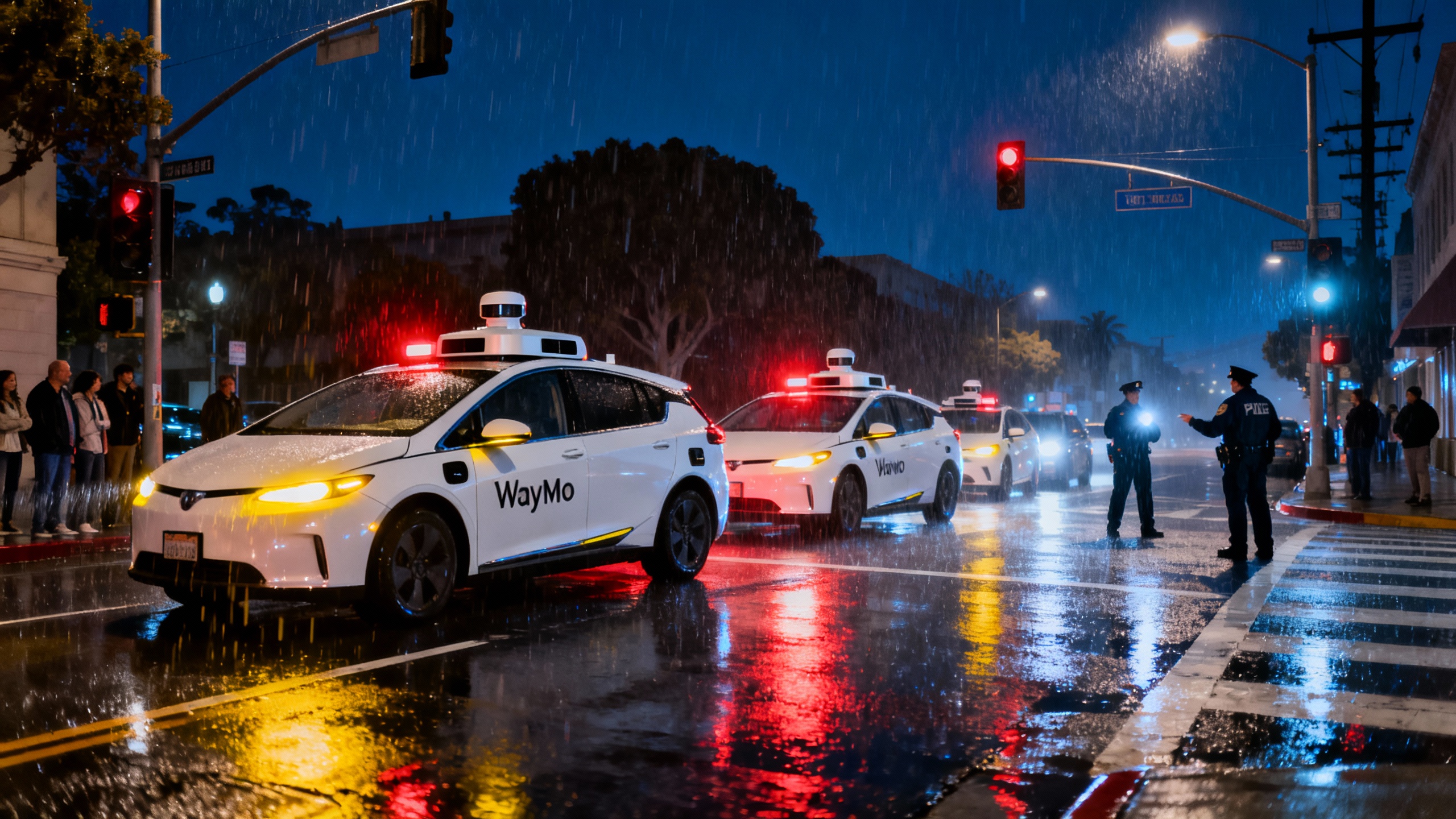
A citywide power outage on December 20, 2025—sparked by a fire at a PG&E substation in SoMa—darkened roughly a third of San Francisco and knocked out traffic signals across large swaths of the city. As lights went dark, clusters of Waymo’s driverless taxis stalled at intersections with hazard lights blinking. The company paused robotaxi service Saturday night and resumed operations the following day after power restoration progressed. Reuters, TechCrunch, SF Chronicle and NBC Bay Area/AP documented the disruption.
Waymo says its vehicles are built to treat dark signals as four‑way stops. But during the blackout, vehicles “occasionally request a confirmation check,” and the citywide surge in those requests created a backlog for human support, contributing to congestion. The company says it will push a fleet‑wide software update to add “power‑outage context” so vehicles can proceed more decisively next time. Reuters.
<<stat label="Dark signals handled on Dec 20" value=">7,000" source="Waymo via Reuters, Dec 24–27, 2025">>
City officials also pressed for a faster response in future emergencies. San Francisco Mayor Daniel Lurie said he called Waymo’s CEO during the outage and asked the company to remove cars from the road immediately—an instruction the company followed. Axios, SF Chronicle.
Teleoperation took center stage
At the heart of the disruption is a largely invisible layer of robotaxi operations: remote human support. In the AV industry, this is often called teleoperation—though the term covers multiple practices with very different safety implications.
- Waymo emphasizes it does not “remote drive” cars. Instead, its “Fleet Response” agents provide context—answering a vehicle’s questions or proposing a path—while the autonomous system retains control and may ignore the input. Waymo blog.
- In contrast, some operators globally have used fully remote drivers who can assume direct control when automation falters. That approach is more sensitive to latency and connectivity loss. Reuters explainer.
During the blackout, Waymo’s help‑seeking “confirmation” workflow appears to have become the bottleneck. The company’s own account—and extensive street‑level video—suggest vehicles queued at dark signals, waited for human input, or pulled over to be retrieved, magnifying gridlock that was already severe due to the outage. Reuters, TechCrunch.
<<callout type="note" title="What teleoperation is—and isn’t"> Teleoperation is an umbrella term. U.S. safety regulators distinguish between:
- Remote driving (a person outside the vehicle performing the driving task), which NHTSA proposes to tightly restrict for vehicles carrying public passengers; and
- Vehicle assistance (a person giving information or instructions without direct control), which is allowed but subject to transparency and oversight.
See NHTSA’s proposed AV STEP framework and Federal Register text for definitions and limits. NHTSA press release, Federal Register summary, Covington summary.
Teleoperation modes and policy stance
| Mode | Who’s in control? | Typical use | U.S. policy direction |
|---|---|---|---|
| Remote driving (fallback personnel) | Human teleoperator drives in real time | Rare, last‑resort maneuvering | Proposed prohibition for rides with public passengers, with narrow exceptions after a minimal‑risk stop. Federal Register (AV STEP) |
| Vehicle assistance (remote help) | ADS remains in control; human provides context | Confirmation checks, path hints | Allowed with reporting/transparency; NHTSA seeks detailed disclosures. NHTSA AV STEP |
| Remote monitoring only | Humans watch dashboards/alerts | Fleet health and incident triage | Generally permissible; still subject to state/local permit conditions |
Regulators signal closer scrutiny of remote operations
The outage triggered immediate questions from safety experts and regulators about whether today’s remote‑support playbooks can scale under stress. Carnegie Mellon’s Philip Koopman and GMU’s Missy Cummings argue that operators should have to prove they can handle disaster‑scale events—and that federal rules should govern how remote operations work and fail safely. Reuters.
In California, both the DMV and the Public Utilities Commission (CPUC) said they’re reviewing the incident. The DMV’s 2025 rulemaking cycle already proposes tighter reporting for light‑duty AVs and expanded permitting for heavy‑duty AVs, with comment rounds through December 2025. CPUC opened a successor proceeding in August 2025 to revisit safety, data, operations, and passenger policies for driverless services. Expect teleoperation accountability to be a focal point in both forums. Reuters, California DMV update, DMV AV regulations, CPUC rulemaking notice.
Federally, NHTSA’s proposed AV STEP program would draw a bright line between remote driving and remote assistance, require more disclosure, and generally bar passenger service that depends on a remote driver. That puts momentum behind formal teleoperation guardrails rather than leaving practices to company policy alone. NHTSA press release, Federal Register summary, EE Times overview.
What Waymo says—and what it’s changing
Waymo contends its vehicles successfully handled the majority of dark intersections and that the spike in “confirmation” requests—not a failure of the core driving stack—caused clogs at hotspots. The company plans to refine its confirmation logic and add explicit outage context so vehicles don’t wait for human feedback in bulk failure scenarios. Reuters.
Separately, Waymo points to third‑party audits of its safety case and remote‑assistance program by TÜV SÜD as evidence of process rigor. Those audits reviewed training, tooling, and alignment with industry best practices for remote assistance. Waymo audit announcement.
It’s also worth noting that multiple forms of mobility—including human‑driven traffic and public transit—were hampered by the blackout. Still, the visibility of clusters of empty AVs heightened public concern and created a vivid test case for how robotaxi fleets should behave when city infrastructure fails. SF Chronicle, Reuters analysis.
The path forward: Design for failure at scale
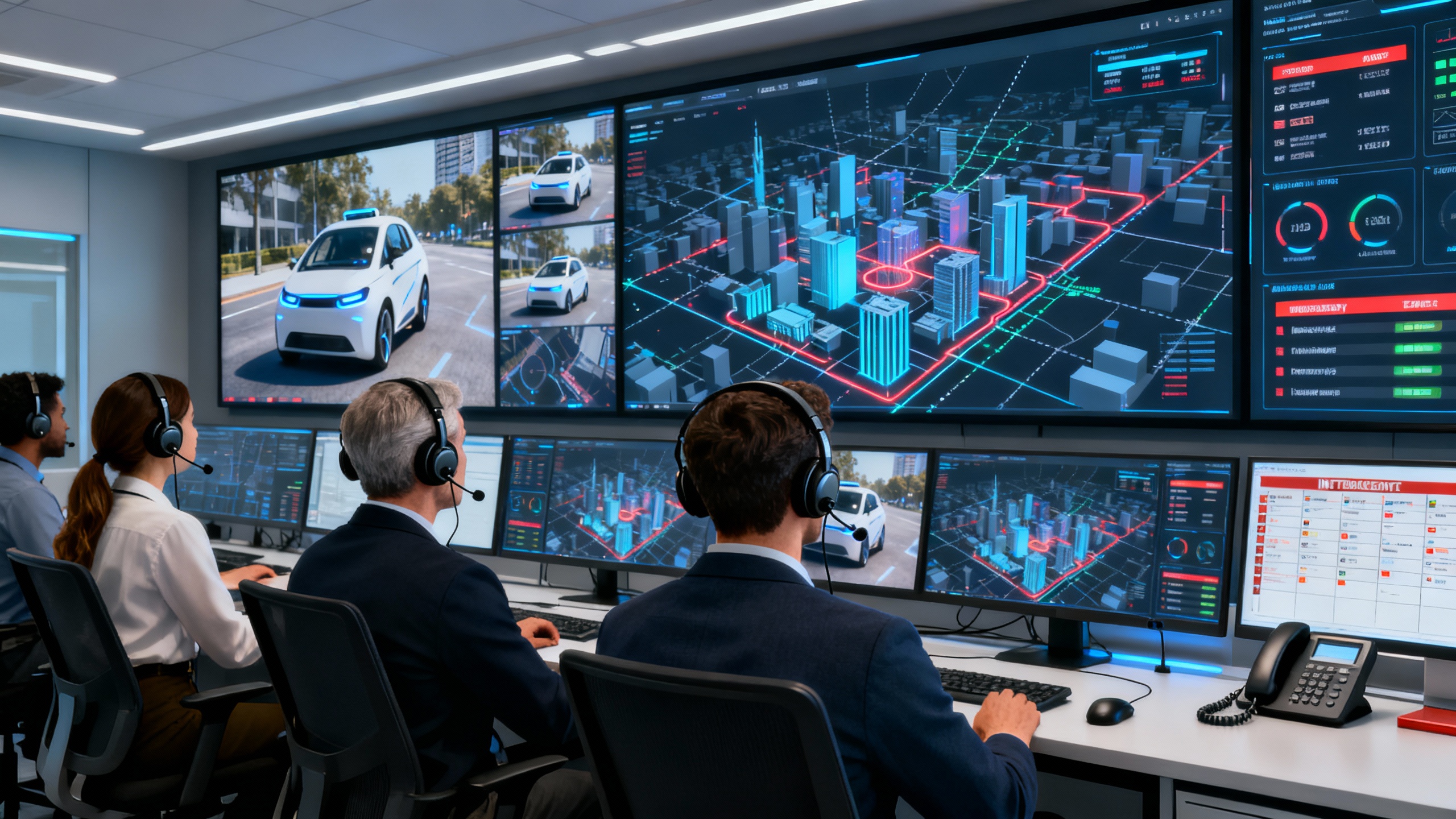
When hundreds of vehicles simultaneously seek help, today’s teleoperation models can saturate. Building resilience means treating “blackouts, floods, wildfires, and network failures” as first‑class requirements—not edge cases.
Here are pragmatic steps cities and operators can agree on now:
- Declare emergency playbooks upfront. Mandate written protocols that define when fleets must pull over, how they’ll be retrieved, and who triggers a citywide stand‑down. Require real‑time escalation lines between operators and the city’s Emergency Operations Center (EOC). CPUC scope.
- Set minimum capacity for remote support. Establish operator‑to‑vehicle ratios for surge conditions, with testable drills. Require redundancy across multiple cellular carriers and back‑up control rooms. Reuters analysis on teleop limits.
- Codify the remote‑driving line. Align local permits with NHTSA’s AV STEP direction: no public passenger service that relies on remote driving, narrow exceptions only after a minimal‑risk stop, and disclosure of any remote‑assist capabilities. NHTSA AV STEP, Federal Register text.
- Test like it’s an earthquake. Run joint blackout drills with city DOTs and first responders, measuring clearance times at key intersections when hundreds of AVs enter minimal‑risk states. Publicly report results as part of permitting. SF Chronicle’s earthquake lens.
- Tighten transparency. Expand incident reporting to include teleoperation backlog metrics during declared emergencies and publish post‑mortems within a fixed window. California DMV rulemaking.
<<callout type="action" title="30‑day checklist for regulators and operators">
- Define the city’s AV emergency trigger and who can order a stand‑down.
- Require multi‑carrier connectivity and a documented loss‑of‑comms strategy.
- Stress‑test teleoperation staffing with a city‑run drill; publish results.
- Align permits with AV STEP: no reliance on remote driving for passenger service.
- Add “infrastructure‑failure context” tests to pre‑deployment validation.
The takeaway for automation in cities
Automation doesn’t fail often—but when it fails, it must fail gracefully. San Francisco’s blackout exposed a scaling limit in remote assistance and forced a healthy rethink of where humans belong in the loop. Waymo’s planned software changes are a start. The faster regulators clarify teleoperation rules—and the sooner operators prove their emergency muscle under drill conditions—the more trust cities can place in driverless services that have to share the road with ambulances, fire engines, and worried neighbors on a rainy night. Reuters, NHTSA AV STEP.