

White House Drafts Order to Sue States Over AI Laws
What’s happening
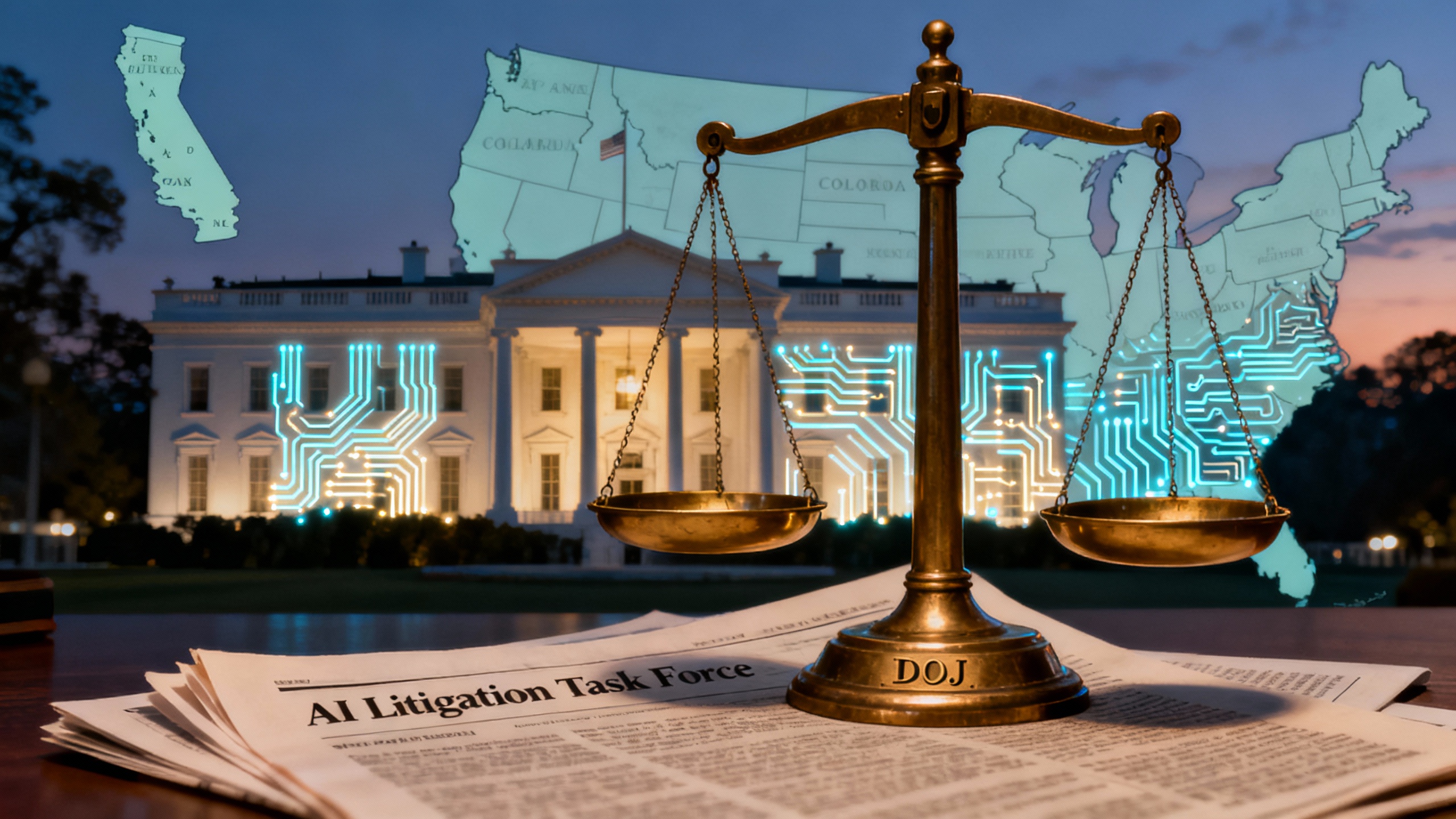
The White House is circulating a draft executive order that would direct the Justice Department to sue states that pass their own AI regulations, arguing those laws burden interstate commerce and conflict with a national approach to AI. The draft also contemplates an “AI Litigation Task Force” at DOJ, potential conditions on certain federal grants to states with AI rules, and agency moves at the FTC, FCC, and Commerce to undermine or preempt conflicting state policies. The plan is not final and could change before any signing.
Why now: Congress punted, states surged
A push earlier this year to enact a 10‑year federal moratorium on state AI regulation collapsed in the Senate on July 1, 2025, after a 99–1 vote stripped the provision from a sweeping Republican bill. With Congress failing to preempt state laws, the administration is exploring executive action to centralize AI policy.
States have been filling the vacuum. By late spring 2025, at least 48 states and Puerto Rico had introduced 1,000+ AI‑related bills; many targeted deepfakes, consumer disclosures, or algorithmic bias. Colorado enacted the nation’s first broad AI act in 2024 and this year delayed core obligations until June 30, 2026, while it refines implementation.
What the draft order would do
Reporting from multiple outlets describes a three‑pronged strategy: litigate, condition funds, and coordinate agencies.
- Direct DOJ to launch an “AI Litigation Task Force” within 30 days to challenge state AI laws as violating the Dormant Commerce Clause or otherwise conflicting with federal interests.
- Instruct Commerce to catalogue “burdensome” state AI rules within 90 days and to explore conditioning certain broadband grants (e.g., BEAD) on state compliance with federal standards.
- Ask the FTC to issue a policy statement on how the FTC Act applies to AI developers and deployers—and the FCC to consider a uniform AI disclosure standard that could preempt conflicting state requirements.
- Coordinate across the administration by leveraging the White House special adviser for AI and crypto.
What the draft order proposes vs. the path to impact
| Proposal | Mechanism | Target | Timeline (in draft) | Legal risk/notes |
|---|---|---|---|---|
| DOJ “AI Litigation Task Force” | Civil lawsuits | State AI laws | 30 days | Success depends on case‑by‑case court rulings under the Dormant Commerce Clause. |
| Commerce review + grant conditions | Grant eligibility policy | State broadband funds | 90 days | Must satisfy Spending Clause limits (germaneness, non‑coercion). |
| FTC policy statement on AI | Non‑binding guidance | Market conduct | 90 days | Guidance doesn’t itself preempt; future rulemaking would need statutory basis. |
| FCC AI disclosure standard | Rulemaking | Model/reporting disclosures | Initiate in 90 days | Agency preemption typically requires clear congressional authority. |
Can an executive order really preempt state AI laws?
Short answer: not by itself. Executive orders can direct agencies and litigation strategy, but they don’t override state statutes unless anchored in federal law or upheld by courts. Federal preemption generally arises from acts of Congress or valid agency rules under statute; absent that, the administration would rely on court challenges (e.g., under the Dormant Commerce Clause) to knock out particular state provisions.
The draft’s grant‑conditioning ideas face their own guardrails. The Supreme Court has allowed Congress to attach conditions to federal funds if they are unambiguous, related to the program, and not coercive—but those precedents apply to statutes, and overly aggressive conditions risk legal challenges.
Long‑standing federalism orders also instruct agencies to avoid unnecessary preemption and to consult states when national standards are truly needed—another reason sweeping, unilateral preemption via EO would be contested.
The politics: Unusual battle lines
Some Republican governors and many state lawmakers who typically champion states’ rights have already objected to federal AI preemption. The National Conference of State Legislatures reaffirmed last month that “partnership, not preemption” is the path forward—and it praised the Senate’s summer vote rejecting a moratorium on state AI laws.
Industry isn’t monolithic either. Several major AI companies have argued that a 50‑state patchwork is unworkable, while others (including Anthropic’s CEO) warned that a blanket ban on state action is “too blunt.” Expect tech to push for a single national framework but diverge on how strict it should be.
What it means for AI, automation, and your roadmap
Even if signed, the EO would set off months (or years) of litigation and rulemaking. In the near term, the state patchwork remains—and the most mature obligations (e.g., Colorado’s high‑risk AI duties) begin in mid‑2026 unless there’s further legislative change or a successful court challenge. Companies should assume continued multi‑jurisdictional compliance through 2025–2026.
TipIf you build or deploy AI across states
- Keep a live register of state AI obligations (disclosures, impact assessments, risk controls) tied to product features and markets served.
- Align internal controls with recognized frameworks (e.g., NIST AI RMF) to strengthen “reasonable care” defenses where laws provide them.
- Partition model behaviors and disclosures by jurisdiction via feature flags—so you can adjust quickly if courts stay or strike a state rule.
- Watch for agency moves: an FTC policy statement could shape “unfair/deceptive” risk; an FCC docket could affect disclosure standards; Commerce could change grant conditions that impact public‑sector deployments.
- Budget for discovery and reporting tooling now; it’s cheaper than retrofitting when audits or AG inquiries arrive.
What to watch next
- Signing (or shelving) the order: The White House has not announced a date; drafts can materially change.
- Immediate litigation posture: If issued, look for DOJ to prioritize suits against states with the most far‑reaching AI regimes. California and Colorado are frequent focal points in reporting.
- Agency timelines: 30–90‑day clocks for DOJ, FTC, FCC, and Commerce actions would start on signature, but actual market impact will depend on court and rulemaking outcomes.
- Congress: The administration has also floated adding a federal AI standard to other vehicles (e.g., defense authorization). That would be a faster route to true preemption if it can pass.
The bottom line
For now, treat this as high‑stakes positioning in the federalism tug‑of‑war over AI. The White House can sue and signal, but courts and Congress will decide whether state AI rules survive. Meanwhile, keep shipping—but keep your compliance stack nimble.
Sources
- Washington Post: White House drafts order directing DOJ to sue states that pass AI regulations (Nov. 19–20, 2025)
- Axios: White House floats executive order to rein in state AI laws (Nov. 19, 2025)
- Politico: White House prepares executive order to block state AI laws (Nov. 19, 2025)
- Reuters: U.S. Senate strikes AI regulation ban from Trump megabill (July 1, 2025)
- NCSL: Joint statement—‘States Are Leading on AI—Partnership, Not Preemption’ (Nov. 20, 2025)
- CRS (EveryCRSReport): State AI legislation as of April 2025—1,000+ bills introduced
- Colorado General Assembly: SB24‑205 summary (effective obligations delayed to June 30, 2026 via SB25B‑004) and SB25B‑004 (Aug. 28, 2025)
- CDT letter opposing federal preemption of state AI laws (May 19, 2025)
- South Dakota v. Dole (1987) – Spending Clause limits
- Executive Order 13132—Federalism (1999) – agency preemption principles