

What just happened (Dec 11, 2025)
President Trump signed an executive order, Ensuring a National Policy Framework for Artificial Intelligence (EO 14365), to curb state-level AI rules and push toward one national standard. The order directs the Justice Department to create an “AI Litigation Task Force” to sue states over laws the administration says hinder AI innovation, asks the Commerce Department to identify “onerous” state AI laws, threatens to condition certain federal grants (including portions of broadband funds) on states’ AI policies, instructs the FTC to issue a policy statement on when state rules that force model outputs to change could be “deceptive,” and tells the FCC to consider a federal AI disclosure standard that would preempt conflicting state requirements. White House, Federal Register.
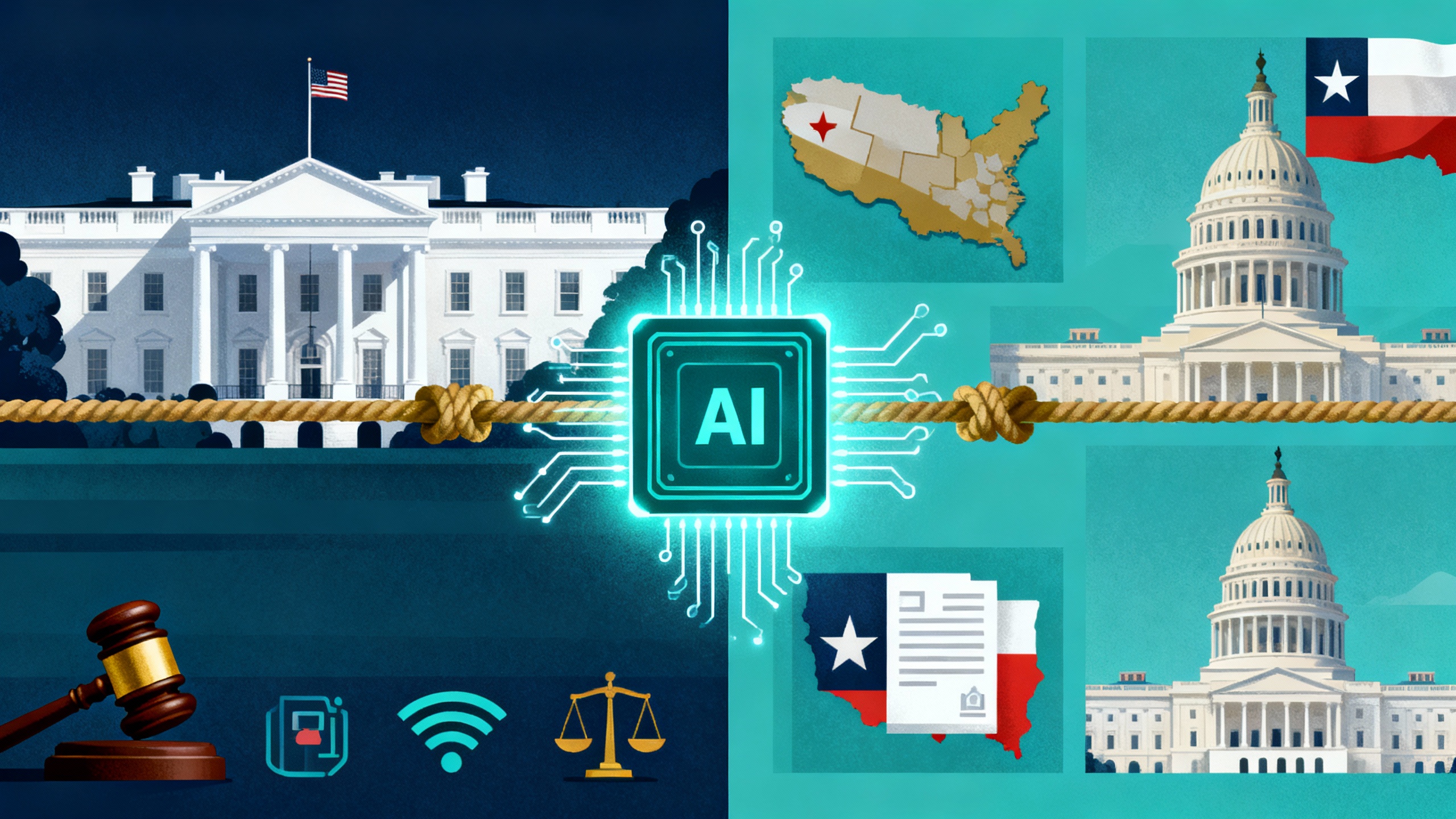
Why this matters: 50-state momentum meets a federal push
States have been sprinting ahead on AI. Colorado’s 2024 Colorado AI Act (SB 24-205) set comprehensive duties for “high-risk” AI used in consequential decisions (hiring, housing, credit, etc.) and was recently delayed to June 30, 2026, to allow revisions. California passed the Transparency in Frontier AI Act (SB 53) focused on catastrophic-risk transparency for advanced models. Utah enacted the 2024 AI Policy Act with disclosure rules, and Texas adopted the 2025 Responsible AI Governance Act with prohibitions and a sandbox. Together they preview an emerging patchwork that companies already plan around. Colorado General Assembly, Colorado SB25B-004, California SB 53, Utah SB 149, Texas TRAIGA.
- The volume is real: research firms tracked more than a thousand state AI bills in 2025; even narrower tallies count hundreds, with over a hundred enacted.
- Health care alone saw 250+ AI-related proposals across 47 states by mid-October. Axios.
The order at a glance
What EO 14365 directs
| Directive | Agency | Deadline window | What it means operationally |
|---|---|---|---|
| Stand up AI Litigation Task Force to challenge state AI laws | DOJ | 30 days from Dec 11, 2025 | Expect lawsuits targeting certain state AI acts (e.g., “algorithmic discrimination” rules) on commerce clause and preemption theories. |
| Publish evaluation of “onerous” state AI laws | Commerce (NTIA) | 90 days | A federal list that could influence grant conditions and litigation priorities. |
| Condition certain federal grants (e.g., portions of BEAD) on AI policy | Commerce + agencies | ~90 days for policy notice; ongoing for grants | Creates leverage over states; likely to draw legal challenges. |
| Consider preemptive AI disclosure/reporting standard | FCC | 90 days after Commerce list | If pursued, would test the FCC’s authority to displace state rules. |
| Issue FTC policy statement on “truthful outputs” and deception | FTC | 90 days | Could argue some state mandates force deceptive practices, but impact depends on legal footing. |
Sources: EO text; Federal Register summary.
Can an executive order preempt state AI laws?
Short answer: not by itself. Executive orders can steer federal agencies and litigation strategy, but preemption generally requires an act of Congress or valid agency rules under clear statutory authority. Expect legal fights over whether any resulting FTC or FCC actions have the power—and the congressional mandate—to displace state statutes. Ropes & Gray, Latham & Watkins, Steptoe.
The order previews arguments under the dormant commerce clause (state laws unduly burden interstate commerce) and First Amendment compelled-speech theories (e.g., if a law forces “ideological” outputs or particular disclosures). Legal analysts say those claims will be tough, absent discrimination against out-of-state interests or clear conflict with federal law. Goodwin, Institute for Law & AI.
The funding lever is also controversial. Conditioning broadband or other grants on a state’s AI stance could face statutory and constitutional challenges—and political pushback in rural states counting on BEAD money. Reuters, Washington Post.
States vow to fight—across parties
- California Governor Gavin Newsom blasted the order and pledged to defend state AI safeguards; California privacy officials had already opposed federal attempts to preempt state AI rules. Office of the Governor; CalPrivacy.
- Illinois leaders said they “won’t back down,” pointing to new laws on AI in therapy, education, hiring, and deepfakes. Journal-Courier/Capitol News Illinois.
- Republican governors and lawmakers also split: Florida’s Ron DeSantis said an EO “doesn’t/can’t preempt state legislative action,” and Utah leaders signaled they’ll continue crafting AI rules. Fox Business, Utah News Dispatch.
- Broader state activism continues: a multistate group of attorneys general recently warned major AI providers about potential violations of state laws, underscoring their appetite to enforce at the state level. The Verge.
Major outlets report immediate backlash and looming lawsuits; the AP, Reuters, Washington Post, and Politico all describe significant legal and political headwinds for the order. AP, Reuters, Washington Post, Politico.
What automation leaders should do now
If you build, buy, or deploy AI systems across multiple states, treat the order as the start of a longer federal–state chess match—not a get-out-of-compliance card.
What it could mean for products, roadmaps, and ROI
- Near term: more—not less—complexity. Until courts or Congress act, state laws remain in force. Compliance engineering and policy ops will stay busy through 2026. Nixon Peabody.
- Medium term: selective federal preemption is possible via agency action, but only with firm statutory grounding and rulemaking—and litigation will follow. Latham & Watkins.
- Strategic takeaway: build a “lowest common denominator” compliance baseline (documentation, testing, disclosures, bias mitigations) that satisfies stricter states. It’s the cheapest hedge while Washington and the courts decide who holds the pen.
The politics: a split coalition and an uncertain path
Even some Republicans objected to the order on federalism grounds, while tech industry groups cheered a move toward unity. This split raises the odds of congressional gridlock rather than a quick federal statute preempting states—especially after earlier efforts to attach broad AI preemption to must-pass bills stumbled. AP, Politico, California AG statement.
TipFollow the dates
- Jan 10, 2026 (30 days): DOJ task force deadline.
- Mar 11, 2026 (90 days): Commerce evaluation of state laws.
- Spring 2026: FTC policy statement; FCC decision whether to open a proceeding, then likely a multi‑month rulemaking if it proceeds. EO 14365.
Bottom line
The White House has fired the opening salvo to centralize AI rules. States—blue and red—say they’ll keep legislating and enforcing anyway. For product, legal, and ops leaders, the most resilient plan is to continue designing for the strictest credible requirements while tracking the federal-state clash that will define AI governance in 2026. AP, Reuters, Washington Post.
Sources
- Executive Order 14365: Ensuring a National Policy Framework for Artificial Intelligence — White House; Federal Register
- Coverage and reactions: Associated Press; Reuters; Washington Post; Politico
- State positions: California Governor; CalPrivacy; Illinois reaction; Florida/DeSantis; Utah reactions; AGs’ letter to AI firms
- State laws and timelines: Colorado SB 24‑205; SB25B‑004 (delay to June 30, 2026); California SB 53; Utah SB 149; Texas TRAIGA
- Legal analysis on preemption: Ropes & Gray; Latham & Watkins; Steptoe; Goodwin; Nixon Peabody
- Activity counts: MultiState; Future of Privacy Forum; Axios health care focus