

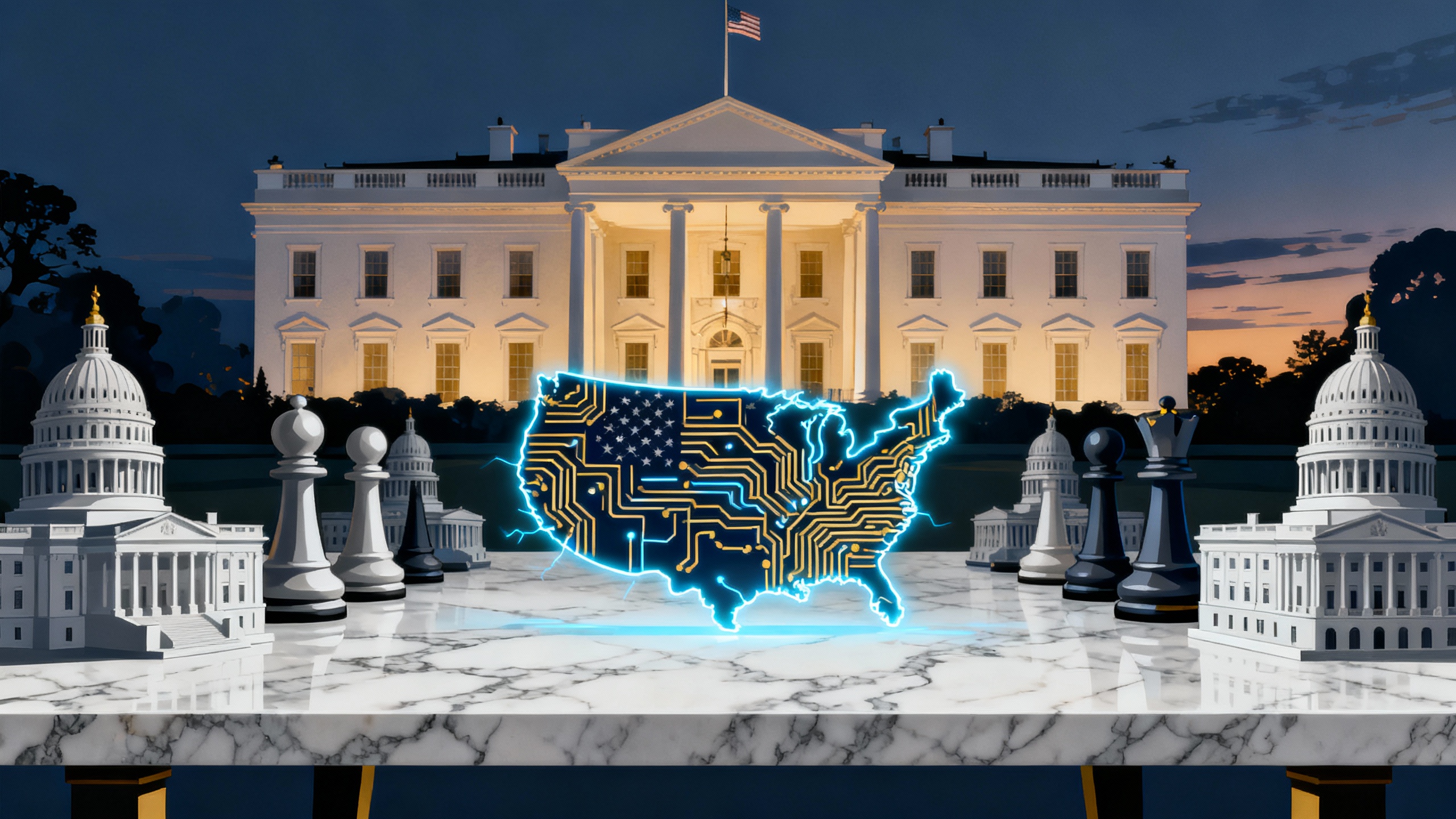
The White House has put a draft executive order on hold that would have sought to preempt state artificial intelligence (AI) laws by directing federal agencies to sue states and potentially leverage broadband funds as pressure. The pause, reported on November 21, 2025, comes amid bipartisan pushback and serious legal questions about whether a president can override state statutes without Congress.
What changed—and why it matters
Reuters reported that the administration has paused a draft order that, if signed, would have empowered the Department of Justice to challenge state AI regulations and asked the Commerce Department to consider withholding certain broadband grants from states with conflicting AI laws. The move follows a week of intense scrutiny after outlets detailed the draft’s contours and its aggressive theory of federal preemption. Reuters, Washington Post, Axios, POLITICO
For teams deploying AI, the immediate takeaway is simple: the state-by-state landscape remains in force. There is no federal safe harbor, and the patchwork of disclosure, safety, and consumer-protection rules across states still governs how AI is built and used.
What the (paused) draft order would have done
- Create a DOJ “AI Litigation Task Force” to challenge state AI laws (e.g., on dormant commerce clause or conflict-preemption grounds). Reuters, Washington Post
- Direct the Commerce Department to review state AI laws and consider conditioning access to remaining Broadband Equity, Access, and Deployment (BEAD) funds on compliance with a federal approach. Reuters
- Ask independent regulators to explore nationwide AI disclosure standards that could preempt conflicting state rules (e.g., an FCC-led reporting/disclosure proceeding; an FTC policy statement on deceptive AI practices). Axios
That strategy met stiff headwinds. Earlier this year, the U.S. Senate voted 99–1 to strip a similar “ban on state AI laws” provision from a budget package, reflecting broad unease with sweeping preemption. The Verge
Why the pause? Law, politics, and federalism
- Legal limits on preemption by executive order. Preempting state law is typically Congress’s job, or occasionally the product of agency rules grounded in a clear statutory mandate. Federalism directives such as Executive Order 13132 and long-standing DOJ guidance caution agencies against asserting preemption absent explicit authority. LII: Preemption overview, National Archives: EO 12612, White House (archived): Preemption memorandum
- Bipartisan state resistance. Attorneys general and lawmakers in both parties have opposed broad federal efforts to sideline state AI rules, warning of risks to consumers, elections, and children. Reuters
- Not over yet. Even as the White House hits pause, congressional allies are floating preemption language for the National Defense Authorization Act (NDAA), signaling that the fight may shift to Capitol Hill. Axios, Roll Call
What it means for AI and automation leaders right now
- Stay the course on state compliance. There is no new federal shield. Continue aligning with state rules where you operate or serve users.
- Map your exposure. Inventory AI use cases against state-specific obligations (disclosure, impact assessments, bias mitigation, model transparency) and note effective dates.
- Prepare for multi-track governance. Design controls that satisfy the strictest applicable state requirements first; you can often cascade those controls nationwide.
- Watch grant-linked conditions. Even the threat of tying broadband or other federal dollars to AI policy can influence timelines for public-sector AI deployments. Track BEAD developments and agency guidance. NTIA BEAD overview
A quick look at state rules shaping deployment
Selected state AI rules to know
| State | What it covers | Status / Date |
|---|---|---|
| Colorado (SB24-205) | “High-risk” AI systems: developer/deployer duties, impact assessments, bias safeguards; AG enforcement under consumer protection law. | Enacted May 17, 2024; major obligations start Feb 1, 2026. Colorado GA |
| Utah (SB149 + 2025 amendments) | Generative AI disclosures in consumer interactions; proactive disclosure for licensed occupations; enforcement under consumer protection law. | Effective May 1, 2024; narrowed and extended via 2025 amendments. Skadden, Davis Polk |
| Tennessee (ELVIS Act) | Protects voice likeness from unauthorized AI cloning; expands right of publicity. | Signed Mar 21, 2024; effective July 1, 2024. TN Governor, Reuters |
| California (election deepfakes + ad disclosures) | Multiple bills to curb AI-enabled election deception and require disclosures; separate frontier-model safety bill (SB 1047) vetoed. | Several measures signed Sep 2024; parts later enjoined; SB 1047 vetoed Sep 29, 2024. CA Governor, LA Times, CA Governor—veto note |
What to watch next
- NDAA negotiations. Preemption language could reappear in defense policy talks; expect vigorous opposition from state officials and civil society. Axios
- Revised executive action. The White House could return with a narrower order—e.g., targeting specific conflicts or directing a longer rulemaking path via agencies.
- Litigation posture. Even without an EO, private firms may sue states over AI rules; DOJ could file statements of interest—but success on dormant commerce clause theories is far from guaranteed. Roll Call
- Agency moves. Watch for FTC policy statements on AI deception and any FCC exploration of uniform disclosure standards that might collide with state rules. Axios
- State AG enforcement. Expect more actions using existing consumer protection and civil rights laws to police AI, regardless of federal gridlock. Reuters
Sources
- Reuters: White House pauses draft order to preempt state AI laws (Nov 21, 2025). Link
- Reuters: Draft order details—DOJ task force, funding leverage (Nov 19, 2025). Link
- Washington Post: What the draft would do; legal context (Nov 20, 2025). Link
- Axios: Draft EO scope; potential FCC/FTC actions (Nov 19, 2025). Link
- POLITICO: Administration prepared EO to block state AI laws (Nov 19, 2025). Link
- The Verge: Senate’s 99–1 vote against moratorium on state AI laws (Jul 1, 2025). Link
- NTIA: BEAD program overview ($42.45B). Link
- Colorado SB24-205 summary. Link
- Utah AI disclosure law and 2025 amendments. Link, Link
- Tennessee ELVIS Act. Link, Link
- California deepfake/election AI measures; partial injunction. Link, Link
- Federalism and preemption references. Link, Link, Link