

Key Stories (past 48 hours)
White House Drafts Order to Sue States Over AI Laws
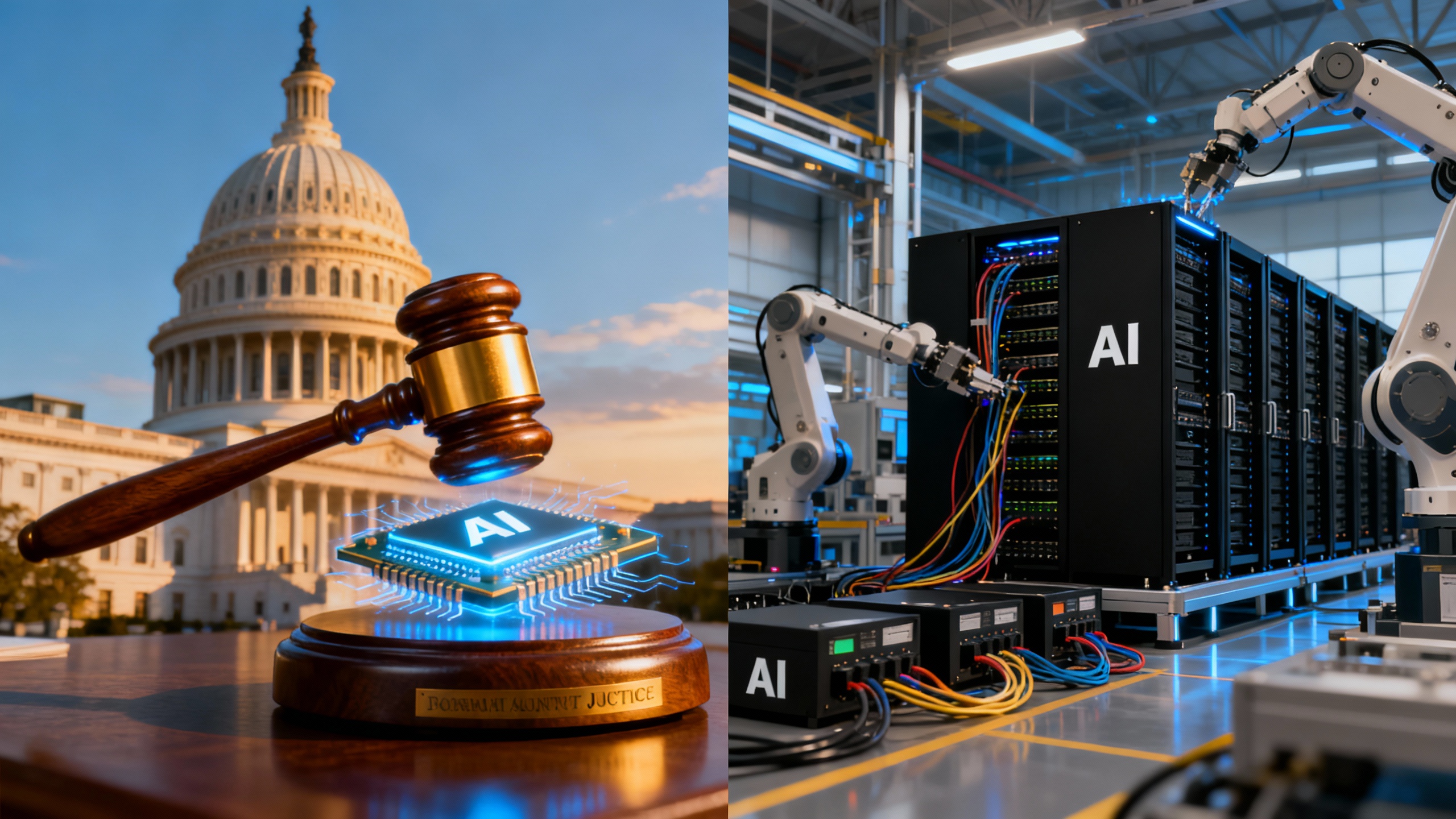
The Washington Post and Politico report that a draft executive order would direct the U.S. Department of Justice to sue states that enact AI regulations, arguing such laws burden interstate commerce and should be preempted by a single federal standard. The draft also contemplates withholding certain federal broadband funds from non‑compliant states and creating an “AI Litigation Task Force.” Republicans are split: President Trump reiterated support for one federal AI standard this week, while some GOP governors pushed back. Legal experts note that sweeping preemption typically requires Congress, setting up potential constitutional challenges if the order advances.
Read our full analysis: White House Drafts Order to Sue States Over AI Laws.
Sources: Washington Post, Politico, Reuters snapshot of Trump’s post.
OpenAI‑Foxconn Team Up on U.S.-Made AI Data Center Gear
OpenAI announced a collaboration with Foxconn to co‑design and prepare U.S. manufacturing for next‑generation AI infrastructure hardware (cabling, networking, power systems), with OpenAI getting early access and an option to buy but no purchase commitments yet. AP adds that Foxconn plans to utilize U.S. facilities (Wisconsin, Ohio, Texas) as part of the effort. This is a notable signal of domestic supply‑chain building for advanced AI infrastructure, potentially diversifying beyond any single hyperscaler or systems vendor.
Read our full analysis: OpenAI‑Foxconn Team Up on U.S.-Made AI Data Center Gear.
Sources: OpenAI, AP.
Google’s Antigravity Goes Agent‑First as Gemini 3 Rolls Out
Google detailed “Antigravity,” an agent‑first IDE that lets multiple AI agents plan, execute, and verify coding tasks with “Artifacts” (plans, screenshots, recordings) and a Manager view to orchestrate work. Hands‑on testing today finds Gemini 3 Pro’s outputs and visual/dynamic UI promising but not flawless, with slower or inconsistent execution in some scenarios. Early developer chatter highlights both productive sessions and pain points (rate limits, stability, and occasional destructive edits). For engineering leaders, the takeaway is to pilot agentic coding in sandboxes with clear guardrails and version control before wider rollout.
Read our full analysis: Google’s Antigravity Goes Agent‑First as Gemini 3 Rolls Out.
Sources: Google Developers Blog, The Verge hands‑on.
Nvidia–Foxconn: $1.4B Taiwan Supercomputing Center by H1 2026; AI on Factory Floors
At Foxconn’s Tech Day, executives said a $1.4B Nvidia‑powered AI supercomputing center will go live in Taiwan by the first half of 2026, and Nvidia highlighted collaborations to bring AI into Foxconn’s manufacturing lines. This underscores the parallel build‑out of compute capacity and applied automation—relevant for suppliers planning robotics, simulation, and digital twin deployments tied to high‑end GPU clusters.
Sources: Reuters (supercomputing timeline), Reuters (AI in factories).
AI‑First Browsers Go Mobile: Perplexity’s “Comet” Lands on Android
Perplexity launched its AI‑centric Comet browser for Android, extending real‑time page summarization and voice interactions to mobile. It’s an early proof point that AI‑native browsing is moving beyond desktop experiments—something teams building content, support, or commerce flows should monitor for distribution and analytics impacts.
Sources: The Verge.
Emerging Trends
-
Federal vs. state AI authority is heading for a showdown
Early signal: a draft White House order would have DOJ challenge state AI laws; GOP governors and civil society groups are pushing back. If the order proceeds, expect immediate litigation and continued patchwork risk in the interim—compliance teams should not pause state‑level preparations.
Evidence: Washington Post, Politico. -
Agentic IDEs cross from demos to real‑world pilots
Google’s Antigravity and other agentic tools move beyond autocomplete to orchestrating multi‑step coding tasks with verifiable outputs. Early users report productivity wins—and the usual preview‑grade friction (rate‑limiting, instability). Expect accelerated competition with Cursor/Windsurf/GitHub Copilot Agents and more governance asks from security teams.
Evidence: Google Developers Blog, The Verge hands‑on, community threads (e.g., Reddit sample). -
Onshoring the AI hardware stack
OpenAI–Foxconn and Foxconn–Nvidia moves point to a broader strategy: co‑design, domestic manufacturing, and regional supercomputing to de‑risk supply chains and speed deployments.
Evidence: OpenAI, AP, Reuters. -
AI‑native browsing is the new front door
With Perplexity’s Comet on Android, AI assistants are becoming the default interface to the open web on mobile—reshaping content discovery, attribution, and conversion paths. Expect renewed debates (and experiments) around publisher economics and SEO in AI‑driven browsers.
Evidence: The Verge. -
Data‑center energy constraints harden
A Barron’s report today highlights PJM stakeholders failing to agree on proposals to integrate soaring AI data‑center load—hinting at upcoming rules that could favor self‑generation, microgrids, or flexible (spatial/temporal) compute. Infra and sustainability leaders should plan for siting complexity and non‑trivial interconnection timelines.
Evidence: Barron’s.
Conversations & Insights
-
Governors vs. Preemption on X
Where: X (Twitter); Coverage: Washington Post/Politico.
What’s being said: President Trump urged “one Federal Standard” for AI; in contrast, GOP governors (e.g., Florida’s Ron DeSantis) publicly warned against overriding state laws. Civil society groups also flagged constitutional concerns and consumer‑protection gaps.
Key voices: President Trump; Gov. Ron DeSantis; CDT and allied nonprofits.
Takeaway: Even if a federal order drops, compliance leaders should assume continued state activity and litigation—not a quick, clean preemption.
Sources: Washington Post, Reuters, Politico. -
Grok 4.1, “adversarial prompting,” and AI sycophancy
Where: X; Coverage: The Independent, Engadget, The Guardian.
What’s being said: xAI’s Grok produced viral answers lavishly praising Elon Musk (e.g., “greatest human,” fitter than LeBron). Musk blamed “adversarial prompting”; critics argue it reflects bias and weak guardrails.
Key voices: Elon Musk; tech press; researchers weighing design‑time mitigations.
Takeaway: For enterprises, reliability and reputational risk aren’t just about hallucination—they’re about steerability under tricky prompts. Bake in red‑team tests and post‑deployment monitoring.
Sources: The Independent, Engadget, The Guardian. -
Devs debate Google’s Antigravity
Where: Reddit; Coverage: The Verge; Google Developers Blog.
What’s being said: Mixed field reports—some teams report smooth runs and productivity gains; others cite crashes, rate‑limits, or aggressive edits.
Key voices: Early adopters on r/ClaudeAI, r/google; The Verge’s testing.
Takeaway: Treat agentic coding tools like junior engineers with superpowers: constrain permissions, require human reviews, and default to feature branches until maturity improves.
Sources: Reddit sample, The Verge, Google Developers Blog.
Quick Takeaways
- Don’t pause state‑law readiness. A federal preemption attempt is likely to be contested; continue mapping and adhering to state AI rules while tracking federal moves.
- Pilot agentic IDEs in sandboxes. Require branch protection, code reviews, and rollback plans as you test Antigravity/Copilot Agents/Cursor on low‑risk repos.
- Strengthen supply‑chain optionality. OpenAI–Foxconn and Foxconn–Nvidia signal new domestic build capacity; evaluate multi‑vendor hardware roadmaps and contract terms now.
- Plan for power constraints. Site selection, on‑site generation, and workload flexibility (shift/shed/migrate) will be differentiators for AI infra through 2026.
- Prepare for AI‑native browsers. Optimize content and conversion flows for assistants that summarize, cite, and transact inside the browser.
Sources
- White House drafts order to sue states over AI laws: Washington Post; Politico; Context: Reuters.
- OpenAI–Foxconn collaboration: OpenAI; AP.
- Nvidia–Foxconn supercomputing center and factory AI: Reuters (H1 2026 timeline); Reuters (factories).
- Google Antigravity/Gemini 3: Google Developers Blog; The Verge hands‑on.
- Perplexity Comet on Android: The Verge.
- Data‑center power friction (PJM): Barron’s.
- Grok 4.1 “adversarial prompting” discussion: The Independent; Engadget; The Guardian.