

Today in AI – 12-19-2025
Key Stories (past 48 hours)
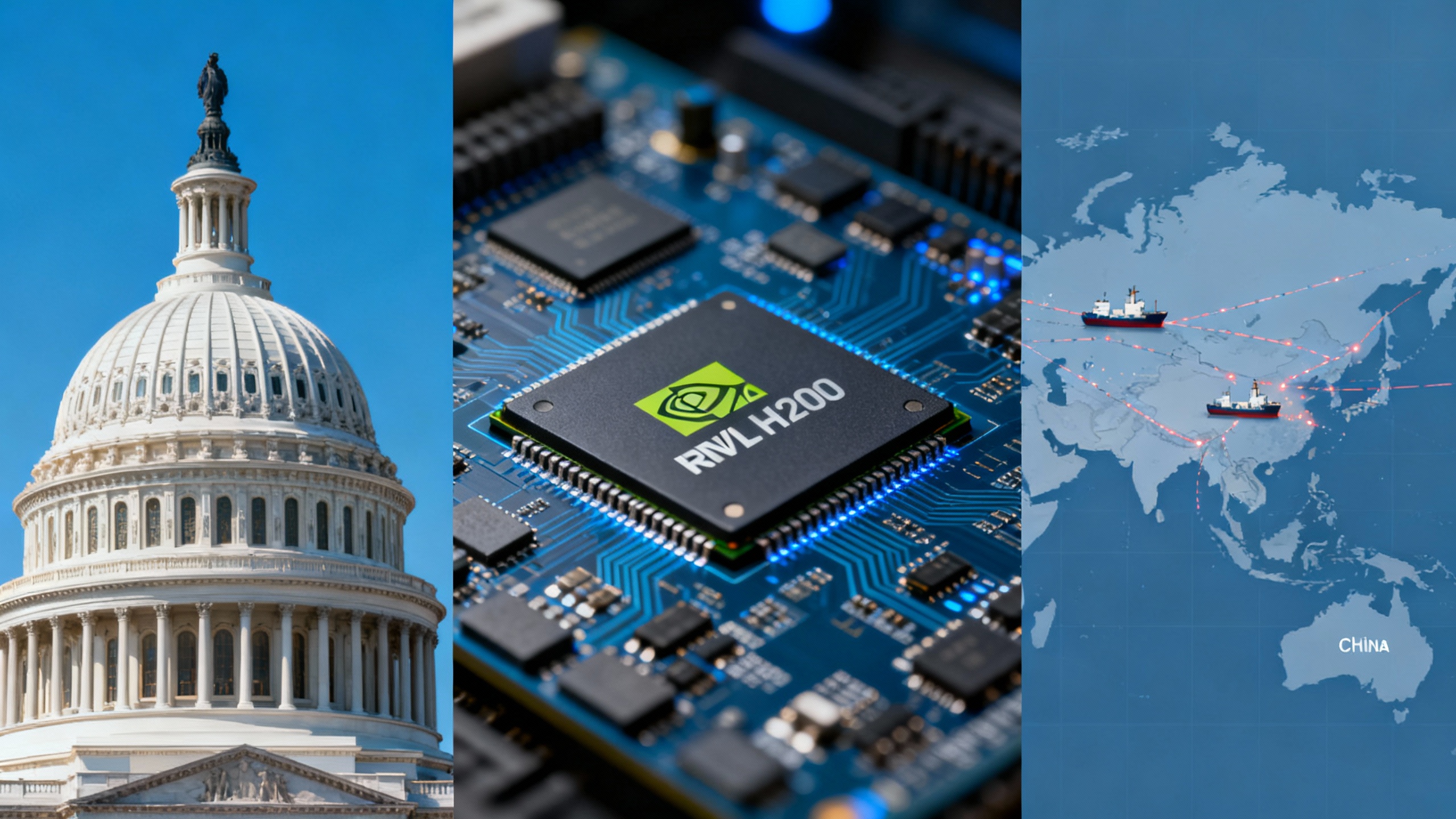
- The U.S. Commerce Department has begun an interagency licensing review that could permit Nvidia to ship its H200 AI accelerators to Chinese buyers—making good on President Trump’s earlier pledge to allow sales subject to a 25% fee paid to the U.S. government. The process involves the State, Energy and Defense Departments and could mark a significant policy shift from prior restrictions. Markets reacted quickly and commentary split along national‑security vs. competitiveness lines. Read our full coverage at the link above.
- Why it matters: Compute geopolitics directly affects AI capacity planning, model training roadmaps, and data‑center buildouts. Any reopening of China demand for advanced U.S. GPUs changes global allocation and pricing dynamics in 2026.
- The Department of Energy unveiled new agreements with a broad cohort of tech firms (cloud, chipmakers, and AI labs) to accelerate scientific discovery under its Genesis Mission. In parallel, Anthropic detailed a multi‑year DOE partnership spanning energy systems, bio/life sciences, and scientific productivity—backed by Claude integrations, agents, and MCP connectors into instruments and tools.
- Why it matters: Expect more funded, domain‑specific “AI for science” programs and procurement cycles across national labs and universities—opening opportunities for tool builders, foundation‑model vendors, and integrators.
- OpenAI updated its Model Spec with under‑18 (U18) principles and said it’s rolling out an age‑prediction model that defaults uncertain cases to a teen experience while offering verification for adults. Anthropic reiterated that Claude is 18+ for direct use, and outlined additional detection and safety handling for minors via partners. Reporting surfaced how both are tightening responses around self‑harm, romance/sexual content, and other higher‑risk topics for teens. Read our full coverage at the link above.
- Why it matters: Online age assurance is moving from policy talk to product reality. Enterprise adopters with teen users (education, creators, gaming, consumer apps) must prepare for stricter controls and verification flows.
- Google’s Gemini app can verify AI‑made videos using SynthID
- Google expanded content transparency tools so users can upload a clip and ask Gemini whether it was generated or edited with Google AI. Gemini scans for imperceptible SynthID watermarks across audio and video and returns timestamped detections; the feature supports up to 100MB/90‑second videos.
- Why it matters: Provenance is becoming table stakes for platforms and brands. SynthID’s move from images to video tightens the authenticity stack for short‑form media and ads.
- Google Cloud lands multi‑year Palo Alto Networks deal ‘approaching $10B,’ tied to AI security
- Reuters reports an expanded partnership in which Palo Alto will invest heavily in Google Cloud over several years, including migrating products and co‑building new services that lean on AI. Executives said AI is accelerating security demand, but the sector remains early in adoption.
- Why it matters: Security is emerging as one of the strongest enterprise AI monetization vectors—fueling large, multi‑year cloud commitments.
- Senate Democrats move to block federal preemption of state AI rules
- Following the Dec 11 executive order asserting a national AI policy that curbs state regulation, Senate Democrats introduced legislation to withhold funds for implementing it and signaled amendments to appropriations. The clash underscores the lack of a unified federal statute—and the near‑term reality of fragmented compliance.
Emerging Trends
-
Compute geopolitics in flux
-
Signals: The U.S. review on H200 exports and fresh reporting on China’s rapid progress (DUV upgrades and a prototype EUV effort) show policy, supply chains, and indigenous capability are all moving targets. Vendors and buyers will face faster‑than‑expected shifts in where the world’s AI training capacity sits.
-
Impact: Procurement teams should scenario‑plan for price swings and export‑control reversals; multi‑sourcing compute and reserving capacity early remain prudent.
-
Safety and age assurance become default features
-
Signals: OpenAI’s U18 Model Spec principles and early rollout of age prediction—plus Anthropic’s under‑18 detection posture—push the industry toward built‑in age gating and differentiated safety policies.
-
Impact: Expect more K‑12/HE pilots, parental controls, and regulator guidance. App developers may need age‑aware UX, content policies, and region‑specific verification flows.
-
Content provenance expands to video
-
Signals: Google’s SynthID support for video/audio detection inside Gemini, alongside its existing image checks, deepens provenance tooling aligned with C2PA.
-
Impact: Brands and platforms can start mandating watermark checks in workflows for ads, creator uploads, and political content.
-
Security spend becomes an AI lighthouse category
-
Signals: The Google Cloud–Palo Alto tie‑up—described as Google Cloud’s largest security deal—tracks with rising AI‑powered defense/offense cycles.
-
Impact: CISOs will see more turnkey “AI‑in‑the‑SOC” offers and may consolidate telemetry and model‑based detection on single clouds.
Conversations & Insights
-
“Teen mode” and age‑prediction rollouts spark user pushback
-
Where: Reddit threads in r/ChatGPTcomplaints debated defaulting to a teen experience when age is uncertain, verification for adults, and guardrails on sensitive topics. Some argue the defaults are over‑broad; others support stronger protections. Takeaway: Clear comms on when/why age checks trigger—and a transparent appeals path—will determine trust.
-
Chip export reversal divides national‑security voices and markets
-
Where: Market commentary (Barron’s) and policy reporting (Reuters) reflect competing narratives—reclaim lost revenue and influence vs. risk boosting a strategic rival’s AI capacity. Takeaway: For builders, the actionable move is supply diversification and assuming periodic regulatory whiplash.
-
Federal vs. state authority on AI
-
Where: Capitol Hill coverage (Axios) highlights Democratic efforts to resist federal preemption of state AI laws. Takeaway: Compliance teams should plan for a hybrid regime through 2026: national guidance + active state AGs and sector regulators.
-
AI for science gains momentum beyond pilots
-
Where: DOE’s Genesis Mission rollout alongside Anthropic’s details shows labs moving from experiments to embedded agents and connectors. Takeaway: Vendors that speak the language of instruments, data governance, and HPC scheduling will win these deals.
Quick Takeaways
- Revisit 2026 compute plans now—price, lead times, and export rules may change quickly.
- Add age‑aware UX and verification hooks to consumer‑facing AI features; document teen‑specific safeguards.
- Bake provenance checks (e.g., watermark detection) into media workflows for ads and UGC.
- Expect security to be one of the first AI categories to get multi‑year budget commitments—align your integrations accordingly.
Sources
- Reuters – Exclusive: US launches review of advanced Nvidia AI chip sales to China. https://www.reuters.com/world/china/us-launches-review-advanced-nvidia-ai-chip-sales-china-sources-say-2025-12-19/
- Barron’s – Nvidia Stock Rises. The Road to Sales in China Opens Up. https://www.barrons.com/articles/nvidia-stock-price-ai-chips-h200-china-374de94e
- Reuters – Google Cloud lands deal with Palo Alto Networks ‘approaching $10 billion’. https://www.reuters.com/business/google-cloud-lands-deal-with-palo-alto-networks-approaching-10-billion-per-2025-12-19/
- Axios – Senate Dems fight back on Trump’s AI order. https://www.axios.com/2025/12/19/trump-democrats-fight-back-ai-order
- Reuters – Exclusive: How China built its ‘Manhattan Project’ to rival the West in AI chips. https://www.reuters.com/world/china/how-china-built-its-manhattan-project-rival-west-ai-chips-2025-12-17/
- Financial Times – China boosts AI chip output by upgrading older ASML machines. https://www.ft.com/content/d10398db-b8b4-40f3-8c6d-b340470f5f3c
- The Verge – OpenAI and Anthropic will start predicting when users are underage. https://www.theverge.com/news/847780/openai-anthropic-teen-safety-chatgpt-claude
- OpenAI – Updating our Model Spec with teen protections. https://openai.com/index/updating-model-spec-with-teen-protections/
- Google – Verify Google AI‑generated videos in the Gemini app. https://blog.google/technology/ai/verify-google-ai-videos-gemini-app/
- Google DeepMind – SynthID. https://deepmind.google/models/synthid/
- Reddit – r/ChatGPTcomplaints threads on age verification and teen protections. https://www.reddit.com/r/ChatGPTcomplaints/comments/1pq026o/update/ and https://www.reddit.com/r/ChatGPTcomplaints/comments/1pqdpbl/the_question_is_when_are_they_gonna_actually/