


1. Introduction
Good prompts are the secret sauce behind great AI output. The catch? Crafting them is slow, inconsistent, and hard to standardize across a team. That’s why prompt libraries exist. In this comparison, we put two popular options—AIPRM and FlowGPT—head to head. If you’ve ever wondered where to find "really good AI prompts" and how to use them effectively, this guide will help you choose the right source for your workflow and governance needs.
TipGood prompts beat long prompts
Quality beats verbosity. Use structure (role, goal, constraints, examples), specify format, and ask the model to reflect before answering. For fundamentals, see OpenAI’s Prompt Engineering Guide, Anthropic’s Prompting Best Practices, and the research on Chain-of-Thought prompting.
2. Overview
AIPRM (Prompt Templates for ChatGPT)
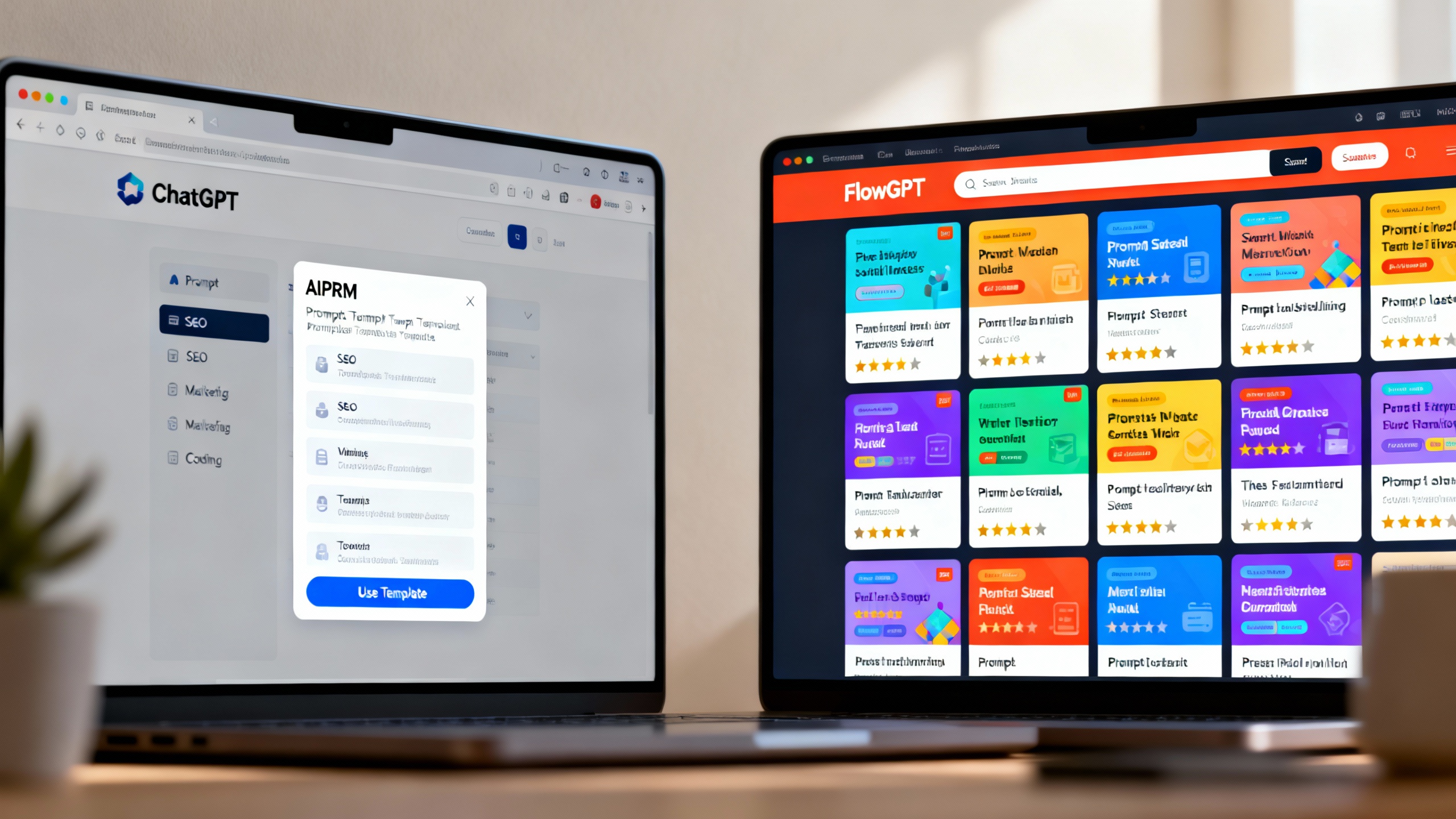
AIPRM is a browser extension that embeds a curated prompt catalog directly inside ChatGPT. You browse categories (e.g., SEO, marketing, coding), click a template, fill in variables, and run it without leaving the conversation. It caters to professionals who want speed, consistency, and repeatable outcomes inside ChatGPT’s native UI. AIPRM offers a free tier plus paid plans with features like private templates, saved lists, and team-oriented controls.
FlowGPT (Community Prompt Marketplace and Agents)
FlowGPT is a community-driven prompt marketplace. You search, filter, and test prompts shared by creators for models like ChatGPT, Claude, and Gemini. It emphasizes discovery (ratings, trending tags, collections) and experimentation. Beyond prompts, FlowGPT increasingly highlights workflows and community-built agents. It suits tinkerers, creators, and teams exploring a wide model ecosystem.
3. Key Differences
-
Curation and Quality Control:
- AIPRM leans on curation and structured templates with variable inputs, making it easier to standardize usage and reduce prompt drift across a team.
- FlowGPT thrives on community variety and fast iteration; you’ll find gems, but quality can be uneven. Ratings and comments help surface the best.
-
Integration and Workflow:
- AIPRM integrates directly into the ChatGPT UI via a browser extension—no tab-hopping. Templates are designed for one-click execution.
- FlowGPT is primarily a web app for discovery. You copy/paste or use one-click actions to open prompts in your model of choice.
-
Model Coverage:
- AIPRM is built around ChatGPT usage, which keeps things streamlined.
- FlowGPT spans multiple model providers (OpenAI, Anthropic, Google, and open-source variants), useful if you’re model-agnostic.
-
Collaboration and Governance:
- AIPRM’s structured templates and private lists help teams enforce standards and reuse prompts safely.
- FlowGPT is great for exploration and inspiration, but governance is more DIY unless you build internal curation layers.
-
Pricing:
- Both offer free tiers. AIPRM’s paid plans add advanced features for professionals and teams. FlowGPT has premium options focused on power users and creators. Exact pricing and entitlements change—check their sites.
-
Learning Curve:
- AIPRM’s in-ChatGPT experience is beginner-friendly and consistent.
- FlowGPT rewards explorers comfortable evaluating prompts and tweaking across models.
Feature comparison
| Category | AIPRM | FlowGPT |
|---|---|---|
| Core Value | Curated, structured templates in ChatGPT | Broad discovery of community prompts and agents |
| Setup | Browser extension | Web app (with copy/open to model) |
| Model Support | Primarily ChatGPT | Multi-model (OpenAI, Anthropic, Google, others) |
| Team Controls | Stronger (private lists, template control) | Lighter; governance is user-driven |
| Curation | Higher baseline consistency | High variety; quality varies |
| Best For | Repeatable workflows, business use | Exploration, creative experiments, cross-model use |
4. Pros and Cons
AIPRM
- Pros:
- Seamless inside ChatGPT; reduces context-switching.
- Structured templates with variables promote consistency.
- Good for teams needing guardrails and repeatability.
- Faster onboarding for non-technical users.
- Cons:
- ChatGPT-centric; not ideal if you rely on multiple model providers.
- Extension-based approach may limit use in locked-down IT environments.
- Less breadth than a wide-open community marketplace.
FlowGPT
- Pros:
- Huge variety and rapid iteration from a global community.
- Multi-model perspective (see how prompts port across systems).
- Great for discovering novel techniques and niche use cases.
- Collections and community feedback surface high performers.
- Cons:
- Quality varies; more work to validate and standardize.
- Copy/paste or hand-off steps add friction to daily use.
- Governance and version control require extra process on your side.
5. Use Case Recommendations
-
If you manage a team with defined outputs (e.g., SEO briefs, product spec templates, customer replies):
- Choose AIPRM for consistency, faster training, and built-in structure. Create private lists, document variables, and share prompt SOPs.
-
If you’re a solo creator, researcher, or engineer hunting for cutting-edge techniques and inspiration:
- Choose FlowGPT for discovery and experimentation. Bookmark collections and compare prompts across models to learn what generalizes.
-
If you’re model-agnostic or evaluating vendors:
- FlowGPT’s cross-model angle helps you test portability. Use the same task across ChatGPT, Claude, and Gemini to find the best fit.
-
If your org prioritizes compliance and repeatability:
- AIPRM’s curated templates and clearer guardrails simplify governance and reduce variance in outputs.
6. Verdict
Both platforms help you find "really good AI prompts"—but they solve different problems.
- AIPRM is the better fit for professionals and teams who value consistency, speed, and in-ChatGPT execution. It’s excellent for standard operating prompts (SOPs) where the template is the product.
- FlowGPT is ideal for explorers who want breadth, community innovation, and multi-model experimentation. It’s where new ideas and unconventional techniques appear first.
If you must pick one: choose AIPRM for repeatable business workflows; choose FlowGPT for discovery and learning. Many power users keep both—AIPRM to operationalize, FlowGPT to explore. That combo keeps your prompt stack both stable and evolving.