


-
Introduction
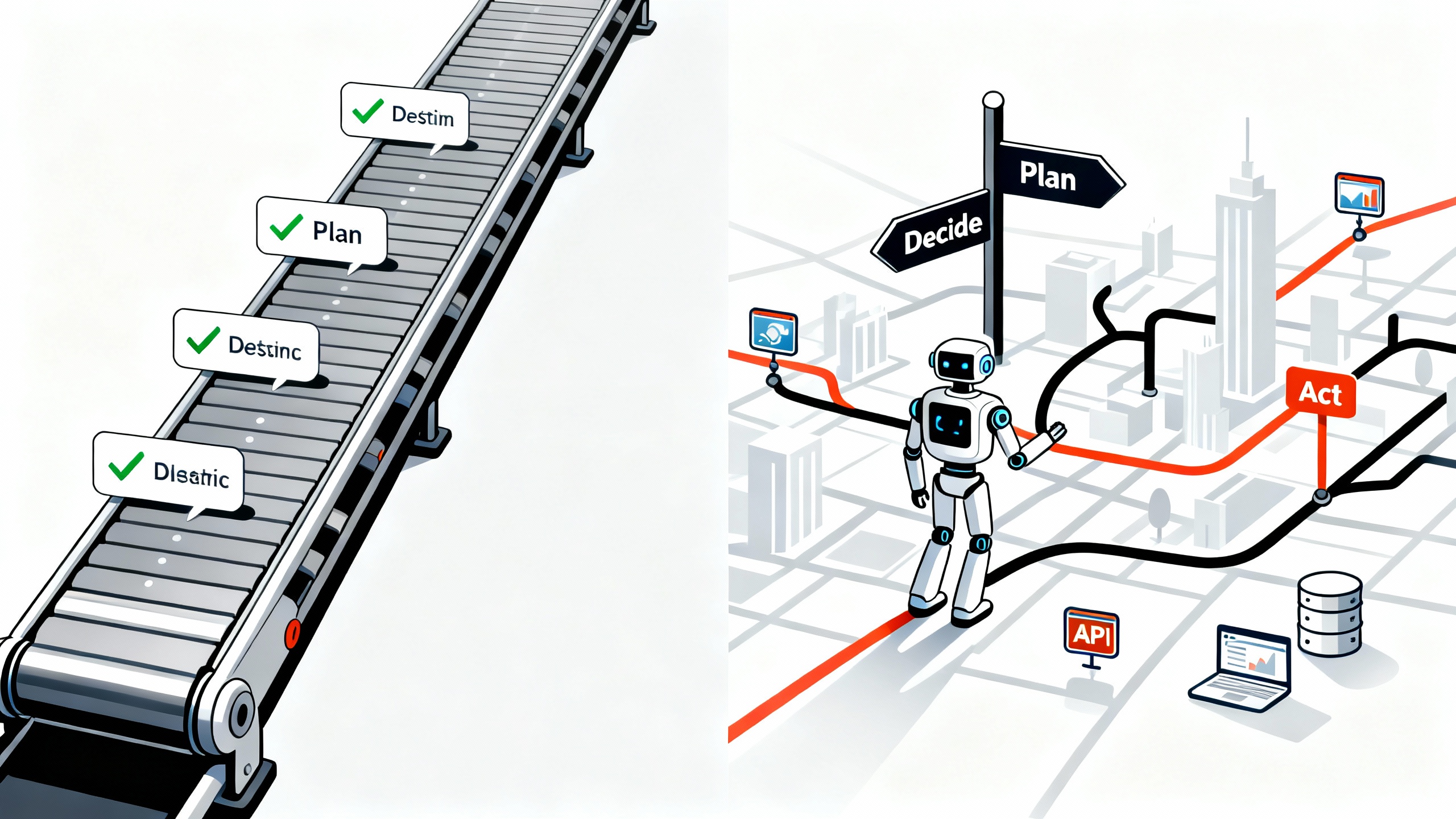
Automation and agentic AI are often lumped together, but they solve different problems. Traditional automation executes predefined steps with machine precision. Agentic AI, powered by large language models (LLMs), can set sub-goals, call tools, and adapt to novel inputs. Understanding the gap—deterministic rules versus goal-directed reasoning—will help you avoid over-engineering stable processes or underestimating tasks that need judgment.
-
What Are We Comparing?
Automation (RPA, iPaaS, BPM)
Think UiPath, Automation Anywhere, Zapier/Make, Camunda, and ServiceNow flows. These systems orchestrate triggers, APIs, and UI interactions using explicit logic. They excel at high-volume, well-structured tasks: data entry, reconciliations, ETL, approvals, and ticket routing. Benefits include reliability, auditability, and predictable cost.
- Typical users: Operations, finance, IT, and process owners
- Strength: Deterministic execution and compliance
- Limitation: Struggles when rules are ambiguous or data is unstructured
Agentic AI (Autonomous or Semi-autonomous LLM Agents)
Agentic systems use LLMs to plan, decide, and act. They can browse, call APIs, write code, and revise their own steps through tool use and reflection. Frameworks include LangChain Agents, Microsoft AutoGen, CrewAI, and vendor offerings from OpenAI and others.
- Typical users: Product teams, data/AI engineers, innovation groups
- Strength: Handles unstructured inputs, complex reasoning, and toolchains
- Limitation: Non-deterministic, requires guardrails, harder to govern
References: NIST AI RMF, McKinsey on GenAI impact, OpenAI function calling, LangChain Agents
-
Key Differences That Actually Matter
Automation vs Agentic AI at a glance
Factor Automation (RPA/iPaaS/BPM) Agentic AI (LLM Agents) Nature of logic Explicit rules and flows Goal-driven reasoning and planning Typical inputs Structured data, stable UIs/APIs Unstructured text, changing contexts Reliability High, deterministic Variable; needs evals/guardrails Cost predictability High (per bot/task) Medium (per token/call + tools) Governance Mature audit trails Emerging; must design controls Speed to value Fast for known processes Fast for novel, fuzzy tasks Best for Repetitive, high-volume workflows Researchy, multi-hop, judgment tasks - Determinism vs. Adaptability: Automation is a straight road. Agents are off-road vehicles—slower on pavement, essential in rough terrain.
- Error Modes: Automation fails loudly when a selector breaks. Agents can fail silently via hallucinations or partial reasoning—demanding evals and confidence thresholds.
- Tooling & Testing: Automation uses unit tests and regression checks. Agents require prompt tests, sandboxed tool access, and outcome evals.
- Cost & Scale: Automation scales linearly with volume. Agents scale with context length, tool use, and prompt complexity; monitoring is mandatory.
-
Pros and Cons
Automation
- Pros:
- Predictable, auditable, and reliable
- Mature ecosystem; strong admin and observability
- Excellent for SLAs and compliance
- Cons:
- Brittle with UI changes or ambiguous rules
- Limited on unstructured content and nuance
- Can be slow to adapt to novel scenarios
Agentic AI
- Pros:
- Handles messy inputs and multi-step reasoning
- Rapid prototyping for new or evolving workflows
- Can use tools (APIs, search, code) to self-correct
- Cons:
- Non-deterministic outputs; requires human-in-the-loop or gates
- Ongoing costs tied to tokens, context windows, and retries
- Harder to certify for high-stakes processes
- Pros:
TipCrawl, walk, run
Start with co-pilot patterns (drafts, suggestions). Graduate to agent-in-the-loop (agent proposes + human approves). Only then consider full autonomy for low-risk tasks.
-
Use Case Recommendations
-
Choose Automation when:
- Inputs are structured; rules rarely change (e.g., invoice posting, user provisioning)
- You need strict SLAs, traceability, and deterministic outcomes
- Volume is high and variability is low
-
Choose Agentic AI when:
- Tasks require synthesis across unstructured sources (e.g., RFP responses, research summaries)
- Decision paths vary by context and tools (search, code, CRM) are needed
- You can tolerate non-determinism with review steps
-
Choose a Hybrid when:
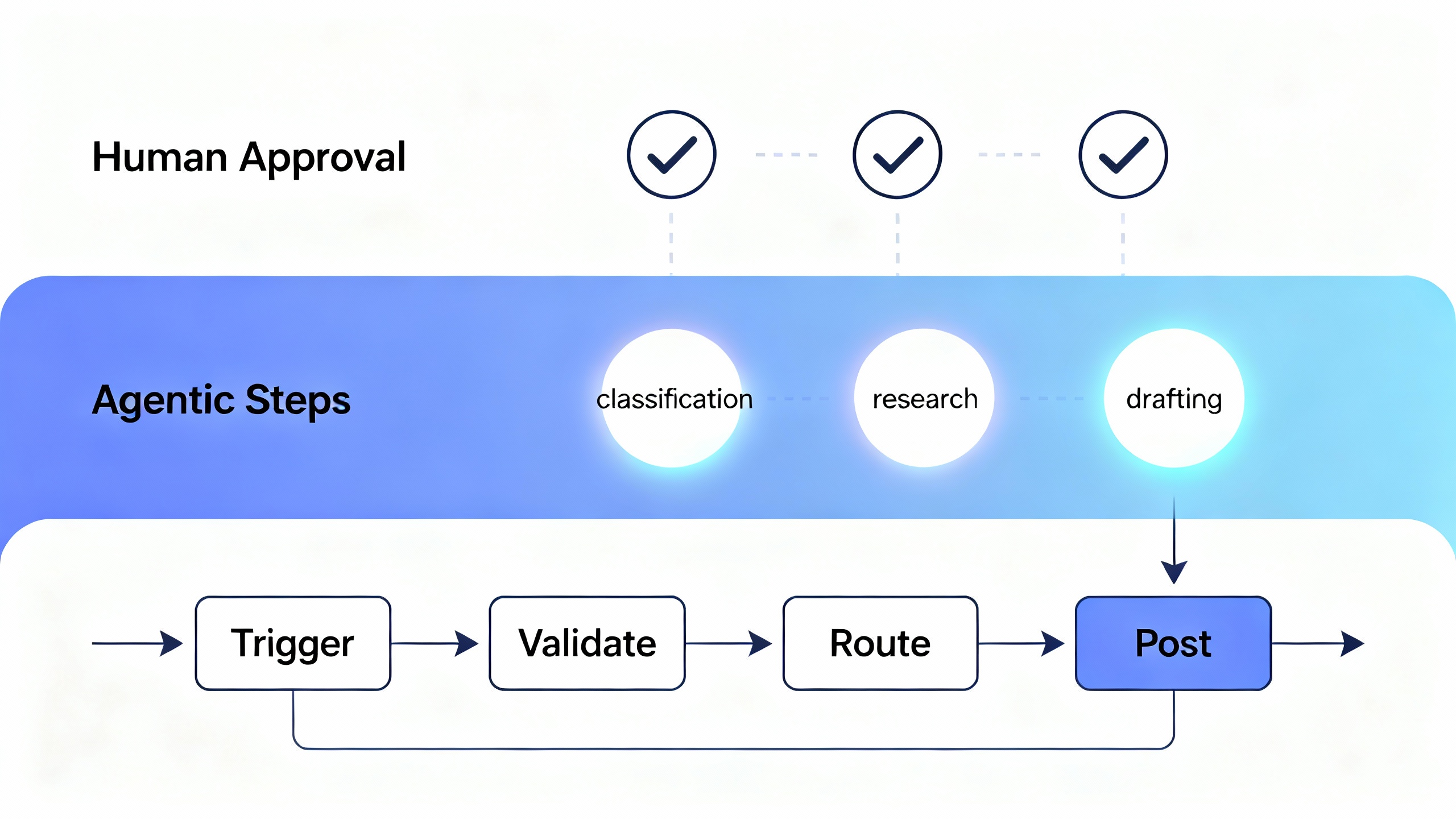
- A deterministic backbone orchestrates steps, but LLMs handle judgments like classification, extraction, or drafting
- You want automation to “own” the SLA while the agent handles the fuzzy middle
-
-
Verdict
There isn’t a single winner—there’s a winning architecture. Put automation at the core where reliability, compliance, and scale matter. Add agentic AI at the edges where creativity, unstructured data, and changing contexts live. In practice, the high-ROI pattern is a hybrid: a deterministic workflow that invokes agents for classification, extraction, planning, or drafting, and then routes to human approval for high-risk steps.
To operationalize:
- Establish guardrails: allowlists for tools, rate limits, and red-team prompts (NIST AI RMF).
- Implement evals: accuracy checks, toxicity filters, and regression tests across prompts (Microsoft AI safety guidance).
- Monitor cost and drift: token budgets, prompt/version pinning, and canary releases.
- Keep auditability: log inputs/outputs, tool calls, and human decisions.
Used thoughtfully, automation delivers dependable throughput while agentic AI unlocks capability in the gray areas of work. Together, they make your operations both sturdy and smart.