

Key Stories (past 24–48 hours)
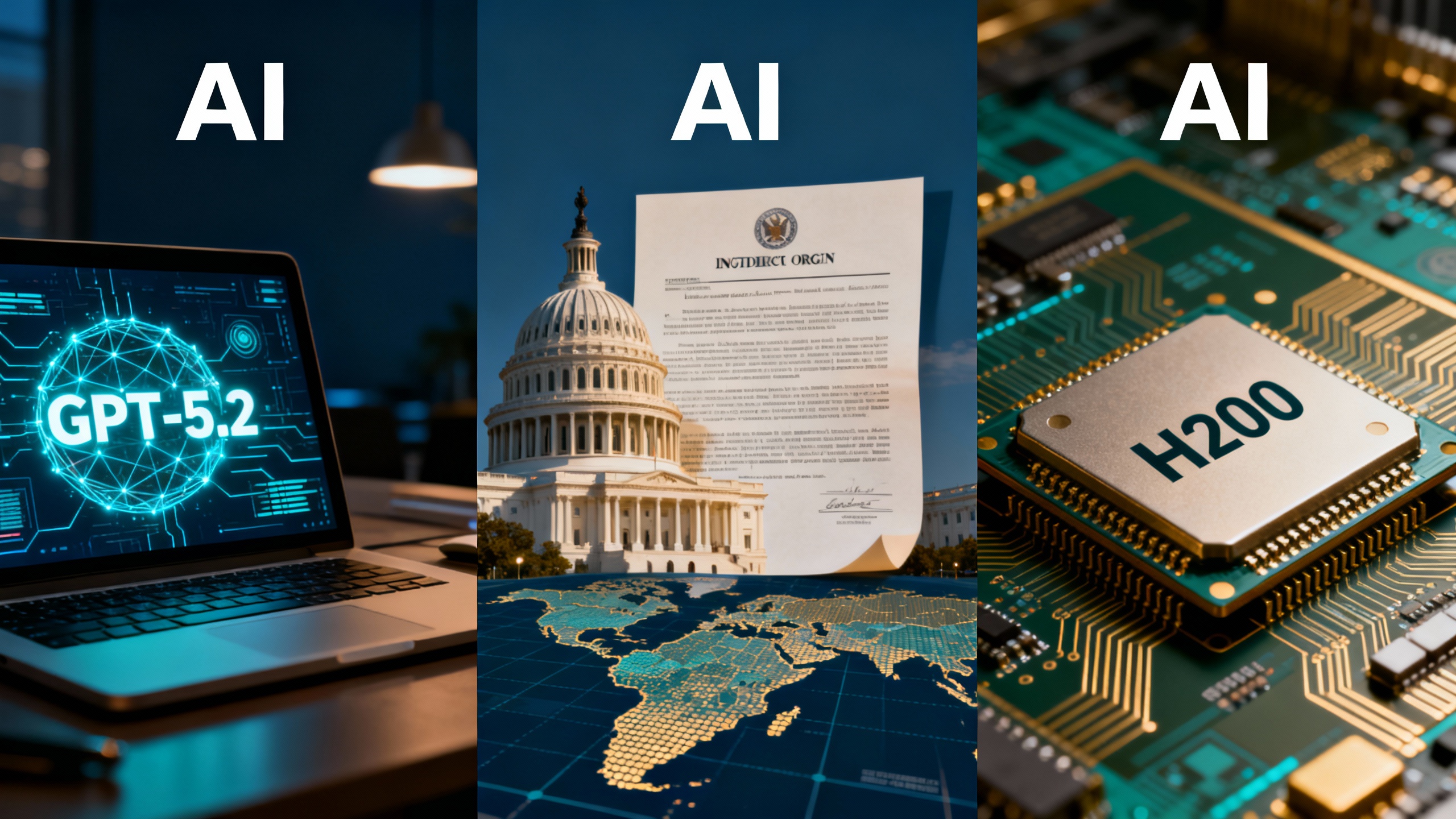
OpenAI released GPT-5.2 on December 11, rolling out three model variants (Instant, Thinking, Pro) to paid ChatGPT plans and the API. The company says GPT-5.2 improves long‑context tasks, coding, multimodal perception, and tool use; it also introduces additional safety work (e.g., mental health handling improvements and an age prediction model to gate sensitive content) and updated pricing for API use. On the same day, Disney unveiled a three‑year deal that invests $1B into OpenAI and licenses 200+ Disney/Marvel/Pixar/Star Wars characters for Sora short-form video generation, with selected fan-made clips to appear on Disney+. The licensing excludes actors’ likenesses/voices and includes guardrails. These moves signal OpenAI’s push for enterprise utility and consumer entertainment partnerships at once—and Hollywood’s first major IP licensing bet on GenAI video.
On December 11–12, the White House issued an executive order directing DOJ to create an “AI Litigation Task Force” to challenge state AI laws deemed “onerous,” and to consider restricting certain federal funds (e.g., BEAD) to states with such laws. Separately, the administration said LLM vendors must measure “political bias” for federal sales (except national security systems). Supporters argue a unified federal stance avoids a patchwork; critics—including California officials—call it federal overreach that weakens consumer protections. Expect court tests and procurement impacts as agencies interpret the bias‑testing requirement.
Reuters reports Nvidia is considering adding H200 capacity on stronger‑than‑expected Chinese demand after the U.S. approved exports with a 25% tariff. The move follows this week’s policy shift and has already prompted political scrutiny in Washington. If green‑lit, added H200 supply would alter near‑term capacity allocation amid tight foundry constraints, as vendors balance demand for current Hopper‑class parts with next‑gen Blackwell/Rubin.
- BBVA expands OpenAI deal; ChatGPT Enterprise rolls out to 120,000 employees
Spain’s BBVA announced a multi‑year expansion with OpenAI, scaling ChatGPT Enterprise across its 120k‑person workforce and co‑developing AI solutions for customer interactions, risk analysis, and internal productivity. BBVA says early pilots saved roughly three hours per week per user; OpenAI frames this as one of the largest financial‑sector deployments to date. For banks weighing AI at scale, the announcement offers a template for governed deployment, adoption frameworks, and internal agent use.
- xAI partners with El Salvador on nationwide AI‑tutoring rollout in 5,000 public schools
President Nayib Bukele and xAI announced a plan to deploy Grok‑powered tutoring to over 1 million students over two years. Proponents tout personalized learning and teacher support; critics note Grok’s prior moderation lapses and the risks of embedding a controversial chatbot into public education. Pilot design, safety controls, and oversight will determine whether this becomes a model—or a warning— for national ed‑tech.
- AI hardware economics wobble: Broadcom flags margin pressure from custom AI silicon
Broadcom shares fell after the company warned that a rising mix of lower‑margin custom AI processors will pressure gross margins—even as AI orders and backlog remain strong. Coming a day after a steep post‑earnings drop at Oracle tied to heavy AI capex, the news is feeding a broader investor debate about near‑term AI ROI vs. long‑term payoff across the stack.
Emerging Trends
- Brand‑safe GenAI video enters the mainstream
Disney’s licensing pact with OpenAI is a watershed for IP‑cleared, walled‑garden GenAI experiences. It contrasts with rights‑holder pushback elsewhere (e.g., Disney’s reported cease‑and‑desist to Google over alleged AI‑generated infringing content), pointing to an emerging split: closed, licensed ecosystems vs. open models trained on broad web data. Watch for similar licensing frameworks from other media owners as they seek controlled fan creation and new engagement.
- Federal procurement as a lever on model behavior
The new U.S. requirement that vendors measure “political bias” to sell LLMs to federal agencies—on top of the EO’s anti‑preemption stance—suggests procurement specs will increasingly shape eval suites, model training, and reporting. Vendors selling into government should expect RFP language and audits to harden around measurable bias/safety claims.
- Enterprise‑wide agentic adoption playbooks
BBVA’s group‑wide rollout, coupled with OpenAI’s claim that enterprise users save 40–60 minutes daily, are signals that large firms are moving from pilots to institutionalized AI workflows—often with custom agents and governed “internal GPTs.” Expect more org‑level standards for access, red‑teaming, telemetry, and value tracking, as well as vendor‑neutral agent standards (e.g., Agentic AI Foundation work) gaining traction.
- Geopolitics keeps re‑wiring the AI compute supply chain
Allowing H200 exports to China (with tariffs) while Washington debates broader chip controls underscores a pragmatic, transactional phase in compute policy. For builders, this means continued price/performance volatility, license diligence, and multi‑sourcing contingencies as foundries juggle aged and next‑gen lines.
- Investors recalibrate near‑term AI ROI
Broadcom’s margin commentary and Oracle’s capex‑heavy path add to a growing narrative: AI infra revenues can be enormous, but profits may compress when vendors shift toward custom silicon and system sales. This pressures CFOs to pair AI bets with clearer unit‑economics, not just TAM slides.
Conversations & Insights
- Disney–OpenAI: “opportunity vs. threat” for creatives
Where it’s happening: CNBC/Fortune interviews, tech/business press, and industry forums. Key voices: Bob Iger argues the collaboration is defensive and responsible—“We’d rather participate than be disrupted”—with licensing guardrails and no likeness/voice rights; children’s advocates and some creators worry about normalizing AI‑generated IP and youth engagement. Takeaway: Licensed, brand‑safe GenAI is likely to expand, but expect continued scrutiny on creator economics and safeguards.
- Federal vs. state AI rules: uniformity or overreach?
Where it’s happening: Executive order text, national press, statements from state leaders. Key voices: White House framing stresses competitiveness and a single standard; California leaders (e.g., Gov. Newsom, Sen. Padilla) call it an attack on state consumer protections; industry groups push for preemption to avoid a patchwork. Takeaway: Courts will likely decide how far Washington can go; in the meantime, procurement levers (bias‑testing) could define practical compliance for U.S. public‑sector deals.
- Chips to China: security risk vs. market necessity
Where it’s happening: Reuters reporting and Hill commentary. Key voices: Sen. Elizabeth Warren seeks testimony from Nvidia and Commerce on the policy shift; industry emphasizes licensing and compliance. Takeaway: Policy volatility around export controls will keep sourcing and capacity planning front‑and‑center for AI infrastructure buyers through 2026.
- AI in classrooms at national scale
Where it’s happening: xAI blog, AP coverage, international ed‑tech circles. Key voices: Bukele positions El Salvador as an AI‑education pioneer; critics point to Grok’s prior moderation failures and risks of over‑automation. Takeaway: National deployments will hinge on transparent curricula integration, teacher agency, and robust safety audits—not just chatbot availability.
Quick Takeaways
- Model launches are converging with major IP and enterprise deals—plan for rapid changes in model capability, licensing availability, and price per token in Q1.
- U.S. federal procurement is set to shape evaluation norms (e.g., bias measurement) before Congress legislates—vendors should prep documentation and testing protocols now.
- Compute sourcing will stay dynamic; lock in alternative capacity and monitor export‑license conditions closely if you rely on H‑class silicon.
- If you’re a media or consumer brand, walled‑garden GenAI with explicit rights is becoming the safer path to experimentation than “open‑web trained” tools.
Sources
- Reuters: OpenAI launches GPT‑5.2; Disney invests $1B, Sora licensing; Nvidia/H200; Broadcom margins; U.S. bias‑testing rule. Link 1, Link 2, Link 3, Link 4.
- OpenAI: GPT‑5.2 product blog; Disney–OpenAI agreement; BBVA collaboration. Link, Link, Link.
- AP News: Trump EO on state AI laws; xAI–El Salvador schools. Link, Link.
- The Guardian / Washington Post / FT: Context and reaction on EO. Guardian, WaPo, FT.
- White House: Executive Order text. Link.
- Fortune: Iger on Disney–OpenAI. Link.
- BBVA: Corporate announcement. Link.
- xAI: El Salvador partnership. Link.