


Today in AI – 12-13-2025
KEY STORIES (past 48 hours)
White House Seeks Single Federal AI Rulebook
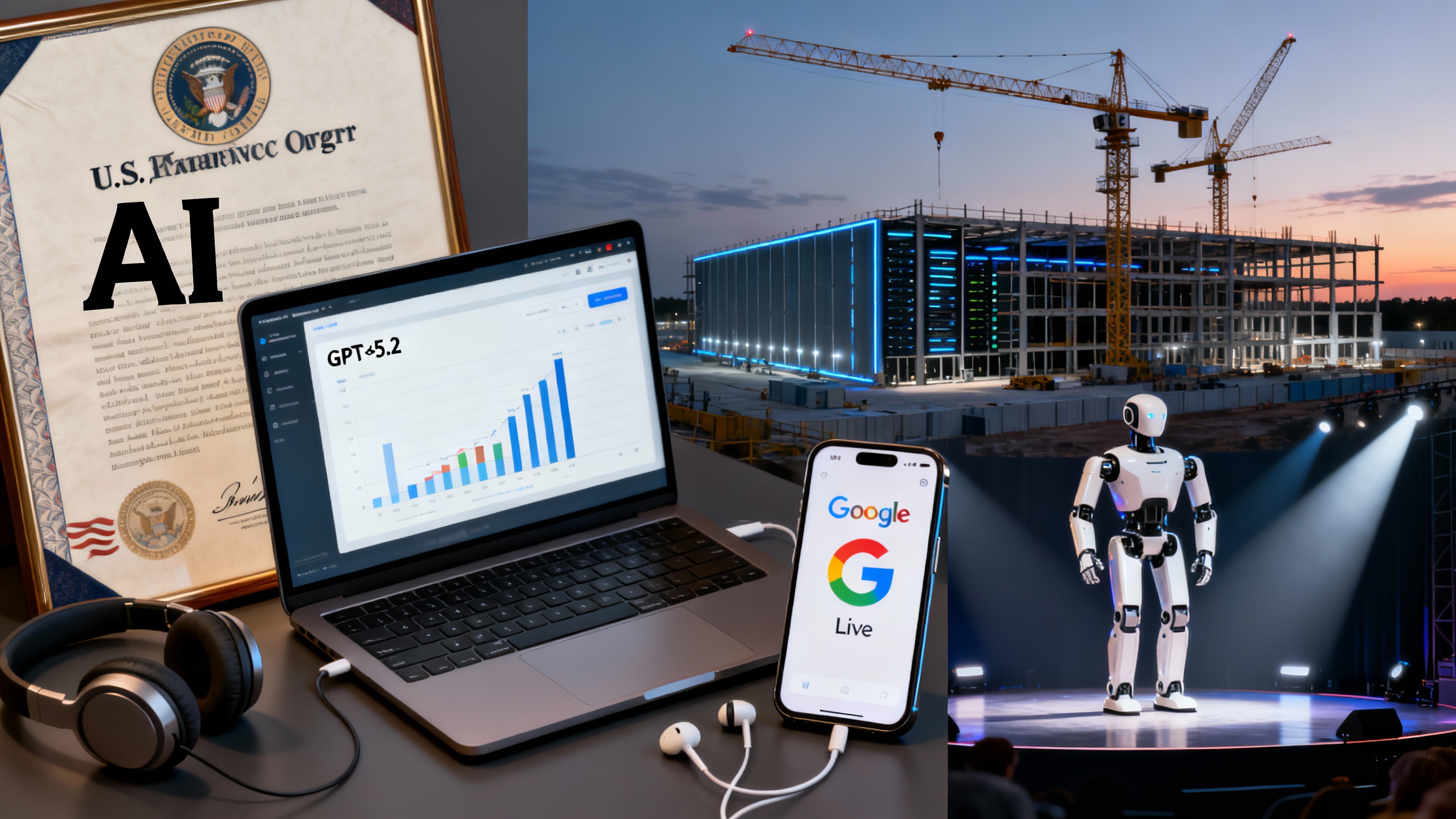
President Trump signed an executive order on December 11 aimed at preempting “onerous” state AI laws, creating a DOJ AI Litigation Task Force to challenge them, directing Commerce to publish an assessment of state AI statutes, and asking the FTC to clarify when state requirements that “alter truthful outputs” could be preempted as unfair or deceptive. The White House says it will now work with Congress on legislation to establish a unified national framework. Legal analysts note the order faces significant constitutional and political hurdles, particularly around federal preemption, BEAD broadband funding leverage, and dormant commerce clause claims. States signal pushback. Our stand‑alone brief.
- Why it matters: If upheld, a single federal regime would simplify compliance for AI builders and enterprise adopters operating across multiple states; if struck down, companies face continued patchwork risk and potential litigation exposure when deploying AI-enabled services in the U.S.
OpenAI GPT‑5.2 Lands — Microsoft Brings It to Copilot
OpenAI released GPT‑5.2 on December 11 with Instant, Thinking, and Pro variants. OpenAI highlights gains in long‑context performance, tool use, coding, and “professional knowledge work,” citing a 70.9% score on its GDPval benchmark versus 38.8% for GPT‑5.1 Thinking. Microsoft began same‑day rollout of GPT‑5.2 in Microsoft 365 Copilot and Copilot Studio. Separately, Disney announced a $1 billion investment and a three‑year licensing deal to bring 200+ Disney/Marvel/Pixar/Star Wars characters to OpenAI’s Sora video platform. Our stand‑alone brief.
- Why it matters: GPT‑5.2’s stronger long‑context and tool‑calling support target end‑to‑end workflows (coding, analysis, document operations). Immediate Copilot integration accelerates enterprise exposure and could shift evaluation roadmaps for procurement and IT. Disney’s deal underscores a new phase of IP licensing for generative media tools.
Google Gemini Powers Live Headphone Translation and a New Interactions API
Google rolled out Gemini‑powered translation upgrades and a beta that turns any headphones into a live translation device in the Translate app (Android first in the U.S., Mexico, and India; 70+ languages; iOS to follow in 2026). In parallel, Google launched the Interactions API (public beta) to build agentic apps and to access the Gemini Deep Research agent via a unified endpoint. Our stand‑alone brief.
- Why it matters: Real‑time, native‑audio translation broadens multimodal, on‑device workflows for field operations, travel, and multilingual support. Interactions API is an early signal of platform‑level agent primitives moving into developer hands, with server‑side state and long‑horizon task orchestration.
Market Puts AI Infrastructure on Notice
Oracle rebutted a report of delays to OpenAI‑related data centers, saying milestones remain on track. Still, AI‑adjacent equities slid Friday after Broadcom flagged margin pressure from custom AI chips; the Nasdaq also dipped as investors reassessed heavy capex and the timing of AI returns. Analysts describe a shift from “build at any cost” to capital discipline.
- Why it matters: Tightening scrutiny on AI infra ROI could affect procurement cycles, financing for new regions, and hyperscaler‑startup contract terms (capacity reservations, take‑or‑pay clauses). Expect more focus on utilization, power availability, and supply‑chain risk.
Rivian Unveils Custom Autonomy Chip and Low‑Cost ADAS Package
At its first Autonomy & AI Day (Dec 11), Rivian detailed an in‑house autonomy processor (TSMC‑made) and a new driver‑assist package, Autonomy+, priced at $2,500 one‑time or $49.99/month. Analysts praised the strategy and the stock jumped; Rivian plans broader hands‑free coverage now and “eyes‑off” ambitions in 2026.
Intel Reportedly in Advanced Talks to Buy SambaNova
Bloomberg reporting indicates Intel is negotiating a roughly $1.6B acquisition (including debt) of AI‑chip startup SambaNova, following earlier signs a term sheet was signed this week. The deal is not final. It would deepen Intel’s AI portfolio as CEO Lip‑Bu Tan faces scrutiny over potential conflicts given prior connections to AI startups.
EMERGING TRENDS
-
Agents move from demos to platforms
-
Google’s Interactions API exposes server‑side state, background execution, and a unified schema for model + agent histories; Microsoft is similarly weaving agent modes into Copilot. OpenAI emphasizes tool‑calling and long‑context for “professional knowledge work.” Expect vendor ecosystems and standards (e.g., ADK, Agent2Agent) to mature quickly as enterprises prototype multi‑step automations.
-
Real‑time voice translation hits the mainstream
-
Gemini‑powered live speech‑to‑speech translation to any headphones plus upgraded idiom/slang handling moves AI from assistant to ambient layer in everyday communications. Early adopters: global support teams, travel, healthcare intake, and multilingual field ops.
-
Capital discipline for AI infrastructure
-
Broadcom’s margin commentary and volatility in Oracle/Nvidia signal investors want clearer payback and utilization before green‑lighting the next wave of gigawatt‑scale builds. Procurement teams should expect more stringent milestones and power‑availability covenants in contracts.
-
Automakers insource autonomy stacks
-
Rivian’s shift to a custom autonomy chip and expanded sensor suite illustrates a broader pattern: OEMs seeking tighter control over cost, roadmap, and data loops for LDM‑style driving models and telematics. This could reshape supplier relationships in 2026+.
-
Automation beyond chat keeps attracting capital
-
Funding clustered around “post‑code” AI ops (Harness $240M for AI‑driven software delivery), enterprise service automation (Serval $75M to AI‑automate IT/HR/legal flows), and physical “AI wet labs” (Medra $52M). Signals demand for systems that turn model outputs into real‑world execution.
CONVERSATIONS & INSIGHTS
-
Federal vs. state AI law: lines in the sand
-
Where it’s happening: National media, policy newsletters, X posts from administration advisors; state officials and editorial boards.
-
Key voices: WH adviser Sriram Krishnan (“work with Congress”), editorial caution on preemption, Axios reporting on state defiance. Takeaway: even supporters of a national framework expect a court fight; companies should map state‑by‑state exposure and prepare for parallel compliance until Congress legislates.
-
GPT‑5.2 user reaction: productivity gains vs. “over‑safety” friction
-
Where it’s happening: Reddit developer and user forums; tech press roundups.
-
Key voices: Users praise long‑context coherence and coding stability; others criticize heavier safety interventions and tone. Dev forum posts flag billing/vision token issues. Takeaway: enterprises may welcome safer defaults; power users want more controllable guardrails and transparent modes.
-
The AI infra “re‑rating” debate
-
Where it’s happening: Financial press and analyst notes.
-
Key voices: FT and Axios frame a rotation toward fundamentals; Oracle’s denial pushed back on a bearish narrative, but volatility remains. Takeaway: infra buyers should align roadmaps to realistic power/build schedules and stress‑test scenario timelines for capacity.
-
Humanoids Summit: hype vs. deployment reality
-
Where it’s happening: Conference coverage and regional TV.
-
Key voices: AP reports a surge of interest alongside skepticism (Rodney Brooks’ dexterity critique cited repeatedly). Takeaway: near‑term wins look task‑specific (logistics, entertainment rigs) while general‑purpose humanoids face long tail risks in manipulation.
QUICK TAKEAWAYS
- U.S. governance risk is elevated until Congress acts; plan for a two‑track compliance posture (federal signals + state laws) and monitor DOJ/FTC actions under the EO timeline.
- Evaluate GPT‑5.2 in constrained pilots where long‑context and tool use drive measurable lift (analytics, code remediation, doc operations), and validate tone/safety settings for frontline use.
- For global operations, test Google’s live headphone translation for field support and travel workflows; assess latency, accuracy, and data‑handling in pilot geos.
- Revisit AI infra contracts and buildouts with power, timeline, and utilization contingencies; push for milestone‑based commitments.
- OEMs and mobility suppliers should expect faster cycles toward in‑house autonomy chips and LDM‑based stacks; align partnerships and data strategies accordingly.
Sources
- Executive Order: Ensuring a National Policy Framework for Artificial Intelligence (White House), Reuters analyses, Washington Post editorial, Axios state reactions.
- OpenAI: Introducing GPT‑5.2; System Card Update; Microsoft 365 Copilot rollout; press coverage (Reuters, Business Insider).
- Google: Gemini translation upgrades and live headphone beta; Interactions API (Google AI Studio + Developers blog); TechCrunch coverage.
- Markets & Infra: Oracle denial and stock moves; FT and Axios market context.
- Rivian Autonomy & AI Day: Reuters recap; IBD/Yahoo analysis.
- Intel–SambaNova talks: Bloomberg/Yahoo updates; RTT; context on Intel governance scrutiny (Reuters).